Scaling for a hyper-online world
Videos · Government, Technology
By Rishabh Srivastava, Founder of Loki.ai
This summary was largely done for my own note-taking, sharing it just in case it adds more value to other people.
I have no affiliation whatsoever with either the presenters or the organisers. This is a summary largely taken for my own reference, and may contain errors :)
Context
Source URL:
https://www.youtube.com/watch?v=sou0Sjie-1s
Why is it important: So much more of our lives are online now. How can nations build up and scales systems to cope with ever-increasing amounts of information
Keywords
Digital Transformation, Governance, Scale
Summary
...
Highlights
A. Scaling up health for the online world
By Dr Petty Chen, Product Manager of Tech-Enabled Healthy Population, Open Government Products, Govtech Singapore
Communication and information delivery is super important
"Reliable information from governments helps people make informed decisions about their daily routines, build public trust, and enables public authorities to act decisively to flatten the curve." – UN Report
"Even if you're still trying to understand the extent of the problem, be honest and open to maintain credibility. Approach the situation with empathy. Put yourself in your constituents' shoes to understand their anxiety. You will sometimes get it right, and you will often be wrong. But it's still better to be as transparent as you can." – HBR
Postman: a tool for governments to communicate with citizens over multiple channels
Broadcast message that goes out to citizens:
https://postman.gov.sg Code is open sourced!
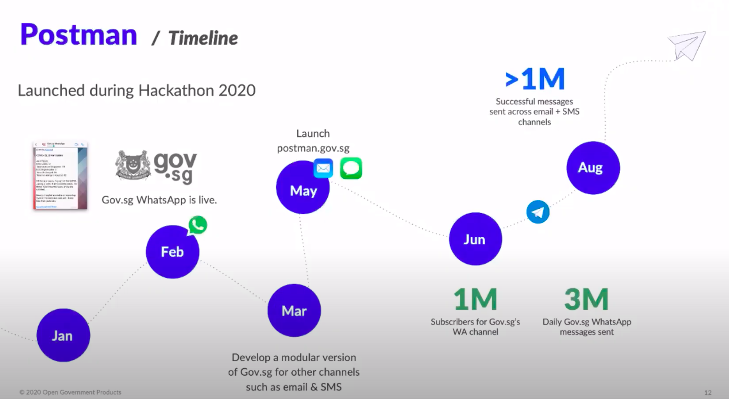
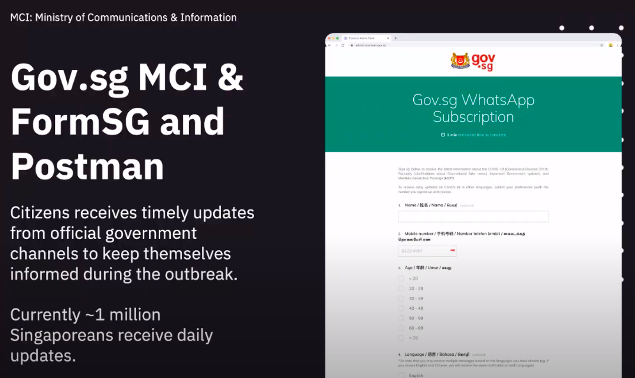
3 channels beyond WhatsApp:
- Telegram bot: Newest feature. Send customised messages to citizens who subscribe to your bot
- SMS: SMS service via Twilio
- Email: Personalized emails. Free, can send in bulk
Core Features:
- Multichannel
- Bulk Sending
- Personalised
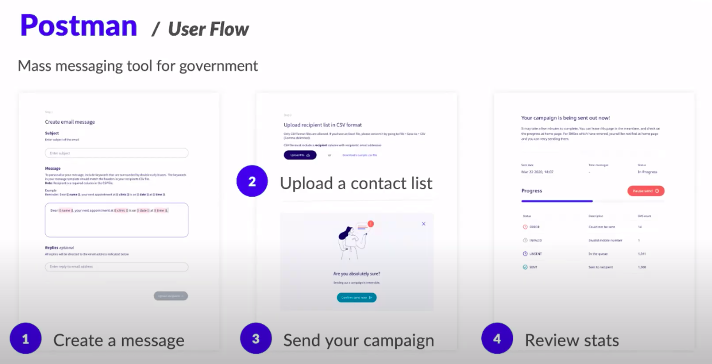
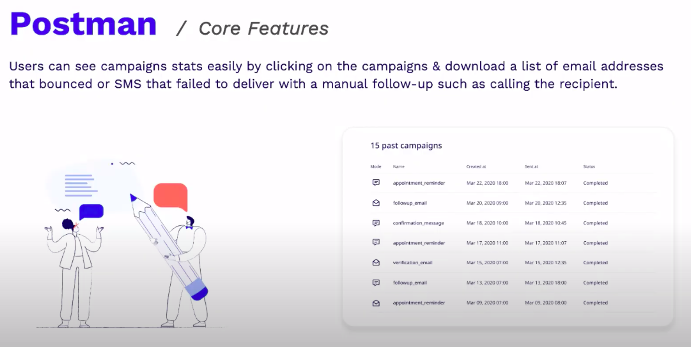
New feature: password protected messages. Good for content that is high in sensitivity
- Add in a new column called password in your CSV
- Everything else just works!
B. Scaling up legal for the online world
By Toh Yung Cheong, Chief Information Officer, State Courts Singapore
What are the problems that court users are trying to solve?
- Defending themselves against an accusation
- Making a claim
- Defending themselves against harassment
- Employee/Employer grievances
- Neighbour Disputes
To make this more efficient, we can use digital
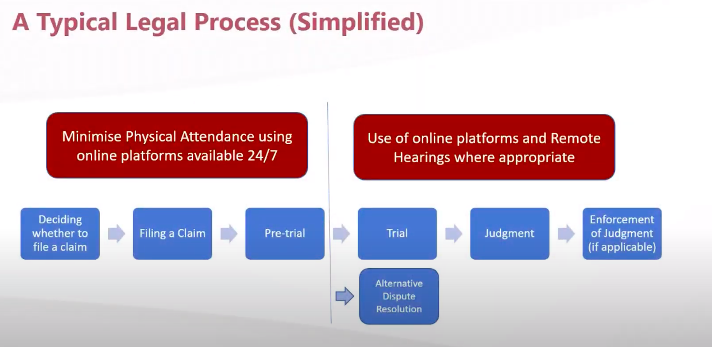
Information is key here. Not just to tell the user what to do, but also to reassure the user who may be stressed and anxious
Example: the Community Justice and Tribunals System
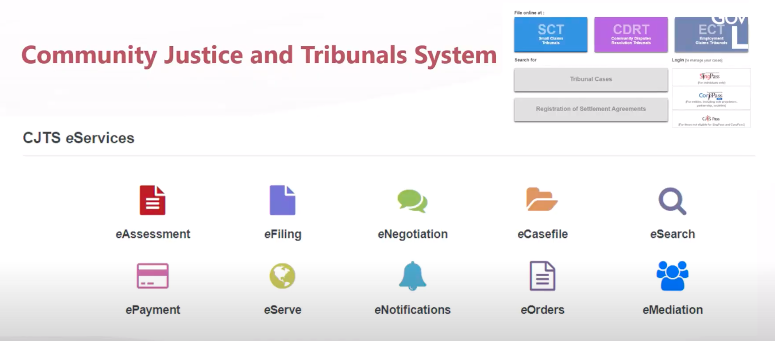
You can simply log in to the platform, and can start your user journey online. Very often, you can even finish resolving the dispute and have your hearing online
Moreover, we have have asynchronous hearings. All parties don't have to be present at the same time! Parties can negotiate within themselves asynchronously in order to reach a settlement
If that fails, a trained mediator can log in online to have an online mediation session between the parties to come up with a settlement. Have found that for some things, a physical presence is not really required. An online platform is just as good for reaching settlements. Once the settlement is reached, an order can be issued totally online and there is no need for a visit to the courts
Example: self-help tools for motor accidents
Provision of self-help tools that provides users automated guidance of apportionment of liability between two parties given how a motor accident went
Also developing an intelligent case-retrieval system to show how similar past cases have gone
These things really help reduce the anxiety of users
Example: In aftermath of Covid-19, remote online hearings where parties can log in via Zoom
If the numbers are small, the current system works. But as the numbers grow larger, we need more tools like a queue management system and a virtual waiting room. Need to integrate these tools with both Zoom and the Courts' case management system
Inclusivity
There are 3 gaps that the Court must be aware of:
- The Distance Gap: the physical distance between the user and the court. For some, it's a major effort to just get to the court. You may have to take leave and forego your work
- The Cost Gap: this has to be cheap
- The Literacy/Awareness Gap: information awareness and digital literacy
C. SolarWind (sponsor explaining their services)
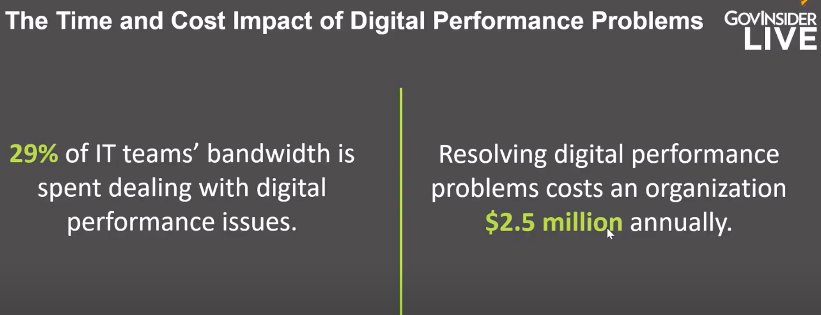
D. Mohamed Hardi, National Heritage Board
For Digital Transformation, moving to the cloud was a really important step. Having the right monitoring, devops, and security was really important.
How do you make a museum digital? You had to pivot the business and move it towards a digital realm. Launched livestreams, virtual walks, and videos to do this. Mobile phone is now both the most important interface AND an important creation tool
At NHB, have started to invest a lot in end-to-end performance management and making sure that our system is in place.
Have just launched a National Innovation Challenge
E. Panel discussion
What have been the biggest innovations that have emerged
Quick building of crisis dashboards through this tool called Thwack
Biggest challenges in Digital Museums
Viewership in-person is going to be very low. Replicating high-quality, high-fidelity experiences in a virtual setting was very difficult. But loads of opportunities emerging
Why was it crucial to scale up communications delivery at an early stage?
Most users feel very anxious if they don't have information. Great and consistent information delivery really helps alleviate these anxieties
What kind of new public-private opportunities have emerged?
The idea of interconnectivity and making sure that systems talk to each other — both within ministries and between public and private
Inclusivity as an important principle: what is the vision for courts and justice specially with more of it being online
Vision is to have equal justice for all regardless of your place in society
- Digital Identity and authentication is going to be critical for this
- Digital gap: what if people don't have Zoom compatible devices? what if they don't have a safe, private space to access services digital (for example, they are living in a dorm)
- Are trialling "Zoom Booths" for justice, which will be like Telephone Booths of the past. This will ensure privacy and access
What kind of digital challenges will come up in the next year and how can organizations adapt to that?
Everyone is remote right now. Tools will have to be able to take control and manage devices remotely. Automation and virtual tools will help a lot with this
Learnings from pandemic
You need to have great business processes and organizational processes so that everything works well together.
To Hardi from NHB: What technology are you most excited about
5G!