Anthony Deden (Real Vision Interview) 👎🏽
Videos · Investing
Created by Rishabh Srivastava
This summary was largely done for my own note-taking, sharing it just in case it adds more value to other people.
I have no affiliation whatsoever with anyone in this note. This is a summary largely taken for my own reference, and may contain errors :)
💡 Note: His returns aren’t great, he doesn’t manage very many assets, and his returns are highly correlated to that of the market — so I wouldn’t take this too seriously (though there certainly are plausible sounding points). May be a case where Beware What Sounds Insightful applies
Source URL:
Why is it important: Is a perspective on value investing – though not a particularly good one. Important to understand how traditional value investors think, but not for anything else
Keywords
Investing, Value Investing, Tony Deden, Edelweiss Holdings
Summary
Caveat: Take what Deden says with a huge pinch of salt
He claims to have something that is meant to “protect” wealth instead of grow it. But his firm’s returns are highly correlated with the market while barely being above it. In the time period since its inception, he returned 378.8%, the NASDAQ returned 729% and the S&P 500 returned 260%
For reference, the Berkshire Hathaway stock grew 428% in the same period. This may just be an indictment of traditional value investing in a tech-driven world
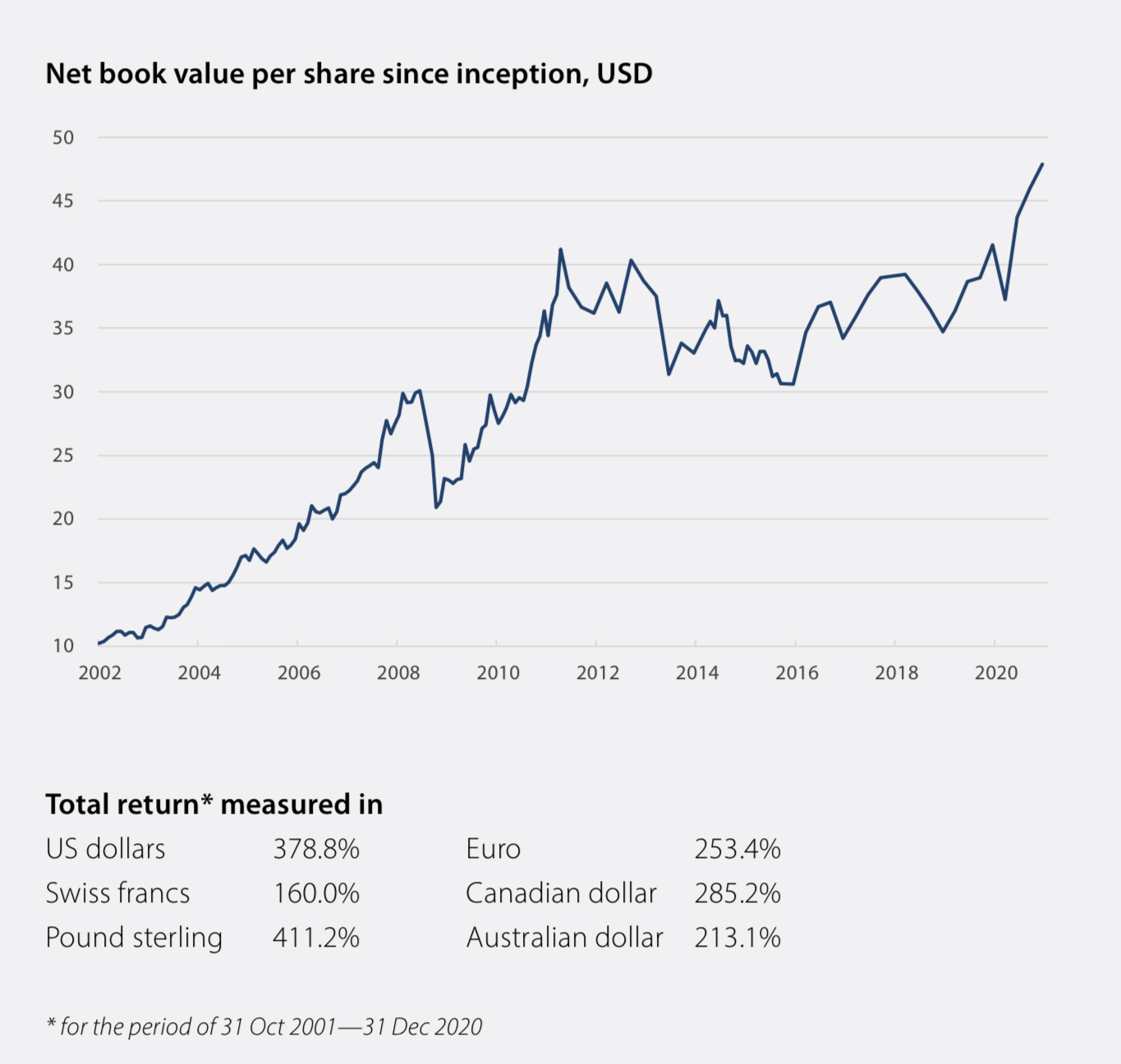
From Edelweiss Holdings Corporate Presentation (https://edelweissholdings.com/docs/EH-Corporate-Presentation.pdf)
He is clearly not lowering risk for his investors that much (since it’s so closely correlated with the market — though he does have a lower beta), while giving them crappier returns! Moreover, many of the companies he touts as great investments are at risk of technological obsolescence. A car component company he touts as having a monopoly on a small component will be useless once electric cars become the primary form of transportation.
Can see why he will appeal to the people that like Tetlock and a “less-wrong“ way of thinking. He sounds wise. But his strategy is not really worth replicating. Has some interesting points to think about, though!
The good points
Principles about evaluating opportunities
- The principle of exclusion: Excludes whole swaths of things from his universe of options. In the whole world, there are only 150-200 companies that he would even consider owning a piece of
- Thought more as an owner than as an investor. An investor buys something hoping he’ll sell it at a higher price. Owners don’t do this. They’re interested in building substance. They’re interested in building the production base of the company — in recapitalizing the earnings
- Avoid unnecessary leverage. The idea of leveraging a balance sheet is completely foreign to owners, though it’s more common in America. For owners, the balance sheet is a lot more important than the income statement
- If I am interested in acquiring a part of your enterprise, I want to be absolute certain that the motivation you have is that of an owner rather than an investor. You should be making choices that will have an impact 20-30 years from now, rather than next quarter or next year
Defining value
Value is not defined by multiples and other such metrics. It’s a much more qualitative exercise.
Highlights
Traveled around the world. Lived in America for 30 years. Then moved back to Switzerland
Traveled a lot to learn and observe
Found himself in investing by accident. Was asked to help a family in investment affairs after the patriarch passed away in 1985. Then started helping more families. Became an investment counselor without any background in investing or banking
There’s a sense of irreplaceability to capital in families. You never want to take risk of ruin
It’s easier to make money than to keep it. Not merely on account of external issues, but also internal things like error and impudence
Feels that investment has become two much of a cowboy game now. Managers don’t care as much about protecting the savings of those who invest with them
Was always more on what could go wrong and what could go right. What could go wrong isn’t necessarily of the quantitative nature like the stock market or the bond market. Instead, it’s about the kind of decisions that one makes and the short- and long-term impact of those decisions on the whole.
How did you begin to form your investment framework?
Initially, erred on the side of inaction. Eventually made some friends in the industry and learned about the idea of seeking to understand the investment objectives and risk parameters of their clients. Then tried to design a portfolio suited to their needs
At the time, this made sense to him. But then thought that it’s non-sense
Eventually figured out the idea of value investing that Graham and Buffett had followed. Became fascinated by the idea of value, because it made sense theoretically. Then came the crash of 1987. Didn’t effect him, because he had no exposure to the equities market. But he had the opportunities to deploy capital in 1988 when multiple securities were underpriced
Wondered about the nature of money. We measure our wealth in terms of money, but he couldn’t figure out what money was by itself. Had really fundamental questions about negative interest rates. Studied more economics in order to gain more of a perspective on the world
Became aware of the nature of risk and the nature of value. Realised that much of the quantification that was done in the financial sector was not really necessary
The idea of organising each investment portfolio with the so called needs of each family was not consistent with reality. Because people’s idea of risk is not really real. Risk for most people is the uncertainty of the unknown. But for Deden, risk is the idea of losing your capital permanently with no ability for recall
Went to the 10-12 families that he advised at the time and told them that he had changed his view of investment management. Told them that his idea was to grow the capital at the same risk profile. Protecting and enhancing and deploying capital permanently — with the idea that you have a long-term time horizon
What did this change in investment strategy do to your portfolios? Did you change your composition radically, or did you just tinker around the edges?
Starting around 1996/97, he never looked it at portfolio. Only looked at it as a collection of assets in the form of securities having a purpose. Each of the components have a purpose of their own. You don’t worry about randomly ticking buckets
The idea of having X% in industrials and Y% in something else and underweighting this or overweighting that is complete madness in his opinion
Every component has a purpose
Value of irreplaceability. Bonds are fixed capital and you can’t redeploy them. In those days, he only invested in two kinds of bonds – government and junk. Didn’t invest in corporate bonds, because found the rating system behind them lacking
Had high yields on bonds back then
Over time, monetary policy became the driver. Industrial activity took a backseat to financial activity
Prices of securities were going up, independent of economic results/activity. That was mostly in the US, but eventually in the rest of the world too. Prices become untethered from the reality of the situation, eventually. In 1998, became convinced that there must an error. Either his error in valuing securities, or the market’s. Went to a period of soul searching. Asked himself if he was wrong and if his ideas were too rigid
If he was wrong, his actions or inactions would have an effect on other people’s savings. So he had to do something about it
Went back to the very basics. Tried to rethink the basic assumptions of what is real and what is not. Didn’t believe the authorities, the ratings agencies, the government statistics and officials. Questioned everything. Went to retrace his steps, but discovered that he was right. That gave him a great deal of courage to acquire at the time what no one wanted. What people didn’t want at the time was oil, copper, gold, coal, silver, and German government bonds
This situation eventually culminated in the dot com bust and he was proven right. This started a new era, where we somehow reinflated the system
We have gone from booms to busts to booms to busts. If you’re in front of a Bloomberg machine, you anticipate that you can anticipate these matters. That you can anticipate the interest rates and other things. But you’re deluding yourself. No one really knows where the next boom or bust will take place or where, until the wheels are already in motion
The problem is not in trying to impress your customer (retail investors in this case), but trying to protect what he has spent years accumulating
(Paused at 23:49)
How do you come out of a period of soul searching believing that you are right and everybody else is wrong? How do you stick to your conviction and explain it to your customers?
Was always eager to communicate the framework that motivates actions. In 1999, worked hard to create a document explaining the situation to his clients — explained that the seeming prosperity that existed was an illusion
Have a way of investing in permanence and endurance – opportunities that will be there for a long time. How do you go about identifying these?
In the beginning of the QE period, was convinced that the rules of the game had changed. When the rules change, the basic framework that you use to make a decision changes.
2 things change:
- The rules of the game changed
- The expectations of people changed
Considered leaving the game at this point. But then began thinking about alternatives. Had to examine what was real and what was not. People talk about outstanding companies and good management — but what are these? People judge others and make value decisions based on the stock price
Began thinking about what it was that was important. Americans like faster, bigger, better — growth overwhelms our thoughts and actions. But what if these measurements were wrong? What if what mattered was not bigger and better
Until this point, had been examining the idea of failure. Began thinking of those investors who had survived the test of time. Tried to recognise the ingredients that allowed the few who had survived and endured and tried to replicate them
If he was to protect earnings of his clients for the future, he had to deploy them in a manner that is consistent with some enduring characteristics
Had a few principles he found:
- The principle of exclusion: Excludes whole swaths of things from his universe of options. In the whole world, there are only 150-200 companies that he would even consider owning a piece of
- Thought more as an owner than as an investor. An investor buys something hoping he’ll sell it at a higher price. Owners don’t do this. They’re interested in building substance. They’re interested in building the production base of the company — in recapitalizing the earnings
- Avoid unnecessary leverage. The idea of leveraging a balance sheet is completely foreign to owners, though it’s more common in America. For owners, the balance sheet is a lot more important than the income statement
- If I am interested in acquiring a part of your enterprise, I want to be absolute certain that the motivation you have is that of an owner rather than an investor. You should be making choices that will have an impact 20-30 years from now, rather than next quarter or next year
Simplicity in decision making framework
💡 Antifragile is one of the most extraordinary books he’s ever read – an analysis of this ability to survive and actually gain strength from a difficult environment
To make the simple decisions, just exit the financial world completely. In the financial world, the ability to own something for the long term has been taken away by monthly liquidity and how many basis points are you going to miss the benchmark by. Owning something for a month is just renting.
“I don’t want to own ‘stock’. I want to own a business participation in a business run by owners whose motivation is the same as mine”
What is value?
When you think of value in financial terms as a price (P/E ratio, Price to Book ratio) — all of these are accounting terms. They also reflect what happend in the past. It’s the same for guidance
Real owners do not think of the value of business as a multiple of the cost to generate before everything. The idea of earnings is important. A company must be profitable, and it must also generate cash
But even though this is the case, the idea of profitability on any one period to another is really a function of oftentimes temporal events
A P/E ratio is not essential to value. Don’t really pay any attention to that
BUT, do want to see recapitalization of earnings
The compounding of earnings to book value per share is a far more important indicator of a company’s ability to compound it, because that’s really what wealth is. Wealth is the compounding of earnings
You acquire machinery and equipment to allow you greater freedom in adding to that, so you take from existing earnings and add to future earnings
Often today, the attention is placed on the income statement — often to the complete exclusion of the balance sheet. The balance sheet is probably more important to the nature of endurance — including the nature of the assets, and their economic value in the process
Forward guidance is generally nonsense. Most CEOs have no clue. Even if they did have a clue, why would not give you a forward guidance? The only purpose of giving forward guidance is to manage the price of the stock. The price of the stock becomes a product and a game. The focus is not on making something, it’s on how to make money
Money is made as a result of doing something well. The principle foundational aspect of it is that you do well financially as an individual, because you contribute something worth what someone else if willing to pay
On diversification
Is open to investing in nearly everything — except for businesses that are finance related (banks, insurance companies etc).
You don’t know what anything is worth until you know what can go wrong. We value things differently because we way components differently
Just buying a bunch of different stocks in different industries ≠ diversification
Scarcity and why it’s important
Transitioned from an advisor to a fund manager in 2002-03. Main idea of the fund — we’ll keep this money like it’s the only money you have
Scarcity is the most important law in economics – no one can have all that they want. There’s not just scarcity in visible, tangible resources. There’s also scarcity in skill sets. There’s also scarcity in the character of people
Another component – endurance. The kind of policies, practices, and behaviour what is designed to endure rather than merely grow. You can grow and become fragile and then die — that’s not interesting
Third part — independence. Much of what we see in the world is interdependent today. We depend on so many external factors. In business, we depend on many key suppliers that often are in a weak situation. We have competitive situations that would not have been there had there not been credit. In order to survive, companies have to adapt to the conditions.
There can be dependence on subsidies or favourable government policies. Sometimes, there is dependence on one customer. Dependence makes a system fragile. The more independent an organism is from external weaknesses, the more likely it is to add to its endurance and strength. Independence is very valuable, and is actually costly
Actually doesn’t use the word wealth at all. Uses the word savings — that’s what is left over for production after consumption and the accumulated results of that
Distinguish what has economic value from what has financial value (a claim or a promise). Be incredibly discriminating when making capital allocation decisions
Wealth Protection ≠ Wealth Creation
The tools with which you protect wealth are different from the tools you need to create wealth. The tools are different, the framework is different, the objectives are different, the methods are different, the language is different
Risk
In modern times, we distill “risk” down to a number and call it volatility. But in doing so, we’re ignoring the very nature of risk itself. Example – when you’re trying to build multi-generational wealth, there’s the risk of a third-generation family member who wants a Ferrari instead of the family business. That kind of risk cannot be quantified
The more frequently that you look at something, the more frequently you’ll second guess why you own it and what else you could own instead
Permanence
For his firm, the shareholder turnover is much lower than the portfolio turnover. And both are extremely low
Ideas that matter include the ability to judge other people. You can only do this with practice and by observing. They’ve made complete reversals on investments they own on the basis of a single sentence that was uttered by a CEO or CFO that betrayed something that they would not want to have.
When this happens, you don’t sit there and rationalities that “this is not what he meant” and “the PE ratio is good and EBITDA is good and the prospects are great — so we’ll hold it”. You get out
How would you act if you owned the entire thing? You meet the head of the business or the head of development, and ask yourself – if I owned the entire thing, would I hire this guy to run it?
Looking at people’s track record is incredibly important for this
If what the management says and what they do are totally different, exit the company
Asset allocation
Gold represents 35% of their portfolio today
If he did not own gold, would own treasure bills, short-term paper, cash-deposits, and other things to provide liquidity
About 60% of capital is permanently invested. About 40% — most of which is in gold — is liquid
Any good investment operation, particularly if it involves irreplaceable capital, must have embedded in it a source of continuity, substance, and reserves
Alternatives to gold are someone else’s debt. Gold gives you scarcity, endurance, and independence from the financial system
Structure of Production
There is scarcity or oligopoly in certain areas that has come as a result of events/economic positions that are impossible to compete with ⇒ essentially investing in monopolies with high barriers to entry
Ideally, this is not something that is subject to seasonal demand or external risks (government intervention, regulation, or competition)
Find processes that are defensible and profitable and will help a company make money for a long period
It’s a subjective process — hard to have a checklist approach to this
“If I own the company, would I want to have the same people run it? Would I want to own the entire thing? Is this business likely to be around 20 years from now?” — assumes that if the business has been around for 150-200 years, it will be around for another 20 years. Very dangerous assumption