The Platform Delusion
Books · Startups · Source
Overview
- Investors and entrepreneurs often treat achieving platform status with strong network effects as a gold standard, but they are not always the source of a firm’s competitive advantage or its moat
- No one called a local monopoly newspaper a platform, but it was: it connected advertisers to readers as well as buyers to sellers through the classifieds
- “Traditional” platforms like malls and newspapers had two major benefits: their vendors were committed to long-term leases and their users’ next best option was difficult to find
- On the internet, the platform’s relationships with both buyer and seller typically exhibit none of this durability
- A company can expect to deliver exceptional results in two ways. It can be a better operator or it can benefit from structural attributes that impede effective competitive attack. The fundamental difference between value creation deriving from operational and from structural sources is their respective durability.
- Efficient operations can eventually be copied; great leaders can be poached. Process and culture do not have the resilience of a structural advantage. A natural monopoly, a patented critical proprietary technology, and an exclusive long-term government franchise are extreme examples of structural advantages that support persistent success
- Platforms and network effects are not necessarily a source of competitive advantage
- Some advantages manifest on the supply side, facilitating the delivery of an otherwise largely identical product at a lower cost than that of a competitor (or sometimes a better product at the same cost). Other entry barriers enjoyed by lucky incumbents are demand-side phenomena. These keep customers captive in the face of apparently equally attractive, or even somewhat better or cheaper, alternatives
- Very large companies in very large markets that can support many similarly sized giants have no scale advantage vis-à-vis each other, whereas much smaller businesses in smaller markets that can only support a single profitable operator do.
- The relative predominance of fixed costs drives the most important advantages associated with scale. Where costs are mostly variable, being the biggest simply doesn’t provide nearly as much of a leg up, and it can sometimes prove a hindrance as communication, management, and coordination become more complex
- the less significant the fixed-cost requirements, the easier it is for a new competitor to enter in the first place.
- Notable sectors that benefit from such advantages are consumer products with massive fixed marketing and distribution infrastructures (think Coke and P&G) and technology businesses with massive fixed R&D costs (think Intel and Oracle)
- Arthur Sulzberger, the publisher of the New York Times, was hardly alone when he exulted, “it’s wonderful,” at the prospect of a future without printing presses, newsstands, and delivery trucks, those very fixed costs that had served as a key barrier to entry against subscale players unable to afford them.
- Local newspaper franchises were a winner-take-all market precisely because the fixed costs required made only a single paper economically feasible, whereas most online classified marketplaces, while benefiting from network effects, appear to support multiple competitors.
- Knowing the required market share to achieve commercial viability yields two significant insights with profound implications for the intensity of actual and potential competition to be anticipated in any domain.
- it is possible to estimate how long it would take for a new entrant to achieve breakeven
- While TAM is hard to put one’s finger on, gross margins and fixed-cost requirements are not. Viable industries without meaningful fixed-cost requirements often allow competitors to operate at very low break-even market shares. And even industries where costs are predominantly fixed, but extremely low relative to the overall addressable market opportunity, can support many competitors.
- Relatively few markets can really only support a single competitor—a so-called natural monopoly. A single scale incumbent that dominates a sector that can sustain multiple participants will certainly enjoy superior returns for a time. But if its only advantage is scale on the supply side, it is vulnerable to anyone with deep pockets and an interest in sharing the spoils
- strongest supply-side-driven scale franchises have been paired with a variety of demand-side advantages. What all these fortifying advantages have in common is that they encourage existing customers to stay put in the face of an identical, or even somewhat better, offer by a new entrant
- Beyond simple habit, the most typical forms of customer captivity are switching costs and search costs. What makes the internet such a revolutionary medium for consumers is the ease with which it allows switching and searching. These advantages for the consumer are usually not so good for the producer.
- if strong analog fixed-cost-scale businesses are most often paired with customer captivity, digital network effects businesses seem to lend themselves to reinforcing advantages on the supply side, whether from learning, data and artificial intelligence, fixed-cost scale itself, or a combination of cost advantages
- Amazon’s continuous upping of the fixed-cost table stakes in online retail is a sensible strategy to protect scale advantage. But it must do so continually, and the period of competitive differentiation that results appears to be getting shorter and shorter, which suggests that the underlying scale advantage is not that strong to begin with
- Netflix was not a content company. “Generally, I am a believer in circle of competence,” Hastings explained to investors at the time. “Reading a script and guessing who might be good to cast in it—it’s not something that fundamentally as a tech company . . . we’re likely to build a distinctive organizational competence in.” His conclusion could not have been clearer: “We think that we’re better off letting other people take creative risks.”
- Media-distribution companies, particularly in the cable and phone markets, have among the worst customer relations of any industry: cable companies’ core services, internet service provision, and subscription television were the absolute worst of forty-six industries surveyed by the American Customer Satisfaction Index
- Cable channel owners’ collective recognition of the need to amp up investment in original content reflected a commercial necessity in the face of growing over-the-top (OTT) streaming alternatives and diminishing clout with distributors
- The moral here is not that Netflix shouldn’t invest hugely in original production. Indeed, in the face of the competitive onslaught it makes absolute sense to press its relative scale to heighten the fixed-cost price of entry. And original rather than licensed product has advantages beyond being able to retain rights for their own competitive services
- just because something makes strategic sense compared to the alternative doesn’t mean it is good news
Highlights (for my internal reference only – not relevant for most people)
Introduction
[platforms] often lull growth-starved incumbent competitors into collaboration that accelerates their demise. Lured by the promise of sharing in a digital bounty and recapturing their corporate mojo, they reveal too much, forget who they are, and are reduced to an unrecognizable shadow of their former selves
An accepted narrative has emerged to explain the triumph of digital platforms over the hapless analog businesses trampled by the tech titans’ apparently relentless march. In this worldview, digital platforms are a kind of unstoppable virus. Indeed, the 2020 pandemic seemed to accelerate its spread
fallacy that underpins the systematic tendency to overestimate the potential and the resiliency of a wide range of digital businesses
the structural changes wrought by the internet, more often than not, have hindered rather than helped businesses’ ability to secure and maintain strong barriers to entry.
the defining characteristic of a platform is that its core value proposition flows from the connections it facilitates. Many of the most iconic and valuable digital businesses fit this definition: the operating systems that connect software developers and users (Microsoft and Apple), the marketplaces that connect buyers and sellers (Amazon), the social networks that connect communities (Facebook), the search engines that connect advertisers and digital publishers with searchers (Google). But although the term platform has only relatively recently entered the vernacular, businesses with precisely this defining characteristic were around for decades before the invention of the internet. What’s more, as we shall see, many of these were actually better businesses than the internet-infused versions of the same enterprises
No one called a local monopoly newspaper a platform, but it was: it connected advertisers to readers as well as buyers to sellers through the classifieds
On the internet, the proliferation of competing news content and classified sites has ensured that such levels of profitability are largely unheard of in these digital platforms
the fact that many of the best digital businesses are “platforms” does not imply either that most platform businesses deliver superior returns or that it is the platform status of the demonstrably superior businesses that is responsible for their superior results. In fact, consistent superior returns are only achievable through structural competitive advantage, and the resilience of the best platform businesses are the result of multiple mutually reinforcing advantages that are notable more for the differences than the commonalities in each specific case
suggest otherwise—that is, to proffer a simple unitary all-encompassing platform-driven basis for their success—is reminiscent of a particular sleight of hand favored by media moguls: if you only count the hits, inherently risky businesses suddenly seem invincible.
Network effects have been touted as the dominant source of competitive advantage in the digital age. This phenomenon makes a product inherently better with the addition of every new user. But most businesses that exhibit network effects do not deliver exceptional results. What’s more, strong network effects are not, as commonly supposed, exhibited in all platform businesses
Many of the new growth vectors spurring the unprecedented valuations of the FAANG companies receive limited support from the competitive advantages upon which their core franchises rely. Notably, in the case of Apple’s entertainment initiatives in music and television and Amazon’s accelerating investments in international markets and grocery, it can be argued both that the firms operate at a competitive disadvantage in these areas
Netflix does not enjoy meaningful network effects and its decision to enter the original content arena is not justified or supported by the imagined ability of artificial intelligence to systematically deliver “hits.”
The acquisition sprees by many FAANG companies reveal vulnerabilities in their armor and the limits of their advantages. The ability of independent e-commerce players to establish durable leads over Amazon in diapers, footwear, fabric, pet supplies, and furniture and the ability of Instagram, WhatsApp, and TikTok to establish global online communities independent of Facebook reflect these structural constraints
The power of network effects in the context of any given sector is significantly influenced by the complexity of the product or service being provided and the break-even economics for a given market. This explains why Airbnb will always be a far better business than Uber and why Booking and Expedia make most of their money from selling hotel rooms and almost nothing from flights
focused multibillion-dollar software companies undermines the predictions that AI will lead to “the gradual demise of traditional specialization” and an increasingly winner-take-all world.
The benefits of network effects are very different from the benefits of traditional scale, which derive primarily from spreading fixed costs
Scale of any kind without additional reinforcing competitive advantages is vulnerable to competitive incursion
1. 4 Pillars of Platform Delusion
Each of these is demonstrably false.
- Platforms Are a Revolutionary New Business Model.
- Digital Platforms Are Structurally Superior to Analog Platforms.
- All Platforms Exhibit Powerful Network Effects.
- Network Effects Lead Inexorably to Winner-Take-All Markets
Some of the platform businesses that predated the internet were primarily electronic, like credit cards
Other long-established platform businesses are physical, like the iconic malls that connect retailers with shoppers throughout the country
Movie theaters similarly are platform businesses
platform businesses has not fundamentally changed with the internet. Operators face the same basic business issues—who and how to charge, encouraging platform loyalty, and “traffic” monetization strategies, for instance—in seeking to build and maintain successful multisided platforms
the internet has vastly expanded the range, scope, and size of potential platform businesses. In many cases, these new digital models have proved devastating to long-established franchises. But bigger is not always better, and the ability to upend does not always signal a capability of creating lasting value.
The undeniable, sometimes shocking strength of the handful of the largest digital platforms established in recent decades—Google and Facebook in particular—has led to a broader assumption that digital platforms are consistently better businesses than the analog equivalents. This is an assumption that does not bear up to scrutiny. It has also proven costly to many investors.
Traditional malls had two major benefits: their vendors were committed to long-term leases and their shoppers’ next best option was many miles away. Before committing to construction, a mall developer will typically secure a handful of anchor tenants and often obtain not only an extended commitment, but a promise not to open any other stores within a certain distance of the mall
A key analysis here is to confirm that the subsequent establishment of a competing nearby mall is impractical. These features ensure that the mall operator is able to secure superior returns for its investors. On the internet, the platform’s relationships with both buyer and seller typically exhibit none of this durability. Alternatives for buyers are only a click away, and sophisticated sellers dynamically optimize their ability to reach customers across competing platforms or directly
Online deal marketplace Groupon’s 2011 IPO was the largest since Google’s in 2004, valuing the company at well over $10 billion.13 Today, it is a largely forgotten microcap
Although COVID-19 initially interrupted the IPO dreams of many in the planned e-commerce class of 2020, the sector dramatically recovered as investors came to believe in a permanent shift to online buying
During the quarter century since the birth of the commercial internet, dozens of companies in some form of e-commerce have gone public. Almost a quarter have gone bankrupt or delisted. Of those that managed to get acquired before facing that unpleasant prospect, over two thirds sold out for less than their original public offering price. Of the third that remain public companies, over 60 percent have lagged the overall market since their respective IPOs
it is a mistake to conclude that all platforms are powered by strong network effects. In fact, plenty of platform businesses receive little assistance from network effects.
relative profitability has historically been predominantly a function of whether the theaters are regionally clustered in small markets that support few theaters or spread nationally across highly competitive big cities
most platform businesses do exhibit network effects. Nonetheless, even where they exist, the nature, extent, and impact of the effects on the attractiveness of the enterprises vary widely
least likely source of failure: “In a relatively small number of platform spaces, failure was a function of a genuine winner-take-all or winner-take-most outcome for a competitor.”26
identification of network effects should represent the beginning, not the end, of the analysis
Since 2015, the number of new large-cap internet companies has accelerated. Many of these described themselves as a “platform” of one kind or another but to date have generally failed to achieve consistent profitability
What is alarming, however, is the extent to which the euphoria triggered by the Platform Delusion has led investors to forget that, ultimately, the existence of competitive advantage is what drives the ability of any business, digital or analog, to produce consistently superior returns
competitive advantage is disarmingly simple: the structural characteristics that allow a company to do what its rivals cannot
A company can expect to deliver exceptional results in two ways. It can be a better operator or it can benefit from structural attributes that impede effective competitive attack. Such structural attributes are called competitive advantage. Identifying which of the two routes is the basis for any particular instance of outperformance is critical for leaders and investors looking to repeat the feat.
The fundamental difference between value creation deriving from operational and from structural sources is their respective durability. And it is during periods of market euphoria—when financial success is available indiscriminately without the need for deep understanding of the true value of individual assets—that an appreciation of durability is especially important
Efficient operations can eventually be copied; great leaders can be poached. Process and culture do not have the resilience of a structural advantage. A natural monopoly, a patented critical proprietary technology, and an exclusive long-term government franchise are extreme examples of structural advantages that support persistent success
For managers, knowing to what extent a company owes its success to efficiency and competitive advantage should fundamentally drive resource allocation. Strategy is all about actions that will allow a business to perform better than its peers over the long term. The focus must accordingly be on establishing or reinforcing competitive advantage and will involve interrelated considerations of how to invest internally and how to interact with other constituents in the broader ecosystem
Effective strategy requires an appreciation of the precise sources of competitive advantage in order to better protect and exploit the barrier. Some advantages manifest on the supply side, facilitating the delivery of an otherwise largely identical product at a lower cost than that of a competitor (or sometimes a better product at the same cost). Other entry barriers enjoyed by lucky incumbents are demand-side phenomena. These keep customers captive in the face of apparently equally attractive, or even somewhat better or cheaper, alternatives
strong competitive advantage has a tendency to dull the senses when it comes to operating efficiency. newspaper industry suffered from notoriously weak management yet outperformed the market and delivered operating margins as high as 40 percent or more for decades
if the level of profitability is exclusively due to the superior execution by a stellar management team rather than structural entry barriers, an investor will likely have some skepticism regarding the longevity of these results
For those who have succumbed to the Platform Delusion or are simply immersed in the culture of internet investing, the notion that growth could ever lack value will likely come as a bit of a shock
On the one hand, it is certainly disruptive to sell product below cost and likely to spark plenty of consumer interest and thus growth. On the other hand, when you have unprofitable unit economics, it is simply not possible to make it up on volume.
this criticism may seem unfair. The entire concept of “competitive advantage” applies definitionally only to incumbents, not new entrants. How can a new entrant benefit from a barrier to entry? Indeed, many of these negative-gross-margin businesses are start-ups. And maybe their plan is to grow into sustainable competitive advantage: once they get big enough, unit costs could go down based on greater purchasing clout and they may be able to raise prices so that gross margins will become positive. The losses incurred along the way could be justified by the quality of the scale franchise ultimately established
2015 blog post by the uncommonly thoughtful venture capitalist Fred Wilson of Union Square Ventures, he complained bitterly of the “tremendous number of high growth companies raising money this year with negative gross margins.”
“if there are other start-ups competing with you and offering a similar service, you aren’t going to be able to take prices up without losing customers to a similar competitor, unless your service truly has ‘lock in.’ ”
2. Scale
Very large companies in very large markets that can support many similarly sized giants have no scale advantage vis-à-vis each other, whereas much smaller businesses in smaller markets that can only support a single profitable operator do.
The relative predominance of fixed costs drives the most important advantages associated with scale. Where costs are mostly variable, being the biggest simply doesn’t provide nearly as much of a leg up, and it can sometimes prove a hindrance as communication, management, and coordination become more complex
the less significant the fixed-cost requirements, the easier it is for a new competitor to enter in the first place.
The benefits of spreading fixed costs derived from scale underpin many well-known long-established franchises. Notable sectors that benefit from such advantages are consumer products with massive fixed marketing and distribution infrastructures (think Coke and P&G) and technology businesses with massive fixed R&D costs (think Intel and Oracle)
Arthur Sulzberger, the publisher of the New York Times, was hardly alone when he exulted, “it’s wonderful,” at the prospect of a future without printing presses, newsstands, and delivery trucks, those very fixed costs that had served as a key barrier to entry against subscale players unable to afford them. Once the excitement over getting a bargain on their fixed-cost obligations subsided, these incumbents looked around and noticed some unexpected guests: new competitors
network effects yield a benefit on the demand side of the equation: the bigger you are, the easier it is to attract new customers and incremental revenue.
In his book The Content Trap, Professor Anand argues that “chances are you win everything” in network effects markets in contrast to supply-side scale that he believes is more easily copied. Ironically, in the very market Professor Anand leads with—newspapers—the opposite was true. Local newspaper franchises were a winner-take-all market precisely because the fixed costs required made only a single paper economically feasible, whereas most online classified marketplaces, while benefiting from network effects, appear to support multiple competitors.
Knowing the required market share to achieve commercial viability yields two significant insights with profound implications for the intensity of actual and potential competition to be anticipated in any domain.
Second, it is possible to estimate how long it would take for a new entrant to achieve breakeven. The stronger the barriers to entry in a given sector, the less movement there is in market shares in a given year. A good sign of high barriers is a normalized share shift within a sector of under 5 percent over a two-to-three-year period. A new entrant to a market that requires a 15 percent share to break even and in which shares never move more than 3 percent annually could not hope to achieve profitability in under five years.
While TAM is hard to put one’s finger on, gross margins and fixed-cost requirements are not. Viable industries without meaningful fixed-cost requirements often allow competitors to operate at very low break-even market shares. And even industries where costs are predominantly fixed, but extremely low relative to the overall addressable market opportunity, can support many competitors. Either circumstance implies a relatively short time to achieve a sustainable level of turnover and makes market entry relatively attractive. It also makes the establishment of relative scale in the first place less likely and amplifies the vulnerability of an early mover who managed to secure it nonetheless
how big a network needs to be to achieve product viability—and the extent and duration of incremental product enhancement from additional size—depends primarily on how complex the product or service being offered is. In marketplace businesses, in which the importance of broad selection is negligible and the relevant product characteristics are few, the value of network size tends to have a cap
By contrast, in dating applications, where the breadth and variety of relevant human attributes is endless, the continuing value of additional network participants is more durable.
there are many examples where large users have banded together to establish their own highly successful platforms. For instance, the largest insurance companies and banks have both created highly profitable network effects driven businesses built on their collective ownership of a critical mass of valuable categories of risk data
Take a business like Ancestry.com, the world’s largest genealogical service. In addition to the fixed costs associated with developing and maintaining the platform, the company has built up a database of 27 billion family history records across eighty countries, much of it purchased or licensed
The original data assets may have attracted subscribers initially, but it is the network effects that come from the unique user-generated content and the increasing likelihood of connecting with a long-lost family member that makes any effort to just license the same records where possible or outbid Ancestry.com for new data sets seem futile. And the more network effects drive subscriber growth, the more Ancestry.com is able to invest further in content and technology enhancements that make the prospects for a potential new entrant even more bleak. If the business relied either only on fixed-cost supply advantages or only on the network effects from users, it would be much more vulnerable to competitive attack from alternative platforms.
Potential Impact of Network Effects by Industry Use Case
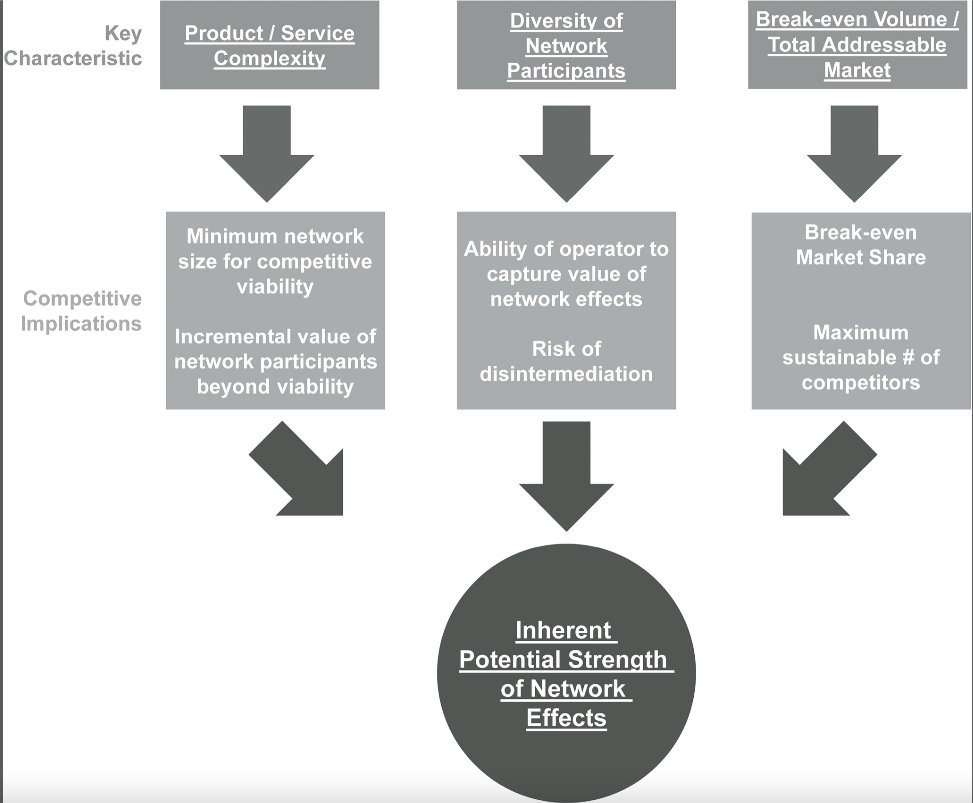
Debating which flavor of scale advantage is preferable in the abstract is not meaningful. Different sectors exhibit stronger or weaker demand- or supply-side advantages from scale. Nor are network effects or a fixed-cost-dominated cost structure strategically valuable in the absence of relative scale
3. Sources of Digital Advantage
Relatively few markets can really only support a single competitor—a so-called natural monopoly. A single scale incumbent that dominates a sector that can sustain multiple participants will certainly enjoy superior returns for a time. But if its only advantage is scale on the supply side, it is vulnerable to anyone with deep pockets and an interest in sharing the spoils
can be avoided, however, where a supply-side scale advantage is complemented by other competitive advantages that impede the ability of others with ready cash to easily copy and divide the market
strongest supply-side-driven scale franchises have been paired with a variety of demand-side advantages. What all these fortifying advantages have in common is that they encourage existing customers to stay put in the face of an identical, or even somewhat better, offer by a new entrant
Beyond simple habit, the most typical forms of customer captivity are switching costs and search costs. What makes the internet such a revolutionary medium for consumers is the ease with which it allows switching and searching. These advantages for the consumer are usually not so good for the producer.
Continuous interactions facilitate continuous product improvement and could accentuate the slope of the learning curve
Google Search’s greatest advantage over Bing derives not from how much better its secret search algorithm is but how many previous searches by the same user it has already undertaken
if strong analog fixed-cost-scale businesses are most often paired with customer captivity, digital network effects businesses seem to lend themselves to reinforcing advantages on the supply side, whether from learning, data and artificial intelligence, fixed-cost scale itself, or a combination of cost advantages
Some combination of high break-even market share, an ability to establish entrenched customer relationships, and a use case that can take advantage of the availability of large quantities of transactional data when paired with network effects can indeed result in remarkably powerful business franchises
Strategy has always been and always will be about establishing and reinforcing barriers to entry. Even the core categories of competitive advantage have not changed: scale, demand, and supply
Sources of Digital Competitive Advantage
| Bad News | Good News | |
|---|---|---|
| Scale (Fixed Cost) | Fixed-cost requirements are getting systematically lowered | Even low fixed cost can be meaningful barrier when coupled with network effects |
| Scale (Network Effects) | Profitable scale is often achievable at very low market shares | Digital plaforms facilitate network effects |
| Customer Captivity (Search) | Searching for competing products is getting easier | Personalization may make finding identical alternatives more difficult |
| Customer Captivity (Switching) | Switching is increasingly less costly | Personalization lowers willingness to switch |
| Customer Captivity (Habit) | Habits are less likely to be developed when tech is changing | Digital application may increase frequency of use |
| Cost (Learning Curve) | Often others can quickly catch up | Slope of learning curve is magnified |
| Cost (Big Data) | Few data applications move the needle | Digital exponentially increases quantum of data |
| Cost (Proprietary Tech) | Speed of superceding inventions is increasing | Truly proprietary tech is rare and data may strengthen it further |
will always experience significant online churn, and managing this becomes increasingly challenging as the customer base moves beyond the most loyal early adopters. Netflix, widely viewed as a leader in customer engagement and retention, still has churn of around 3 percent each month or 36 percent annually
After having a brief negative impact on profitability as legions of new compliance officers were hired, the agencies soon surpassed their previous high-water marks of profitability. The leadership of the agencies sleep well, secure in the knowledge that almost regardless of how aggressively they raise prices, no new entrant could ever bear the massive cost of adherence to the newly reinforced regulatory regime. Warren Buffett made a rare error in financial judgment when he significantly lightened his position in Moody’s in the face of the regulatory turmoil.21 At the height of the financial crisis, Berkshire Hathaway owned as much as 20 percent of Moody’s. After a series of sales in 2009 and 2010, its stake fell below 15 percent and approached 10 percent after further selling in 2013. Moody’s shares have dramatically outperformed both the market and Berkshire since 2009.
GDPR. These rules went into effect in 2018. The ability of Google and Facebook to quickly and effectively comply with regulations appears to have given the companies an additional advantage in the battle for advertisers
Government regulation can often itself be a source of competitive advantage on either the demand or supply side or both. Relying exclusively on such advantages is a dangerous strategy given the inherent volatility of local and national political regimes. A wiser strategy is to assume that they are temporary and to use the time to build a collection of more structurally durable entry barriers
Part 2: Giant Platforms
Diversity of FAANG Competitive Advantage
Notably, all five of these businesses are global, but none appears to have any chance of achieving a genuinely winner-take-all result. For instance, even Google is not only far behind Baidu in China (where Google is a distant fourth or fifth) but also behind Yandex in Russia, and it has meaningful competitors in South Korea (Naver) and Japan (Yahoo). Broad-based global domination is generally not possible because of important differences in market structures, whether on the demand or supply side and whether imposed by organic economic or government imperative
Google does indeed dominate search in the US and most other countries, but Amazon now has a majority of product searches. Although product search is a small part of overall search, given the psychic proximity of this subset of searches to spending money, it is among the most valuable
The story with Facebook is the same. There are many countries in which Facebook is not the leading social network, and often not a close second. That includes not only countries like China, where it is blocked, but countries like Russia and Japan, where it is far behind both homegrown and other international competitors
4. Facebook
Facebook’s 2007 launch of its application developer platform11 laid the groundwork for the FarmVille craze that drove its growth and captured more than 20 percent of Facebook’s users.12 Rather than driving out third-party developers on the platform as MySpace had done, Facebook found a way to not only coexist with these applications but also leverage them to attract new users
I think the strategy of Facebook,” Zuckerberg said, synthesizing the company’s primary focus, “is to learn as quickly as possible what our community wants us to do.”13
The key risk to customer captivity (the demand advantage) is to disappoint or just surprise an otherwise loyal customer. There are many ways to lose a customer, and operating disciplines are an important protection against most of them. Product flaws or inconsistencies can break a habit or provide an excuse to switch. Failure to deliver on any promised benefits or improvements can have similar results. Finally, the relentless addition of new product enhancements—and Facebook has long been famous for an aggressive culture of continuous improvement20—increases satisfaction and ingrains habit while making it more difficult to successfully search out a comparable alternative.
Proprietary technology or data (the supply advantage) on the other hand, is only as valuable as an effective operator makes it
In truth, often the data is of little value. But sometimes information can actually be useful, and the failure to exploit it is simply a reflection of ineffective management (an odd quality for management to tout)
Competing social networks based on different social mechanics compete for users’ time and attention, but there is little evidence that a leadership position in one mechanic would provide a clear gateway to dominating another
5. Amazon
Amazon started out as an online book seller whose value proposition was to offer superior selection, service, and price. Its strategy and its motto as formulated by founder and longtime CEO Jeff Bezos was to “Get Big Fast” in this domain in order to improve terms with key wholesale book distributors on which it relied for product
Amazon remained very much a digital version of a traditional retailer. Already a notoriously thin-margined, competitive sector, retail seemed only more so online. Not a network effect in sight.
It would be almost a decade after Amazon’s founding in 1994 before it launched the “marketplace” business that does indeed benefit from network effects. Amazon Marketplace serves as a platform connecting independent vendors with buyers in these transactions rather than as the actual retailer. Since then, that business has steadily grown far faster than direct sales of their own product.2 Today Amazon transacts more so-called third-party sales on its platform—around double the volume—than direct sales. But because the revenues resulting from third-party sales are simply a 15 percent commission3—unlike direct sales for which the full purchase price counts as revenues—as an accounting matter this still represents a tiny portion of the company’s overall business
Another mythology has built up around Amazon Web Services’ history to the effect that the business grew out of an effort to monetize unused cloud computing capacity at Amazon
But that is not what happened. The idea for what would become AWS emerged from brainstorming sessions around potential services that developers could use. When the head of the company’s IT infrastructure, Chris Pinkham, announced he was leaving to move back home to South Africa, he was assigned this project to keep him connected to the company
Amazon’s continuous upping of the fixed-cost table stakes in online retail is a sensible strategy to protect scale advantage. But it must do so continually, and the period of competitive differentiation that results appears to be getting shorter and shorter, which suggests that the underlying scale advantage is not that strong to begin with
The single most confounding and increasingly expensive Prime benefit is Prime Video, a poor-man’s version of Netflix that is free for Prime subscribers but costs Amazon an escalating king’s ransom. Amazon disclosed that it had increased 2020 spending on entertainment content for Prime members by 41 percent to $11 billion.37 And that was before paying 40 percent more than anyone else was willing—$8.5 billion—for MGM in 2021.38
The last potential source of advantage comes on the supply side from a combination of Amazon’s investment in proprietary technology, unmatched learning from operating e-commerce distribution at massive scale, and valuable consumer data from deep purchasing history. Each of these are real, but the incremental benefits appear increasingly short lived, as the cycle time required for fast followers diminishes
Bezos himself. “We don’t have a single big advantage,” he admitted, “so we have to weave a rope of many small advantages.”46
Why would Amazon need to buy Diapers.com—only to shut it down six years later47—if the advantages of its broad platform were as deep as suggested? And how could the founder of Diapers then go on to build an alternative “platform” in just a year that was compelling enough to attract a $3 billion bid from Walmart to use as the engine of its competing e-commerce business?48
When you are in a business that is obliged to either buy out every Diapers and Zappos that manages to establish a leadership position or invest internally at such levels that it would be “irresponsible” for a customer to choose an alternative, life becomes an endless game of Whac-A-Mole
As recently as 2005, barely 10 percent of sell-side research analysts had a buy on the stock, which remained stubbornly under $50/share. By 2010, with the stock through $100/share, more than half the analysts had been converted to bulls, although a significant minority maintained a hold or even a sell rating. As shares broke $2,000 in 2018, literally 100 percent of the almost fifty research analysts covering the company had a buy on the stock. And that was before COVID-19 forced everyone to rely on their home computers for almost all forms of commerce
All platforms are not equal, and neither is all growth
there was indeed a significant correlation between revenue growth and value creation among the largest media conglomerates over almost a quarter century.56 Unfortunately, that correlation was decidedly negative. The conglomerates had achieved growth largely through overpriced acquisitions and foolish internal projects
If every number one player in a market could easily become the number one player in every other market, all the markets would have a lot of number one players! The clear leader in the UK, Tesco, learned this the hard way only after it poured 1 billion pounds into its efforts to dominate the US before retreating entirely
6. Apple
The idea that brand is a sustainable competitive advantage in itself results from the observation that the brands of many of the seemingly most resilient franchises—not just Apple, but also Coke, McDonald’s, and Nike—are inseparable from the success of these businesses. But that does not mean that the brand is the sole or even primary source of advantage
The high-profile examples of strong businesses having strong brands are certainly worth noting. But a single counterexample is all it takes to disprove a misguided universal theory
The fact that every few years brings the introduction of new luxury car brands suggests that strong incumbent brands do not represent a significant barrier to entry. Digging into the numbers confirms that the two indicia of sustainable advantage—consistently superior return on investment and market share stability—are notably absent from the sector
If these brands are not competitive advantages, one might ask, how is it that so many of them are worth billions of dollars according to multiple brand surveys? The question of whether an asset is valuable is completely distinct from the question of whether the investment required to build the asset is likely to yield superior returns
just because a hit movie is a valuable asset doesn’t mean going into the business of trying to make a hit movie is a wise investment decision.
The analogy between making a hit movie and building a brand breaks down soon after this initial observation
even after being established, a brand requires ongoing maintenance investment. What’s more, brand building does have a structural impact on the business in at least two ways that are not relevant to the overall film business. First, and most obviously, strong brands can drive some level of customer captivity, whether by facilitating buying habits, reinforcing a psychic switching cost, or communicating trust or product
Second, the marketing costs associated with building and maintaining a brand constitute a fixed cost that accentuates the financial significance of relative scale. Making a movie, even a very expensive movie, involves few fixed costs as studio capacity is readily available for lease. Yet despite the importance of fixed marketing and R&D costs in the automotive industry, the overall cost structure is still dominated by variable raw materials and labor
The point is not that brand doesn’t matter. It is that industry structure will determine whether brand can serve as a sustainable competitive differentiator. Customer captivity and scale are the relevant structural barriers to entry. Brand can powerfully reinforce these barriers in sectors where the key supply and demand attributes lend themselves to such support
in consumer packaged goods categories where there is high usage frequency and marketing and distribution dominate the cost structure, brand really matters
During the three decades that Apple Inc. was Apple Computer, the company rarely exceeded a 10 percent operating margin
One can’t argue with the innovations, but the best of these—like the Macintosh’s graphical user interfaces—were quickly copied, leading for most of its history to anemic financial results
Apple’s insistence on tightly integrating its software and hardware in a largely closed system ensured that the copycats would be able to scale Apple’s best ideas faster than Apple itself
When he returned over a decade later in 1997, Jobs succeeded in quickly stanching the bleeding by instituting significant layoffs and radically simplifying the product line. It would be five years, however, before the company would begin to experience sustained revenue growth and a full decade before margins would reach the teens. The next big innovation that moved the needle in Apple’s financial results was the iPod
secret to what revolutionized the profitability of Apple lies less in the expansion of the internal Apple ecosystem beyond computers to music than the fundamental shift in its approach to the external ecosystem.
The iPod itself was a significantly lower-margin product than Apple computers, and the iTunes Store was never meant to be much more than a break-even exercise to drive iPod sales
in 2006 Apple decided to support Microsoft Windows on its devices,12 which was made possible by its decision the previous year to abandon its PowerPC chips for the more powerful Intel technology
Much has been made of the supposed “halo effect” of the explosion in iPod sales and the renaissance in Mac products, both desktop and portable. But by 2006, iPod sales had already plateaued. Between 2006 and 2011, computer sales would triple while iPod sales would decrease
The introduction of the iPhone and iPad transformed the economics of Apple not simply because they were both wildly successful products. Rather, for the first time, the rapid adoption in both instances allowed Apple to benefit from deep network effects, which had previously eluded the company.
Operating systems are classic network effect businesses. The more users, the more developers develop software applications, which in turn attract more users. The Apple II’s early success was attributable in part to the exclusive availability of VisiCalc—a predecessor to Lotus and Excel—just as Microsoft’s development of Excel, Word, and BASIC programs compatible with the operating system were critical for the launch of the Macintosh.
Apple’s long-standing refusal to license its operating systems to third-party manufacturers, in contrast to the ubiquitous Microsoft system that powered IBM and its clone army, ensured that it would be at a significant competitive disadvantage in attracting developers
The iPod, Apple’s first noncomputing product, had such a narrow use case that it didn’t really benefit from network effects.14 The only application that really mattered on the iPod was the iTunes software and store. The device achieved and maintained very high market share for a full decade until its basic functionality was subsumed by smartphones.15 But because Apple played hardball with the desperate major music companies on terms, these partners insisted on nonexclusivity and aggressively made their content available to many others, often with less restrictive terms to encourage competition.
The iPhone finally allowed Apple to benefit from network effects
The real revolution began the next July when Apple introduced the much faster iPhone 3G at a $200 price point—and the App Store. At launch, the App Store carried around 500 applications, many from approved outside developers who had happily agreed to a 70-30 revenue split. Despite being “widely hailed for its beauty and functionality,”17 the original phone had sold barely 6 million units in its first year. The device only included a few preloaded homegrown apps, and Apple had actively discouraged “hackers” from developing their own applications. The new model doubled the previous year’s sales in just the last five months of 2008, and unit sales would continue to almost double every year through 2012, when annual unit sales reached 125 million
year after the App Store appeared, it would have 50,000 apps, which had been collectively downloaded more than 1 billion times.18 Ten years later the store would have over 2 million apps and 20 million registered developers. The store generated more than $100 billion of very high margin revenues over that first decade
The fallacy of the first-mover advantage is that the real advantage—scale—is only achievable once the profile of consumer demand and core technology has stabilized enough to allow an aggressive entrant to quickly secure significant share
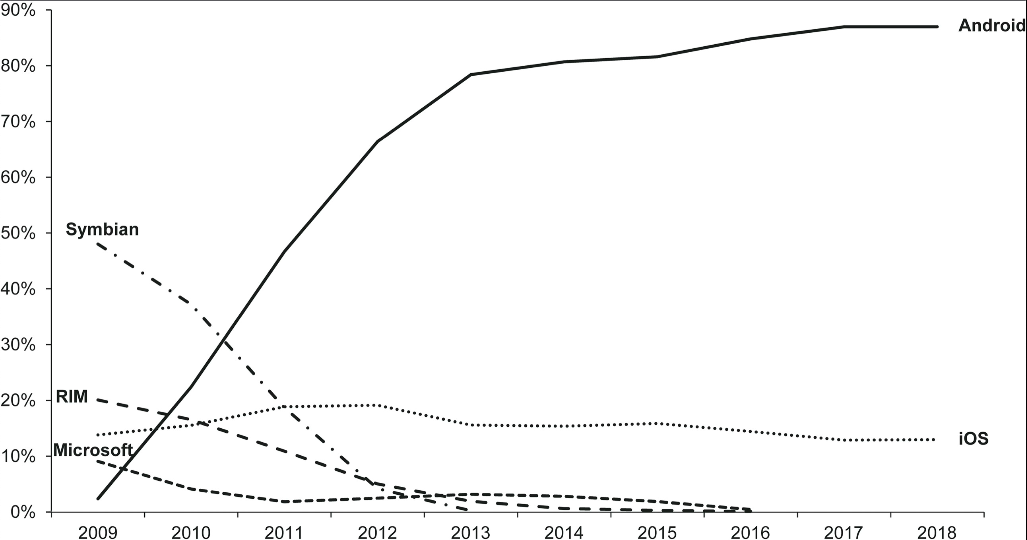
The tenacity of Apple’s share at the high end of the market explains the disproportionate share of industry profit extracted by the company. The intense loyalty of Apple users is well established. And Apple has constructed a complex web of addictive features and services
Bruce Greenwald: “In the long run, everything is a toaster.”
how original or even revolutionary a new product is, over time it will become commoditized as cheap imitators get better and core functionality is integrated into entirely different product categories
Apple began to make it clear where it wanted investors to focus—and where not—in 2018. To the anger of research analysts who had long tracked the company, Apple announced in November 2018 that it would no longer report iPhone unit sales.48 The following quarter, Apple for the first time began reporting the relative profitability of the product and services businesses, which highlighted both how much more inherently profitable the services business was and how much faster it was growing.
Given the relative growth and profitability of services, they could account for a majority of Apple’s revenues by 2030 if current trends persist. This shift should in theory strengthen the overall Apple franchise. But as the company stakes its future on services, investors should pause before going all in for at least three reasons
First is the company’s historic performance in services. Part of Apple’s apparent ambivalence about how to report services related to what a small part of the overall business they represented until recently. But it also reflected the highly uneven performance of Apple’s various initiatives in this arena, suggesting that skills and processes essential to designing remarkable gadgets are different from the requirements of developing addictive services
Second, although Apple services do indeed maintain a higher margin overall than their physical products, under the hood of what the company hopes will be a $50 billion business category in 2020 is a wide range of very different services with very different financial profiles. So, for instance, Google’s multibillion-dollar annual license payment for being the default search engine on the platform must approach a margin of 100 percent profit and has been estimated to be as much as $10 billion
Third and finally, we return to the nature and value of the Apple brand. Apple is not just any kind of brand. Yes, as Larry Ellison pointed out, it is a lifestyle brand. But it is also a global luxury brand, and the only one on this scale in the technology industry
a key characteristic of luxury brands is that they are notoriously difficult to extend beyond their core product categories and, potentially, very close adjacencies
7. Netflix
number of commentators have argued for the expulsion of Netflix from FAANG based on a range of different justifications. The strongest argument against following this advice for current purposes is the simple fact that so many of the other FAANG members seem to want to be Netflix. Prime Video and Apple TV+ are direct assaults on the Netflix citadel
“Content is king” is generally treated as a self-evident notion
the meanings variously attributed to the slogan range from the merely tautological to the demonstrably false
Most harmlessly, it is used to emphasize the inarguable point that popular and valuable entertainment content is indeed popular and valuable. Less benign is the interpretation that within the media and, increasingly, the technology industry value chain, the business of creating compelling content is responsible for a disproportionate share of value. This could not be further from the truth.
There are many different businesses of varying quality dedicated to the development of creative content. Enterprises, however, whose success relies on the regular production of fresh hits—“hot” blockbusters that draw the lion’s share of attention in any given season—share a common characteristic: they generate anemic financial returns over time. The fundamental problem is a lack of entry barriers to financing the prospect of the next runaway success. Even when talent can deliver surefire success, if a star actor, writer, or director is well represented by managers and agents, the return on such investments remains pedestrian
Netflix was not a content company
“Generally, I am a believer in circle of competence,” Hastings explained to investors at the time. “Reading a script and guessing who might be good to cast in it—it’s not something that fundamentally as a tech company . . . we’re likely to build a distinctive organizational competence in.” His conclusion could not have been clearer: “We think that we’re better off letting other people take creative risks.”
Netflix was for most of its history primarily in the business of aggregating entertainment content created by other companies and selling access to it as a subscription service to consumers—first as a DVD-by-mail service and then increasingly, starting in 2007, as a streaming service
content aggregators, not content creators, are the overwhelming source of value creation
The most prevalent sources of industrial strength have been the mutually reinforcing competitive advantages of supply-side scale and customer captivity. Content creation simply does not lend itself to either, while aggregation is amenable to both.
Take scale. Because making a blockbuster movie is expensive, people assume that it is a scale business. But the benefits of relative bigness flow from the ability of the largest players to spread high fixed costs most efficiently. Moviemaking is not this kind of business. The cost of a blockbuster does not vary based on the size of the studio producing it. Creating hit-driven content in any medium does not typically require significant fixed costs. Series-based, subscription, or other kinds of continuously produced content do have a larger fixed-cost component, but they are the exception and not the rule when it comes to the genesis of most megahits.
Aggregation, on the other hand, by its nature requires a large fixed-cost infrastructure to collect, manage, market, and redistribute content. This is why a cable channel with 20 million subscribers loses money but an identical one with 100 million subscribers might generate 50 percent margins
Time was when the content giants in the movie, music, and book industries could earn superior returns. But their ability to do so had nothing to do with content being king. It was a function of the scale and captivity inherent in their aggregation business: the massive marketing and distribution networks that they rented out to smaller, independent content producers, often at usurious rates. The decline of these enterprises does not reflect any change in the nature of content generation—it was as unattractive a business then as it is now. Instead, their decline reflects the loss of their advantages in aggregation—a loss resulting from a combination of external forces and self-inflicted wounds
The obvious external force has been advances in technology
a culture that rewards “stealing” established authors or musicians from competitors the old-fashioned way—by overpaying—will never earn its shareholders a decent return, regardless of the technological environment
Netflix’s early success in streaming video was therefore hardly paradoxical. The company sits squarely in the tradition of the most-successful media businesses: aggregators with economies of scale and customer captivity
Even if the Netflix business model is not original, some cultural and structural aspects do distinguish it from most media companies. Culturally, it is a remarkably well-run company that has always taken pride in both its operating efficiency and its customer focus
contrast, media-content companies historically seemed to feel that efficiency either necessarily suggested a lack of commitment to artistic integrity or was somehow beneath them. Media-distribution companies, particularly in the cable and phone markets, have among the worst customer relations of any industry: cable companies’ core services, internet service provision, and subscription television were the absolute worst of forty-six industries surveyed by the American Customer Satisfaction Index
most media aggregators, such as cable channels, structurally act as wholesalers, whose customers are not the individual consumers but the distributors who manage the physical pipe (or satellite feed) to the home. Netflix is the rare aggregator that manages the direct customer relationship itself, which allows it both to excel in customer service and to perfect the product by harnessing customer feedback
Between 2013 and 2019, the company’s revenues grew from under $5 billion to over $20 billion, and its global subscriber count grew from 32 million to almost 200 million
The biggest change during this period has been Netflix’s reliance on original content
There is only one reason for a successful content aggregator of scale to go into the content production business: heightened competition leaves it no choice. Cable channel owners’ collective recognition of the need to amp up investment in original content reflected a commercial necessity in the face of growing over-the-top (OTT) streaming alternatives and diminishing clout with distributors
declines in profitability and, more precipitously, valuation multiples have been the predictable result. Taking on creative risk may be the right strategic choice compared to the alternative. But it doesn’t make Netflix a better business than it was before
Murdoch, the wiliest of his generation of moguls, decided to largely exit the sector—letting those who remain bid up the price of the assets he had accumulated over the prior thirty-five years
real bottleneck has become producers and showrunners who can effectively manage the volume of production
Guaranteed deals in the hundreds of millions of dollars for proven mass-production executives with names like Ryan Murphy, Greg Berlanti, J. J. Abrams, and Shonda Rhimes reflects the changing—and expanding—nature of the “talent” upon which the modern industry relies
The moral here is not that Netflix shouldn’t invest hugely in original production. Indeed, in the face of the competitive onslaught it makes absolute sense to press its relative scale to heighten the fixed-cost price of entry. And original rather than licensed product has advantages beyond being able to retain rights for their own competitive services
most content rights are licensed locally. As Netflix has gone global, the increasing number of international competitors looking to lock up local streaming rights for themselves44 also justifies the shift toward fully-owned content
But, once again, just because something makes strategic sense compared to the alternative doesn’t mean it is good news
In content production, efficiency has historically been optimized through specialization within genre and audience, not total absolute production volume.
The indirect arguments portray Netflix as a marketplace business in which the ability to attract talent and content is driven by the increased numbers of viewers and vice versa. “Talent is attracted to Netflix’s growing global audience” and corresponding growing “role in pop culture,” argues Deutsche Bank’s Kraft
except as a strained metaphor, Netflix is no more a “marketplace” than any other business that invests in product to attract more customers.
The existence of a water cooler effect has been shown to apply at the margin to movie consumption in theaters, and there is no reason to think it wouldn’t have some application to Netflix viewership.53 But there is also no reason to think the effect is significant or that it would be persistent without the need to continually produce new popular fare.
The other direct network effect sometimes cited is from the incremental user data every new subscriber brings to the service. This, it is argued, allows Netflix to improve the service for everyone, further spinning the flywheel of success beyond the reach of other competitors. This may seem a semantic distinction, but the new users do not improve Netflix. How Netflix mines their data improves the service
precise learning benefits Netflix is able to derive from applying machine learning and artificial intelligence to its unparalleled user base is an important question to which we now turn. It is not, however, a network effect.
Netflix itself has largely eschewed claims of network effects. Reed Hastings contrasts companies like Netflix that have “normal scale economies” with “those rare businesses like LinkedIn and Facebook where there are network effects.”54 It was not for want of trying
Over the years,” Netflix conceded in frustration, “we have tried various ways to make Netflix more social.”55
Hastings ultimately described his futile quest for network effects as a “competitive fantasy.”61
Network effects aside, the competitive advantages Netflix is supposed to generate from its unique repository of “big data” fall into two broad buckets. The first relates to how it manages the customer experience, primarily based on how and what it recommends that subscribers should view. The second relates to the company’s ability to consistently produce hit shows. The first of these is very real, although not new. The second is largely nonsense
Looking at the range of churn rates experienced by other subscription products reminds one just how fickle consumers (as compared to businesses) are in particular, with OTT/SVOD products manifesting some of the highest rates.64 Estimates of Netflix annual churn mostly have ranged from 20 percent to over 35 percent.65 Some research suggests that even with churn toward the higher end of this range, it is meaningfully lower than rates for many other SVOD services
None of this is to suggest that it is not worth wasting time on fully realizing the value of customer data to optimize customer relationship management. Indeed, in difficult markets like these, every little bit matters more and can sometimes mean the difference between life and death for a business
But because we don’t know what churn would have been in the absence of big data, firm conclusions are difficult to draw
there is little doubt that Netflix customer retention is enhanced by using insights gleaned from customer data, it is hard to feel confident that for this use case big data is a strategic game changer
how does big data change the ability of Netflix to deliver more compelling content at a lower cost, particularly in an environment where Netflix needs to produce an increasing proportion of that content itself? Contrary to conventional wisdom, the answer is almost not at all
structural advantages bestowed by big data and artificial intelligence. In this telling, competitors were not privy to three key bits of data that together made House of Cards a surefire hit: the popularity of David Fincher–directed films, Kevin Spacey–starring films, and the original BBC House of Cards series with Netflix viewers. “With those three circles of interest,” according to Carr, “Netflix was able to find a Venn diagram intersection that suggested buying the series would be a very good bet.”71
Soon after the triumph of House of Cards, Netflix committed to a series more than twice as expensive—Marco Polo. Dropped by the original buyer, Starz, because of the prohibitive expense and complications of filming in China, each of the first two ten-episode seasons reportedly cost $100 million. When the show was canceled, no suggestion of an algorithmic glitch was provided. Indeed, the explanations originally proffered for the heavy financial commitment had a very old-school Hollywood sound to them
Marco Polo was one of the first Netflix series to be canceled.74 The relative reluctance of Netflix to cancel shows, at least in the early years, is often cited as evidence of Netflix’s talismanic abilities to identify hits. The service has claimed that it renews series it produces 93 percent of the time as compared to traditional networks’ mere 33 percent of the time.75 This difference, at least historically, is real, but it reflects that Netflix is a different business, solving for different economic outcomes
Television networks need a certain level of national ratings to generate adequate advertising revenue for themselves and their broadcast affiliates
Netflix is managing subscribers that it has organized into no less than thirteen hundred different “taste communities” and looking to give them all enough options to feel satisfied
it is playing a multi-flank long game to provide enough for a wide range of narrow interests along with some broader reach fare
There is, however, little evidence of the existence of an algorithmic hit-factory in any creative domain of substance. Jeff Bezos imagined he could leverage big data and crowd sourcing to dramatically increase the hit rate of original content from 10 percent to 40 percent. He ultimately abandoned his vision of the scientific studio and replaced it, in part, with his own extemporaneous articulation of the twelve elements he thinks all successful shows have in common
Bezos came to resemble an old world studio executive berating employees to “Bring me hits!” His modern version of this ancient refrain: “I want my Game of Thrones.”82
as Netflix has started to report some selective data on the “ratings” of its most watched programs, the fundamental difference in the business Netflix is in has become more apparent. Its most watched programs of the last years—the films Birdbox with Sandra Bullock in 2018 and Murder Mystery with Adam Sandler and Jennifer Aniston in 2019—are not “popular” either with critics or viewers, at least if the lukewarm reviews on Metacritic and Rotten Tomatoes are any indication
It is far from clear whether either of these films would have been successful had they been released into theaters.84 Conversely, it is possible that if the high-profile big-budget flops of recent years, like Cats or Dolittle, instead had been released on Netflix, they would have attracted enough curiosity to be touted as resounding successes
culture and management philosophy, No Rules Rules: Netflix and the Culture of Reinvention, contains a number of anecdotes about programming decisions at the company. What is most notable about these descriptions is just how small a role data appears to play in practice
children’s programming. Hastings had long been of the view that such content neither attracted new subscribers nor played much of a role in keeping existing ones.87 What changed his mind, apparently, was not big data, but an employee meeting in which parents shared the importance of access to trusted advertising-free content in their own subscription decision-making. The resulting decision to develop a global franchise based on a modest Indian animation series, Mighty Little Bheem, was the outcome of broad strategic imperatives, not artificial intelligence. In fact, the ultimate decision maker noted “a lack of historical data on preschool shows—even within India.”88
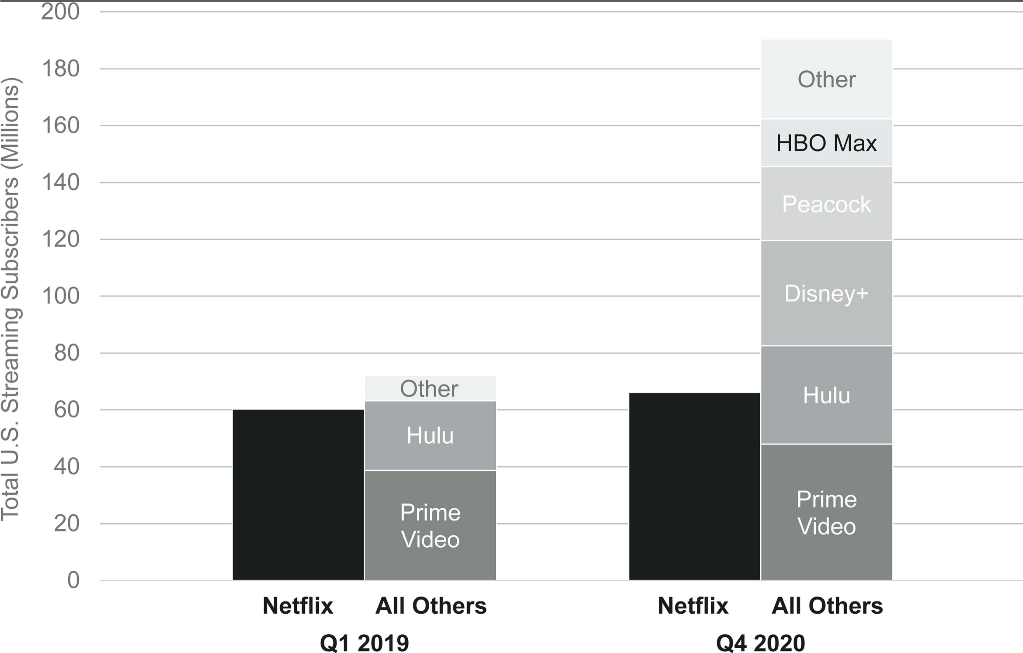
When digital intrusion threatens the profitable content aggregators, the downside is significant. And when your best defense is to move more aggressively into a less attractive business—content creation—margin pressure is the inevitable result
The advantage is not in going first but in gaining scale. And the ability to quickly gain scale by going first requires relatively stable product/market fit and technology. If either is in significant flux, customers are likely to hedge their bets before signing up, making gaining critical mass challenging for the brave first mover
Making enough proven, beloved content created by others available to establish a satisfying service in itself represents a significant fixed cost. And the dominant scale player can set the bar for competitive content high enough that the smaller players will hemorrhage cash while it makes a good living. But the downside of huge global markets is that more players imagine they can achieve the scale required to survive
Netflix now faces at least six well-capitalized competitors chasing the same content, talent, and subscribers.
All the near-term noise around the mounting losses and launches can obscure the longer-term view of what a sustainable market equilibrium might look like. Given the structural attributes lending themselves to fixed-cost scale advantages buttressed by some customer captivity, itself reinforced by learning from data, it would be surprising if a small number of at least modestly profitable players of scale would not emerge
The pure online classified businesses that took significant market share from the newspapers have often fared only marginally better. Although some have managed to achieve multibillion-dollar public valuations, even with network effects—in the absence of any significant customer captivity and with limited fixed-cost requirements—they have eventually collapsed in the public markets as other competitive marketplaces have flooded
Monster.com was the original online employment classified site and one of the earliest successful internet IPOs in 1996. After going public at $7, the stock reached a peak of $91 in 2000 at a valuation approaching $10 billion. It was bought by a global staffing company for a few hundred million dollars in 2016, having long been marginalized by direct broad-based and niche competitors like CareerBuilder and dice.com as well as entirely new competitor categories like LinkedIn and Indeed
Thomas Hobbes described life in the state of nature as “poor, nasty, brutish, and short.” There is no question that the first three adjectives accurately describe what competition will be like during this period. Whether it will be short, given the hundreds of billions of dollars of ready cash and available financing on the competitors’ collective balance sheets, is open to question
8. Google
Alphabet is the unique franchise that seems to simultaneously benefit strongly from every relevant category of competitive advantage
company basically does one thing incredibly well: sell advertising
vast majority of that advertising is sold in connection with the core Google search capability
roughly 85 percent of Google’s over $150 billion in revenues still persistently comes from advertising
Google’s thoughtful approach to positioning its strengths, and its cautious approach to the use of internal emails, has been rewarded with a less far-reaching challenge from US antitrust authorities than the breakup being proposed to Facebook
Like Netflix, Google started life as a pure aggregator—as its corporate mission “to organize the world’s information” makes clear. Unlike Netflix, however, the depth of Google’s structural advantages ensured that it never needed to go into the content creation business in any serious way
Google is the rare company that seems to have strong elements of all three of the most important sources of competitive advantage identified—economies of scale plus reinforcing demand and supply advantages. More remarkable is that Google displays multiple manifestations of each of these categories of advantage: the advantages of Google’s scale flow from both the relative size of its fixed-cost base and network effects; it retains customer captivity of both consumers and advertisers because of habit, switching and search costs; and it secures major cost advantages through proprietary technology enhanced continuously by learning and data
Notwithstanding Google’s sometimes comical arguments over the years that search is not a market at all (you don’t pay for it, so how can it be a market?) or just that it is not the relevant market (it competes against all advertising everywhere or, alternatively, all internet usage of any kind), at 90 percent of global search, Google’s relative scale is not in doubt
Microsoft couldn’t make a dent with Bing after over a decade, it is small wonder that DuckDuckGo has fared no better. Those few who can still claim relevance in the market are restricted to a protected geography (Baidu in China or Yandex in Russia)10 or niche search use case (Amazon in product search).
The greatest benefits of scale in search are of the old-fashioned supply-side variety and stem from the ability to spread the huge fixed-cost requirements over the larger user base. There are a variety of pieces to the fixed-cost infrastructure required to enable the basic search function at scale. Although it is not possible to identify which part of Google’s more than $25 billion R&D budget is reflective of the fixed costs needed to support the continuous improvement of its search functions, its size both absolutely and relative to its FAANG peers is suggestive of the magnitude of the supply-side scale advantage in search.
combined effect of these investments and technologies make Google search results superior in completeness, speed, and, most important, relevance to those of other search engines
Customer loyalty, from both searchers and advertisers, to Google’s search engine is a critical factor reinforcing the benefits of scale. Users become more effective at using particular search programs with experience, and that experience makes the incumbent search engine more effective at delivering relevant results. The sacrifice of this historic search investment by moving to a new search engine is a further source of loyalty to Google.
On the supply side, technology and learning are themselves deeply intertwined advantages in digital environments where customer data facilitate continuous improvement
The core scale advantages that come from the vast and growing investments in both search and advertising R&D reinforce these already tightly connected supply and demand advantages.
Google has well over $100 billion on its balance sheet and is adding tens of billions more every year. Even with an aggressive buyback program, it can’t spend anything near that amount in its core businesses, which display astounding returns—particularly if the government is successful in halting its payments for preferential distribution
In its most recent 10-K, Google quietly removed its insistence that it would not pay a dividend “for the foreseeable future.”35 Based on the historic return on investment of Google’s acquisitions and initiatives outside of its core—the $10 billion write-down of the Motorola Mobility business comes to mind as much as the stream of losses emanating from Google X—starting to systematically give the money back to shareholders seems a more prudent use of the mounting cash hoard
The very exceptionality of Google limits its usefulness as a template for either entrepreneurs or investors. Calling it a platform, which it is, adds little to understanding how it operates. Focusing on network effects, or any one of its myriad competitive advantages in isolation, risks fostering a fundamental misunderstanding of the business
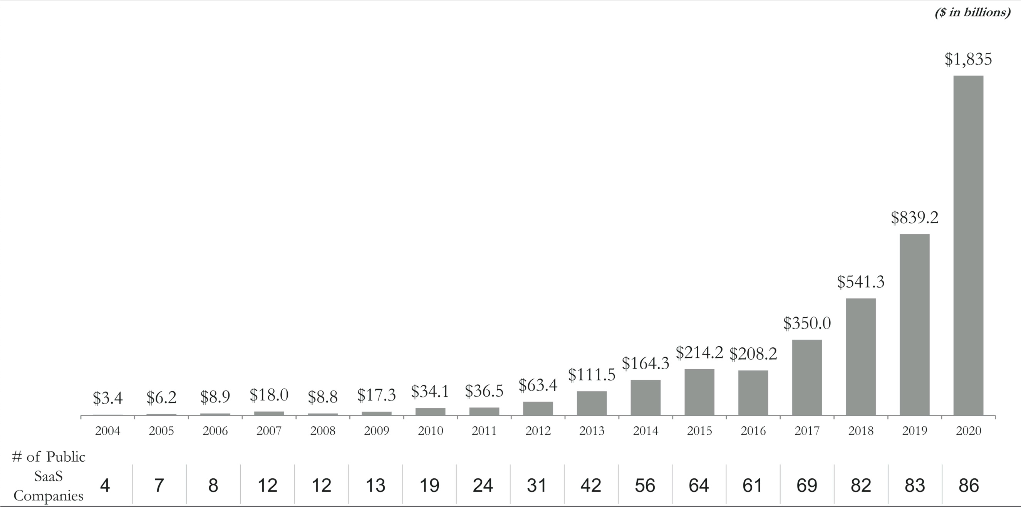
SaaS Market Cap