Snowflake S1 (good company, likely overvalued)
S1s · Investing
Source URL:
Keywords: Snowflake, Data Analysis, Data Cloud
A. Summary
I. Vision
We believe in a data connected world where organizations have seamless access to explore, share, and unlock the value of data. To realize this vision, we are pioneering the Data Cloud, an ecosystem where Snowflake customers, partners, and data providers can break down data silos and derive value from rapidly growing data sets in secure, governed, and compliant ways.
II. Problem Solved
Our platform solves the decades-old problem of data silos and data governance. Leveraging the elasticity and performance of the public cloud, our platform enables customers to unify and query data to support a wide variety of use cases.
III. Product
Overview
Our platform enables customers to consolidate data into a single source of truth to drive meaningful business insights, build data-driven applications, and share data. We deliver our platform through a customer-centric, consumption-based business model, only charging customers for the resources they use.
It also provides frictionless and governed data access so users can securely share data inside and outside of their organizations, generally without copying or moving the underlying data. As a result, customers can blend existing data with new data for broader context, augment data science efforts, or create new monetization streams.
Delivered as a service, our platform requires near-zero maintenance, enabling customers to focus on deriving value from their data rather than managing infrastructure.
Architecture
Our cloud-native architecture consists of three independently scalable layers across storage, compute, and cloud services.
Storage
The storage layer ingests massive amounts and varieties of structured and semi-structured data to create a unified data record
Compute
The compute layer provides dedicated resources to enable users to simultaneously access common data sets for many use cases without latency
Cloud Services
The cloud services layer intelligently optimizes each use case’s performance requirements with no administration. This architecture is built on three major public clouds across 22 regional deployments around the world. These deployments are interconnected to create our single Cloud Data Platform, delivering a consistent, global user experience.
Jobs to be done
Our platform supports a wide range of use cases that enable our customers’ most important business objectives, including:
- data engineering
- data lake
- data warehousing
- data science
- data applications
- data sharing
For example:
- CIOs choose us to help migrate petabytes of raw data to the public cloud and transform it into analytics-ready data
- CMOs choose us to create 360-degree customer views
- Business leaders choose us to distill insights from their most important business metrics
- Data scientists choose us to simplify data transformation to build better machine learning algorithms
IV. Network Effects
Our business benefits from powerful network effects. The Data Cloud will continue to grow as organizations move their siloed data from cloud-based repositories and on-premises data centers to the Data Cloud.
The more customers adopt our platform, the more data can be exchanged with other Snowflake customers, partners, and data providers, enhancing the value of our platform for all users. We believe this network effect will help us drive our vision of the Data Cloud.
B. Industry Overview
I. Key trends
Data is becoming paramount to business success
- Self explanatory
The explosion of data is offering richer insights
Connected devices, applications, and logs = tons of data. Contains valuable insights, including key business and performance metrics, customer attributes and behaviour, and product strengths and capabilities
Cloud adoption is accelerating and diversifying
According to IDC, 49% of data will be stored in public cloud by 2025 — an increase from 30% today. Also, 90% of Global 1000 organizations will have a multi-cloud strategy by 2024
Everyone is becoming a data consumer (technical and non-technical people)
Historically, data and analytics technologies were only accessible for a few, highly trained individuals. The increasing importance of data in the digital economy, and the increase in business applications for knowledge workers, is empowering every role and function within an organization to become a mainstream data consumer
For example, in a 2020 study by IDC, 60% of enterprises cited more pervasive adoption of analytics solutions by more employees and faster time to insights as first order benefits of data and analytics.
Technology consumption is moving from a fixed capacity model to a pay-as-you-use model
Subscription-based business models opened up technology markets to companies that could not previously afford large upfront capital investments and forced software vendors to be more customer focused
However, the fixed pricing of a subscription-based business model often results in customers paying for unused software. We believe that business models are evolving from a fixed to a utility model, where customers pay only for the resources they consume.
II. Limitations of existing data technologies
Legacy Solutions
Legacy database architectures have inherent scalability and capacity constraints and were not originally designed for the adoption of cloud-based workloads.
These shortcomings have resulted in data silos, governance challenges, and limited business insights. Big data architectures have attempted to solve the problem of data silos with large pools of cost-effective storage, but in doing so have often created data integrity and governance challenges.
In recent years, cloud-based companies, including certain public cloud providers, have introduced solutions that are derived from legacy database and big data architectures. Despite being deployed in the public cloud, these solutions generally suffer from the same limitations due to weaknesses in the underlying architectures.
New Solutions
Typically fail to capture, manage, organize, and classify semi-structured data
Big data architectures can capture diverse data types, but the data is generally stored in inconsistent formats requiring transformation prior to use, often resulting in errors and duplicates.
Inability to support large data volumes
Legacy database architectures suffer from storage capacity constraints, redundant data storage, and insufficient compute resources to ingest and transform ever-increasing volumes of data. Big data architectures can often take hours or days to query larger data sets, limiting speed and relevancy of data
Inability to simultaneously support many use cases and users
Legacy database architectures only allow a subset of users or use cases to be effectively addressed at any given point in time. Big data architectures often lack the ability to guarantee the consistency and integrity of data when accessed and manipulated.
Lack of optimised price-performance
Difficult to use
Expensive to manage and maintain
Inability to support a multi-cloud, cross-region strategy
Inability to facilitate data sharing
C. Snowflake’s Solution
Cloud-native architecture with several features
Diverse Data types
Both structured and unstructured data as a common data set [they mean semi-structured data, not unstructured. Includes JSON, Parquet, and Avro]
Massive scalability of data volumes
Can support growing datasets without sacrificing performance (this is true — much like BigQuery and Redshift)
Multiple use-cases and users simultaneously
Platform makes compute resources dynamically available to address the demand of as many users and use cases as needed
Optimized price-performance
Uses advanced optimizations to efficiently access only the data required to deliver the desired results. It delivers speed without the need for tuning or the expense of manually organizing data prior to use. Similar to Bigquery and Redshift
Others
- Easy to use
- Delivered as a service with no overhead
- Multi-cloud and multi-region
- Seamless and secure data sharing
D. Value proposition to consumers
Helps consumers:
- Transform into data-driven businesses
- Consolidate data into a single, analytics-ready source of truth
- Increase agility and augment insights through seamless data sharing
- Create new monetisation streams and data-driven applications
- Benefit from a global multi-cloud strategy
- Reduce time spent managing infrastructure
- Enable greater data access through enhanced data governance
E. Opportunity
Based on our own estimates, we believe the addressable market opportunity for our Cloud Data Platform is approximately $81 billion as of January 31, 2020
According to IDC, the markets for Analytics Data Management and Integration Platforms and Business Intelligence and Analytics Tools, which we believe we address, will have a combined value of $56 billion by the end of 2020 and $84 billion by the end of 2023
F. Growth Strategies
- Innovate and advance the platform
- Drive growth by acquiring new customers
- Drive increased usage within existing customer base
- Expand global footprint
- Expand data sharing across the global ecosytem
- Grow and invest in partnerships
G. Key Risk Factors
- Highly competitive markets
- Failing to innovate and respond to changing customer needs
- Security breach of either their platform or that of a third-party that they use
- Sustained disruptions or outages that cause a reputational loss
- Failure to effectively develop and expand sales and marketing capabilities
H. Network Effects
Our business benefits from powerful network effects, which create accelerating demand for our platform and provide us with competitive advantages. The Data Cloud will continue to grow as organizations move their siloed data from cloud-based repositories and on-premises data centers to the Data Cloud.
The more customers adopt our platform, the more they can share data with, or receive data from, other Snowflake customers, partners, and data providers, enhancing the value of the insights delivered by our platform for all users.
Share data with others and augment with third-party data
Starschema Inc., a data provider to leading organizations, made its COVID-19 epidemiological data available on our Data Marketplace on March 18, 2020. As of July 31, 2020, hundreds of Snowflake customers have consumed this data directly from their accounts to analyze the impact of the outbreak
Our platform allows our customers to unify third-party data sets with their internal data to analyze and measure the impact of COVID-19 on their business operations, sales, and supply chains to make data-driven decisions in near real-time
In addition, customers are able to augment their analysis with other third-party data. For example, customers can use data from Weather Source, LLC, another data provider on our marketplace, to correlate the relationships between disease infection rates and the weather
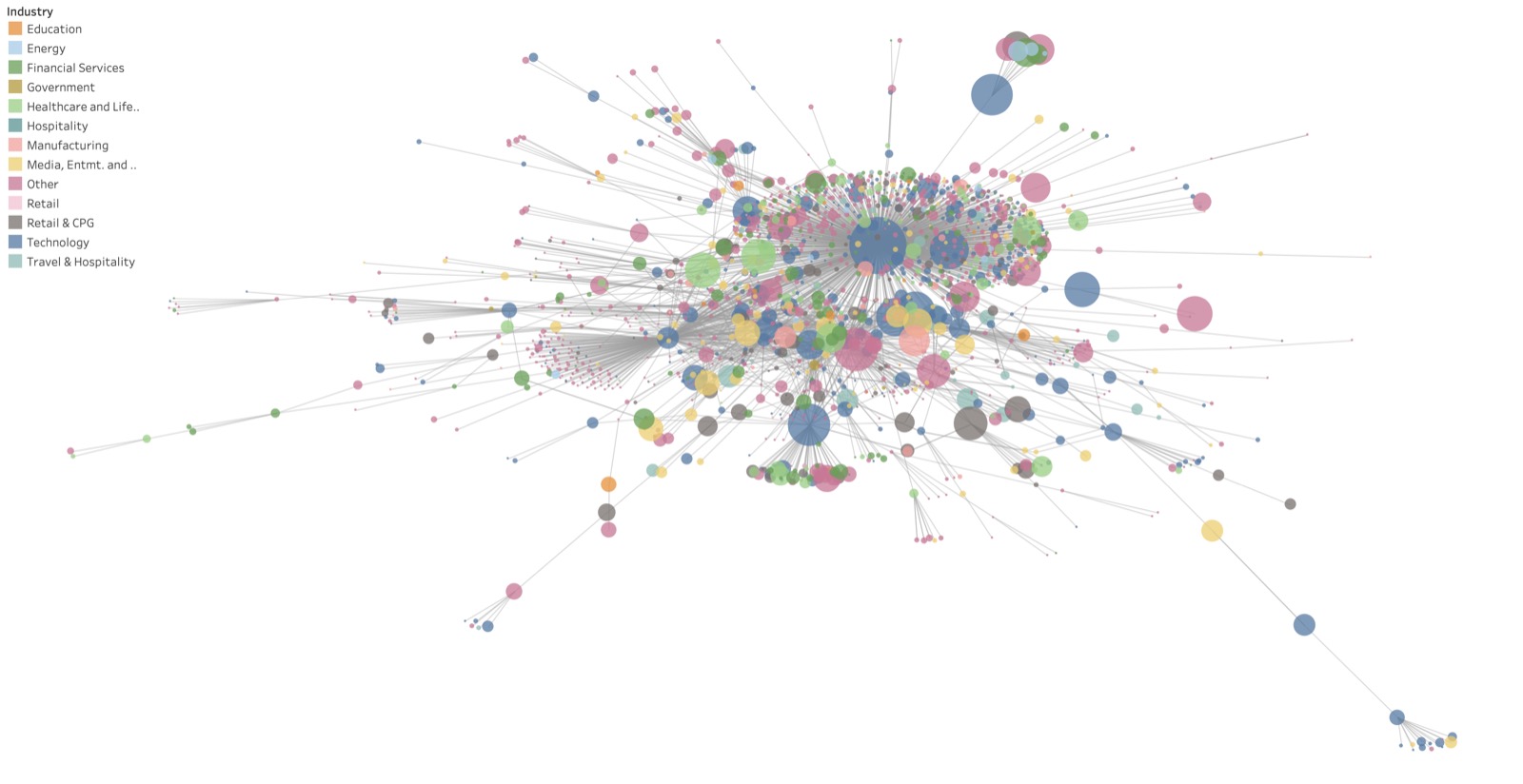
The chart below illustrates the data sharing between Snowflake accounts from February 1, 2020 to July 31, 2020. The blue circle at the center of the cluster represents the hundreds of Snowflake customers that consumed the Starschema COVID-19 data set. This demonstrates how data added to the Data Cloud by one organization can benefit all of our customers in the ecosystem. As more data is migrated to the Data Cloud, we believe our customers will consume and exchange more data, creating a powerful network effect for our business.
I. Technology
I. Managed Service
High availability
Within a region, all components of our platform are distributed over multiple data centers to ensure high availability
Transactions
Platform supports full ACID compliant transactional integrity
Fail-safe
Automatic, non-configurable seven-day period in which data deletions and modifications are recoverable
II. Storage
Columnar Data
Stores data in a proprietary columnar representation, which optimizes the performance of analytical and reporting queries. It also provides high compression ratios, resulting in economic benefits for customers.
Micro-partioning
Platform automatically partitions all data it stores, without the need for user specification or configuration
Creates small files called “micro partitions” based on size, enabling optimizations in query processing to retrieve only the data relevant for user queries, simplifying user administration and enhancing performance.
Metadata
At point of ingestion, automatically extracts and stores metadata to speed up query processing. Does so by collecting data distribution information for all columns in every micro-partition
Semi-structured data
Includes JSON, Avro, and Parquet
III. Query Capabilities
Supports a large subset of the ANSI SQL standard for read operations and data modification operations. Also supports:
Time Travel
Keeps track of all changes happening to a table, which enables customers to query previous versions based on their preferences. Customers can query as of a relative point in time or as of an absolute point in time.
This has a broad array of use cases for customers, including error recovery, time-based analysis, and data quality checks.
Cloning
Offers zero-copy cloning, an operation by which entire tables, schemas, or databases can be duplicated—or cloned—without having to copy or duplicate the underlying data.
Leverages the separation between cloud services and storage to track independent clones of objects sharing the same physical copy of the underlying data. This enables a variety of customer use cases such as making copies of production data for data scientists, creating custom snapshots in time, or testing data pipelines.
IV. Compute Model
Can do multiple operations on data, from ingestion to transformation, as well as rich query and analysis.
Compute services are primarily presented to users in one of two models, either through explicit specification of compute clusters we call virtual warehouses, or through a number of serverless services
Virtual Warehouses
Platform exposes compute clusters as a core concept called virtual warehouses. Customers are able to create as few or as many virtual warehouses as they want, and specify compute capacity at tiered levels.
These clusters can be configured to run only when needed, with cluster instantiation operations typically completed in seconds.
Virtual warehouses can also be configured as a multi-cluster warehouse in which platform can automatically add and remove additional instances of a given cluster to address variations in query demands. This enables the ability to offer extremely high levels of concurrency with a simple configuration specification
Serverless services
Offer a number of additional services, like:
- A data ingestion service that automatically ingests data from cloud storage and allocates compute capacity based on the amount of data ingested
- A clustering service that continuously rearranges the physical layout of data to ensure conformity with clustering key specifications (improving performance)
- A materialized views service that propagates changes from underlying tables to views that have materialized subsets or summaries
- A replication service that moves data between regions or clouds
- A search optimization service that analyzes changes in data and maintains information that speeds up lookup queries
V. Data Sharing
Defined through access control and not through data movement. So the data consumer sees no latency relative to updates from the data provider, and incurs no cost to move or transform data to make it usable.
VI. Global Infrastructure
Database replication
Our platform enables customers to replicate data from one region or public cloud to another region or public cloud while maintaining transactional integrity.
Business continuity
Our platform enables failing over and failing back a database and redirecting clients transparently across regions or public clouds. This provides an integrated and global disaster recovery capability.
Global listings for sharing
Our platform enables a listing to be published globally to access consumers across regions or public clouds.
VII. Built-in Security
Provides a number of capabilities for customers to confidently use the platform while preserving security requirements, including:
Authentication
Includes federated authentication with a number of identity providers, as well as multifactor authentication
Access Control
Provides granular privileges on system objects and actions based on role-based access control
Data encryption
Encrypts all data, both in motion and at rest, and simplifies operations by providing automatic re-keying of data
Also supports customer-managed keys, where an additional layer of encryption is provided by keys controlled by customers, giving them the ability to control access to the data