Market research to consultancy, Redseer bounces around to gain respect - The Ken

It was 11 April, and Southeast Asian tech giant GoTo had just listed on the Indonesia Stock Exchange (IDX), raising US$1.1 billion. Anil Kumar, seated in his plush office overlooking Cubbon Park, Bengaluru’s green haven, was brimming with pride. His firm, Redseer Strategy Consultants, was commissioned to write the industry overview for GoTo’s IPO prospectus—offering prospective investors an overview of the e-commerce, wallet, and ride-hailing industries.
Not only does the 12-year-old, bootstrapped firm charge a significant premium for its IPO services—it didn’t share an exact figure with The Ken—but it’s also getting commissioned by most IPO-bound internet companies. From Paytm, Nykaa, and Zomato to OYO, Mobikwik, and Navi, many startups are availing its ‘industry overview’ services. Redseer claims to have worked on 30 IPOs in 2021—of which seven were in India, Southeast Asia, and West Asia—and has 15 more that are in the process of going public.
In doing so, it has displaced firms such as Technopak, Frost and Sullivan, and Crisil, which typically draft such overviews. Today a de-facto internet market research firm in India, Redseer wants to be seen as a premium consultancy firm for internet companies. Though it began as a market researcher for other consultancy firms like Mckinsey, Boston Consulting Global (BCG), etc., as “an SOS button for consultants to press”, as Kumar put it, it is now a consultant for startups itself.
“We mostly got the Stage-4 cases. When everyone had given up on the job,” said 40-year-old founder and CEO Kumar. With this reinvention of Redseer’s perception, Kumar hopes to meet the trifecta of demand his business entails—to create value, charge dollars, and command respect.
“There has to be a right combination of these three aspects,” he said. Does Redseer pass the test?
When it comes to value, Redseer had brick-by-brick built a market research ecosystem that about 200 clients flock to—ranging from startups like Flipkart, Ola, MyGate, Cure.fit, to investors like Tiger Global, DST Global, GIC, to corporates like Tata and Unilever. Investors come to Redseer to know the ins and outs of the companies they want to invest in—their P&L, target market size, and market share of competitors. Companies come to the consultancy for surveys on new micro-markets, spending habits, and most importantly, competitive analysis.
As for dollars, Redseer has gone from undercutting its competition on price to pricing itself at a premium. Its revenue, claimed Kumar, saw a 100% growth in topline from US$9.4 million in the year ended March 2021 to US$20 million the following year, with US$10 million in bottomline for the year ending March 2022.
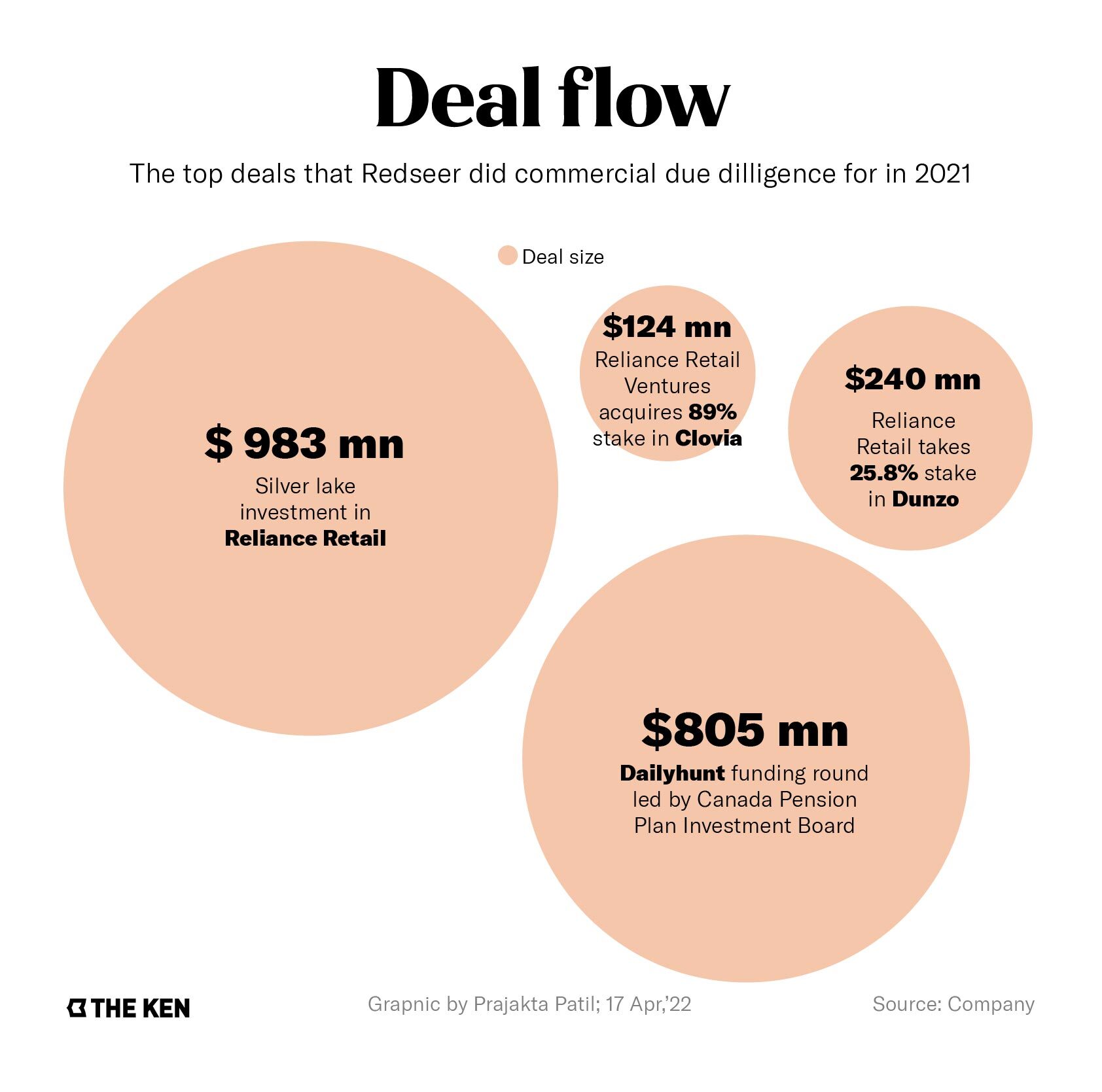
But the third aspect—respect—does not come easy. There are allegations that Redseer’s methods of research have not been above-board, opening it up to questions—“How does it get this data?”, “How does Redseer know?” Redseer’s flagship reports on annual e-commerce festive sales that capture Amazon and Flipkart’s market share have repeatedly been contested by Amazon.
This is where taking on industry overviews for IPOs can help Redseer.
Though industry overviews are glossed over in traditional IPOs, that’s no longer the case. With unprofitable companies going public, the section plays a significant role in telling a company’s story. “When people read the data in an industry overview, either they believe it or discount it, that’s why the name [of the research company] counts,” said the CFO of an IPO-bound company. Having its research in the IPO prospectus is Redseer’s shot at global validation.
Besides, premium consulting companies are not supposed to struggle with respectability.
“Trust and respect are the foundation of consulting. Without this, it is difficult to work on high impact engagements. And this usually takes a lot of time [to establish], especially with leadership and board,” said Pari Natarajan, CEO and co-founder of Zinnov management consulting, a 20-year-old Silicon Valley-Bengaluru based firm that consults on enterprise technology. It does not directly compete with Redseer, though Kumar worked at Zinnov before starting Redseer.
Redseer, though, seems to have grown on the back of accuracy—though its methods aren’t common.
Primary first
Redseer’s growth—which we have documented in detail before—can be traced back to the mid-2010s, when BCG and McKinsey consultants left their jobs to start up. The consultant-turned-startup-executives called on Redseer to do the same kind of market research work they needed in their earlier companies. After all, Redseer had the ability to use elbow grease.
The firm uses a combination of six-seven sources to draw insights from—ranging from supply chain partners to scraping the web to mystery shopping to talking to experts.
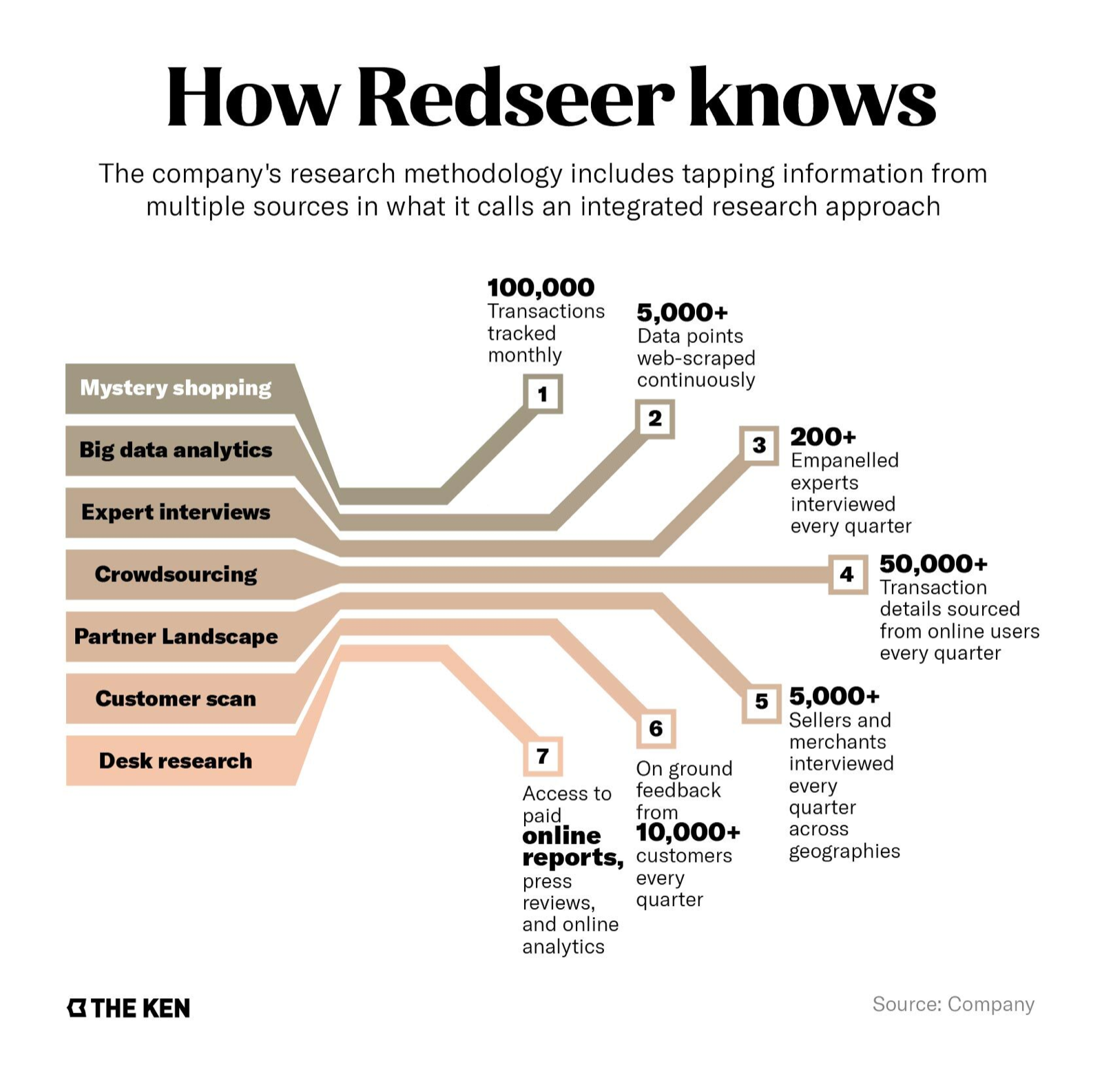
But Kumar never wanted his firm to be just a market research company. He saw this data collection exercise only as a means to an end. He aspired to build a home-grown premium consultancy firm for internet companies. One that can draw on its own data to deliver actionable insights.
For that, Redseer had to become a primary research-first company.
This suited the needs of startups, whose valuations were built on narratives, and needed data that enabled those narratives. “This information helps companies grow,” the former Cure.fit executive said.
Market research to consultancy, Redseer bounces around to gain respect
Redseer’s subscription product, Benchmark, tracks over 100 companies across 30 internet and new-age sectors on hundreds of metrics, including GMV, contribution margin, P&L, and NPS. Access to this costs ~Rs 10 crore (US$1.3 million) per annum. Its consulting business, meanwhile, earns it about US$100,000 per engagement.
Companies typically need two kinds of data. One on trends, market sizes, spending, and consumption habits of its customers. For information like this, large companies engage the likes of Nielsen or IMRB, which can conduct customer research in a sample representative of the actual customer base. Nielsen, for instance, uses a mix of surveys and technology-oriented solutions, such as in-home barcode scanners, and applications on smartphones through which it tracks consumption behaviour.
Market research to consultancy, Redseer bounces around to gain respect
The other kind of data they need is on the competition. Usually, consultants get competitive information by speaking to a panel of experts enlisted with firms like GLG Research and AlphaSights, which provide quantitative and qualitative insights.
But Nielsen and IMRB have stayed away from doing market research in new categories that Indian internet companies dabble in. “It is way too much effort for very little revenue,” said Satish Meena, a former consultant at research and advisory company Forrester. Meena didn’t reveal figures. As for competitive analyses from the likes of GLG, they come with limiting confidentiality clauses. Also, an hour with a GLG expert can cost anywhere from US$100-500.
This is where Redseer could carve its own niche. After all, startups are looking for someone to cater to them.
Market research to consultancy, Redseer bounces around to gain respect
Results at any cost
A few months after Cure.Fit launched Eat.fit in 2018, it wanted to know how its P&L was different from health food competitors like FreshMenu. That meant finding out the packaging cost of food, the kitchen cost, supply chain cost, etc. “I was sure they would find this hard to get. In a startup ecosystem, data is so closely held. It is very tough to find this out on our own,” said the former Cure.fit executive. But two months later, Redseer came back with results.
Its methods were not traditional. Redseer befriended the competition’s kitchen staff, asked them about the number of orders they serve, how many people are employed in a kitchen, and did a back-of-the-envelope calculation. “It seemed fairly accurate,” said the executive.
A senior executive from foodtech Swiggy recounts an incident where the Redseer executive had more up-to-date metrics on city-wise orders per day than the Swiggy executive themselves. “They tell me my own data, which is shockingly accurate,” they said.
So, how does Redseer do it?
It says it has its own tech-backed research centre—a call-centre-like set-up with about 50-70 telecallers. Most research firms outsource this function. Jasbir Juneja, partner at Redseer, claims it has a database of 25 million people, which it keeps adding to every day. This base is segmented by age, income levels, number of children, and city.
As for coveted information on market share, Redseer does its competitive analysis by going directly to the source instead of relying on a panel of experts. Every project is assigned an in-house consultant, a set of two business analysts, and an engagement manager. The consultants use the professional networking site Linkedin to find and incentivise a network of informants across the companies it tracks.
For Southeast Asian companies, it pays informants close to US$100-500 for an hour’s worth of conversation, while in India, it pays Rs 10,000-15,000 (US$131-US$197). It tries to have conversations with different stakeholders of a company.
“We know how to make friends. It takes us a period of one month to establish a relationship and first ask them for broad insights, and then gradually ask them for more specific information. We even warm them up by sending them articles,” shared a former Redseer consultant.
Another ex-Redseer consultant revealed that in the past, consultants sometimes even posed as the HR of competing firms interviewing them for a role, and in the process, got a sense of key business metrics.
A third ex-Redseer consultant said that of all the ways in which Redseer collects data, it gives the most weightage to what it sources directly from the company. All the Redseer sources we spoke with requested anonymity.
This could mean the accuracy of the data could fall entirely on the executive sharing it, though Redseer tries to triangulate it. “We try to validate the numbers we get from at least 2-3 sources, but many times we may get just one source, and we would be forced to go with that source,” said a consultant. It is also not a scalable or sustainable method of data collection because, if the informant quits the company, Redseer is cut off as well.
Redseer though denied speaking with people inside the companies being researched.
“There is no ‘informant’ or direct input on a KPI-basis which is used,” the company insisted. Its research exercise, it said, is a process based on an integrated model and multiple inputs. “Since our products do research on a long-term time horizon with monthly frequency, the process is extremely mature.”
Redseer has allegedly received notices urging it to stop calling employees. “That didn’t stop people from continuing though,” said a former Redseer consultant. The Redseer spokesperson denied this.
“This type of access is tantamount to data theft. Executives want only directional information and not exact data,” said the former Cure.fit executive. Still, startups well aware of its practices are not shunning it. “No one questions this practice because they are seen as a need.” Between needing data to weave startup narratives and the ethical use of data, the former seems to win.
Redseer’s Kumar is unfazed when this dichotomy is brought up.
This is a problem that plagues the industry, he noted. When it comes to alleged practices like posing as HR to extract business metrics, Kumar said, “As a small firm, in our early years there may have been some loopholes. But now, if you go out on the floor, we follow a highly compliant process. Every process is audited every six months. We have had our own set of learning and setting up the right process”. Redseer has a compliance team of lawyers and auditors to ensure all its processes are vetted periodically, he added.
Why won’t Redseer rather drop this sort of primary source data collection? Because it contributes to the Benchmark product, which makes up about 80% of the company’s revenue—as per Kumar—in the long term.
This is a product where Redseer will need to maintain accuracy since companies subscribing to it—including the likes of US investment firm Tiger Global—would have access to their own data for comparison. And accuracy is tough to nail quickly without informants.
Redseer’s catch-22
Even though the recent IPO work is an attempt at bringing Redseer the respect and legitimacy that it needs to grow, it also opens up another challenge. As more and more late-stage companies go public, a lot of the data that competitors would commission Redseer for is now public intel.
RedSeer also realises this—probably why it’s pushing to be seen as a ‘consultancy firm’. Kumar claimed it stopped being just a market research firm at least three years ago. “We are a clear strategy consulting firm. If you look at the revenue per employee per annum, which is the real mark of a consultancy firm, we are one of the most premium consulting firms in India,” he said.
Consultancy can also mean higher margins. If the premium consultancies earn between Rs 1.2-1.7 crore (US$157,200-US$222,712) per consultant per annum, Redseer’s consultants earn between Rs 1.2-1.5 crore (US$196,500), said Kumar.
Redseer has 100 consultants on its payroll, and Kumar said it’s adding another 70 via campus hiring. While premium firms like McKinsey get the coveted first slot on ‘Day 0’ of campus placements at IIMs, Kumar said Redseer gets the last slot on the day. If the premium firms pay between Rs 25-30 lakh (US$32,751-US$ 39,300), Redseer pays Rs 22-25 lakh (US$28,821), he added.
But moving from a market research offering to a higher-end consulting offering is not simply about hiring talent. “IT companies tried to move from application development to higher-end consulting. But that has not been easy,” said Natarajan of Zinnov.
Even though Redseer wants to be seen as a premium consultancy first, if you follow the money, it leads elsewhere—to its subscription product. Scaling the consultancy is limited by the number of people it can hire, but the Benchmark subscription product can get top dollar and Kumar sees it as a billion dollar product in itself.
For that to happen, Redseer will have to walk the fine line between getting accurate data and getting it the right way. After all, respect is the third pillar it seeks to stand on.