Freshworks S1
S1s · Investing · Source
Source URL:
Key Numbers
Last 12 Months Revenue: $308M
LTM Revenue Growth: 49%
LTM GAAP Net Loss: $10M
LTM Cash from Operations: $35M
Total Customers: 52,500
Customers over $5k ARR: 13,000+
Founder Letter
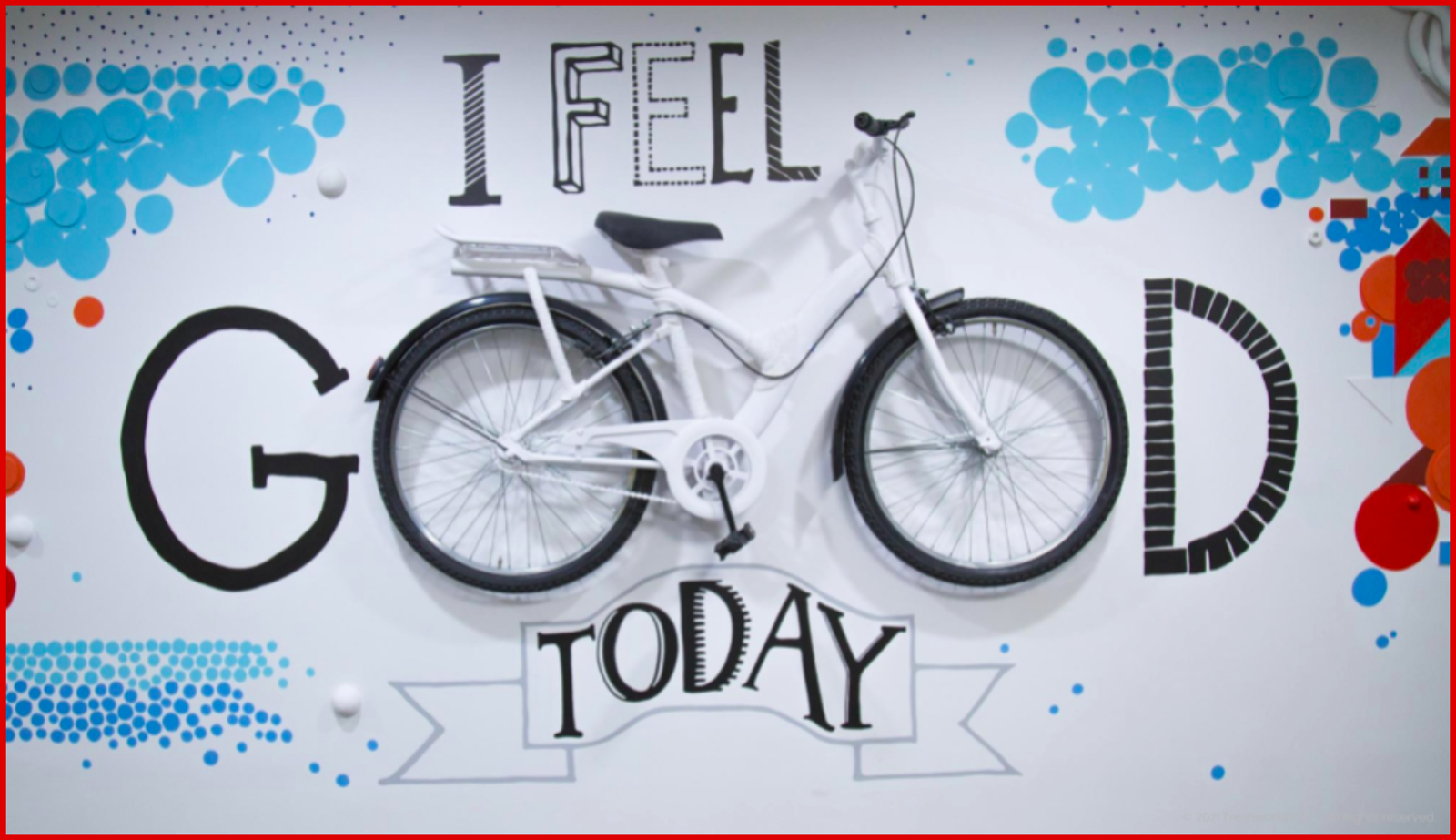
I feel really good today. I show this picture at almost every company meeting. It’s artwork on the wall of our office in Chennai, India. I do this to remind each of us, including myself, that we have a choice in how we approach our work. It’s aspirational for how we want to feel every day. As I reflect on how far Freshworks has come these last 10+ years, this is a proud moment for all of us, and today, I feel really good.
You Can’t Win
Freshworks is the company that wasn’t supposed to win. Whether we could differentiate ourselves in crowded markets, or compete with larger players, or build a global SaaS company from India, the doubts were always there. And people were not shy about telling me! Over the years, I’ve heard it all, including:
- There are 600 help desks in the market. How do you expect to win?
- You can’t find talent in Chennai; you can’t win unless you move to Bangalore.
- Microsoft just acquired Parature. They will put you out of business.
- Don’t enter the CRM market. You just can’t win.
- You really can’t build a global SaaS company from India.
Yet, we kept our heads down and focused on executing, focused on our mission. We realized the profound meaning of what Steve Jobs once said, “Stay hungry, stay foolish.” Freshworks is a very special company. We were unconventional from the beginning - not for its own sake, but because we saw an opening in the market for a unique approach. We weren’t founded in Silicon Valley. We didn’t target large enterprises. We didn’t have access to a been-there-done-that talent pool. We designed our products for the people actually using them. We offered a ‘fresh’ approach relying on efficient, product-led, low-cost, and low-touch sales; and we targeted massive, underserved markets. And we had one simple mantra: happy employees create happy customers. In fact, we made that our mission: Freshworks makes it easy for every business to delight their employees and customers.
Dreaming in Increments
Like so many other startups, Freshworks had very humble beginnings. We started in a 700 square foot warehouse in Chennai in 2010. Our simple idea was to create a ‘fresh’ helpdesk in response to a poor customer service experience I had. We didn’t plan nor expect to change the world. Our dreams came in increments, each building on the next and expanding our vision over time. In 2011, our big dream was to get to $1 million of revenue. In 2012, we started dreaming of our second product - Freshservice - even before we reached that threshold with Freshdesk. In 2014, we started dreaming of growing faster and building out an outbound go-to-market motion. Now, our dream is to be a disruptive player in the CRM market by breaking down the silos of marketing, sales, and customer support with a unified customer cloud. And in the future, we dream of breaking the silos of IT and HR, building a unified employee cloud.
Pioneering Product Led Growth
Freshworks was global from “day one” with our first few customers coming from four different continents. Our initial sales came through search-driven online acquisition, powered by robust product-led growth - well before the term ‘PLG’ became a buzzword.
Our customer acquisition strength came then, and still does, today, from a deep understanding of the online buyer: the frontline support/IT agent or sales rep searching online to find a product to solve their problem. A product that is intuitive, easy to set up, and easy to use. One that is affordable and easy to buy. Freshworks’ products solved their problem, met their needs, and resonated with SMB companies around the globe. Along the way, we saw teams from larger companies come online and buy our products for exactly the same reasons - they loved that our products were intuitive, easy to set up, and easy to use.
Armed with this conviction, we built an outbound sales team and a partner network to scale from SMB to larger customers with the same core tenets: agility, innovation, and affordability. Now we generate a healthy mix of revenue from companies of all sizes. All our products share the original Freshworks product ethos that helped us win our first online buyers:
- Modern products relevant today and well-positioned for the future
- Intuitive, unified, easy-to-use experiences
- Fast time to value
- Affordable for companies of all sizes
Kudumba: Our Heart-led Culture
In the early days, when we were working hard to take an idea and build our first product, we didn’t think about ‘culture’ or even realize we were building one. But we were very clear on recognizing and celebrating the right values and behaviors. Because of that, we have a unique and innovative culture at Freshworks. From the beginning, I wanted to build a company optimized for employee happiness; we want our employees to have the best experience of their life at Freshworks. And for us, the journey will always be more important than the destination. Over time, we codified these values into a simple acronym: CHAT.
- Craftsmanship: Every individual and team lives by the mantra “are you proud to put your name on it?”
- Happy ‘Work’ Environment: It’s not about foosball tables or free food; does the work you do make you happy every day?
- Agility with Accountability: We act with a sense of urgency, and we take ownership of our actions.
- True Friend of the Customer: We always do what’s right for the customer.
There’s another word we use to describe our culture and our company: Kudumba. It means family in Tamil, the language of Chennai. Kudumba is what binds us together. It celebrates our roots and reminds us of where we started. By creating a sense of family - Kudumba - we’ve been able to scale and grow. Our Vision One innovation marked a sea change in consumer behavior, transforming the tech industry forever: the iPhone. Before 2007, we were all using multiple devices - I personally had a Nokia cellphone, a Garmin GPS, a Sandisk MP3 Player, and a Canon point-and-shoot camera. As consumers, we were quick to ditch our gadgets for a single product with a superior unified, intuitive, and delightful experience.
What most people don’t realize is that when Apple introduced the first iPhone, they didn’t invent a single new chip - it was assembled with commercially available technology. It was how they packaged the technology and their relentless focus on user experience that enabled Apple to create a superior product experience. In the business software world, companies are struggling with multiple tools for sales, marketing, customer support across multiple channels, bots, and much more. They often have disparate silos and disjointed information for a single customer - information sitting in multiple databases, none of which communicate natively with each other. This is true even if the tools come from the same vendor, and particularly if they came via acquisitions.What if we can create an iPhone moment in business software by blending existing technology with unified, intuitive, and delightful experiences?
We believe there’s no reason why, with today’s technology, companies should be forced to use multiple tools to engage with customers across their entire lifecycle. Just as the iPhone freed users from the hassles of carrying separate devices, we envision a new product experience that breaks down data silos and creates unified experiences. One thing I learned from dreaming in increments is that patience is critical. We’re designing products now for a future where businesses are ready to embrace our vision of a unified customer cloud - and someday, a unified employee cloud. In the meantime, we continue to execute, build our business, and focus on delighting our customers
The journey ahead
Our success comes from breaking traditional business models and innovating on ways to build, grow, and scale. I’m very proud that Freshworks is a pioneer of Indian entrepreneurship, and of our ability to blend the art of Indian design with the science of Silicon Valley scaling. We’ve been on an incredible journey so far, working hard to build a company that is loved by employees and customers. I hope you will join us on our journey and experience the Freshworks ethos we all love
Prospectus Summary
Overview
Our mission is to make it fast and easy for businesses to delight their customers and employees.We provide businesses of all sizes with modern SaaS products that are designed with the user in mind. We started with Freshdesk, our customer experience (CX) product, and later expanded our offering to include Freshservice, our IT service management (ITSM) product. We then expanded our product offering to include a more complete customer relationship management (CRM) solution, which includes sales force and marketing automation. Finally, business users can have the power of modern SaaS technology with the ease of use of the most widely used consumer internet services. As of June 30, 2021, approximately 52,500 businesses used our software to delight their customers and employees. The first generation of SaaS held enormous potential to give businesses more flexibility in the way they deployed software and make work easier. Despite the technological progress these companies have made, the first generation of SaaS has become too fragmented, unwieldy, and expensive, making it inaccessible for a wide swath of businesses.
Organizations of all sizes, not just large enterprises, are facing increasing pressure to digitally transform and meet higher levels of customer and employee expectations. These stakeholders have become accustomed to the instant gratification of the digital economy, but the business software they use has not kept up.At Freshworks, we build products that make it easier for businesses to delight their customers and employees. Our powerful software delivers the modern functionality and capabilities businesses need, while being intuitive and easy to use, rapid to onboard, agile, and affordable for organizations of all sizes. We build intelligence and automation into our products wherever possible to accelerate user productivity and allow them to quickly meet the increasing demands of customers and employees. By accelerating time to value, increasing productivity, and lowering costs, we provide businesses with a concrete return on their investment in Freshworks. With an increased ability to delight customers and employees, businesses also benefit from improved customer and employee retention, net promoter scores (NPS), and better business outcomes.
In 2011, we launched our first product, Freshdesk. As we continued to grow, we launched additional products and capabilities and expanded our go-to-market function. Over time, Freshworks products were discovered and embraced by teams and divisions within larger organizations, and we have become a leading provider of modern SaaS solutions that solve multiple, complex business problems to companies of all sizes around the globe. Businesses from more than 120 countries around the world use Freshworks products to delight their customers and employees every day. As of June 30, 2021, 13,326 of our customers contributed more than $5,000 in annual recurring revenue (ARR), as compared to 8,588, 9,187, 9,822, 10,723, 11,570, and 12,332 as of December 31, 2019, March 31, 2020, June 30, 2020, September 30, 2020, December 31, 2020, and March 31, 2021, respectively, demonstrating the broad appeal of our products to customers of all sizes and geographies.
As of December 31, 2019, March 31, 2020, June 30, 2020, September 30, 2020, December 31, 2020, March 31, 2021, and June 30, 2021, customers contributing more than $5,000 in ARR represented 78%, 79%, 79%, 80%, 82%, 83%, and 84% of total ARR, respectively. We believe that the number of customers that contribute more than $5,000 in ARR is an indicator of our success in attracting, retaining, and expanding with larger businesses. As of June 30, 2021, over 50% of our ARR was from customers with more than 250 employees, and we had 1,164 customers that each contributed $50,000 or more in ARR. We provide products across multiple massive markets in order to address the needs of businesses of all sizes that need to digitally transform to delight their customers and employees.
Our business model is powered by a strong product-led growth (PLG) motion that helps us serve businesses of all sizes. We make it simple and easy for businesses to find our products organically, trial the product to see if it fits the business use case, and quickly onboard users to the product. We supplement this PLG, or inbound motion, with an outbound motion to larger organizations and a robust partner ecosystem that helps customers extend our products with incremental capabilities to enable organizations of all sizes to have a superior experience. Once users within a business have started to use one of our products, we focus on driving further adoption within that business. We believe that the success of our business model is evidenced by our healthy net dollar retention rate of 118% as of June 30, 2021.
Our business has grown rapidly in recent periods as our customer base and operations have scaled. Our total revenue was $172.4 million and $249.7 million in the years ended December 31, 2019 and 2020, respectively, representing a year-over-year growth rate of 45%. Our total revenue was $110.5 million and $168.9 million in the six months ended June 30, 2020 and 2021, respectively, representing an increase of 53% year-over-year. We incurred operating losses of $29.7 million and $56.1 million in the years ended December 31, 2019 and 2020, respectively, and our net losses were $31.1 million and $57.3 million in the years ended December 31, 2019 and 2020, respectively. We incurred operating losses of $52.8 million and $8.2 million in the six months ended June 30, 2020 and 2021, respectively, and our net losses were $57.1 million and $9.8 million in the six months ended June 30, 2020 and 2021, respectively. In the years ended December 31, 2019 and 2020, our net cash (used in) provided by operating activities was ($8.2) million and $32.5 million, respectively, and our free cash flow was ($23.0) million and $23.5 million, respectively. In the six months ended June 30, 2020 and 2021, our net cash provided by operating activities was $6.3 million and $8.7 million, respectively, and our free cash flow was $1.3 million and $3.7 million, respectively. For more information about free cash flow, a non-GAAP financial measure, and for a reconciliation of free cash flow to its corresponding GAAP measure, see “Management’s Discussion and Analysis of Financial Condition and Results of Operations—Non-GAAP Financial Measures.”
Delighting Customers and Employees is Hard
Requirements for businesses to meet and exceed the demands of both customers and employees have never been higher. Advances in consumer technology and the proliferation of mobile devices over the last two decades have created the ability for anyone to leverage a simple app or website to search for, acquire, exchange, or return goods and services with little friction. These modern consumer experiences have led to higher expectations for business interactions, and attracting customers to stay, buy more, and share their delight is increasingly challenging. Though it is the goal of almost every organization, truly delighting employees and customers is becoming more and more difficult.
Digital Transformation is Accelerating
To address the higher expectations of today’s consumers, organizations of all sizes are being compelled to digitally transform their marketing, sales, and service models. Despite significant investments in technology and services, progress toward meeting the greater demands of customers and employees has lagged. Companies must undergo digital transformations in order to meet and exceed customer and employee expectations.
Users are Demanding Software that Meets their Needs
Business users need software that is powerful and intuitive in order to quickly solve problems for the customers and employees they serve. Yet, they are often forced into using software applications mandated by senior decision makers—executives who do not use the application day to day and have limited understanding of how it works or how it meets the users' needs. Unsatisfied users are pushing back against further software implementations and renewals, and are instead seeking out products that deliver the required functionality while being simple to use.
The Cloud Promise Has Been Broken
In response to rising customer and employee expectations that have intensified over time, many companies have been turning to cloud software. The SaaS revolution, born almost 20 years ago, promised to free organizations of all sizes from the shackles of the client-server paradigm of business software. SaaS was supposed to make users’ lives easier by empowering them to better serve their customers and employees. However, the first generation of SaaS platforms has become, we believe, too fragmented, bloated, and unwieldy to effectively use every day. Despite all the progress in technology and the massive investments from first generation SaaS providers, the enterprise software industry has failed to realize the cloud promise.
The Shortfalls of Legacy SaaS
Legacy SaaS software suffers from the following drawbacks: Not purpose-built to meet users’ needs. Existing business software solutions are not purpose-built to meet the specific needs of the user or the frontline employee whose job day-to-day is to serve customers and employees. The simple yet powerful functionality of consumer technology that users are accustomed to in their personal lives has not translated to their business software. Instead, business software is plagued with complexity, feature bloat, and complicated user interfaces (UI) that often require extensive and ongoing training for users.
Expensive with high total cost of ownership. Legacy SaaS software is often expensive to purchase. It often also requires an army of consultants, significant IT resources, and several months or years to implement and integrate across the IT stack—further increasing costs. The total cost of ownership (TCO) continues to increase with third-party add-ons often required to unlock the full capabilities of the software, as well as ongoing data storage or other hidden fees.
Prolonged time to value. Legacy SaaS software suffers from lengthy approval, purchasing, and implementation cycles frequently extending over many months or even years. Once the software is implemented, users undergo extensive training because the software is complex and cumbersome. Unable to do their job and derive value from the software right away, users often limit their engagement and as a result, businesses are saddled with software that suffers from a prolonged time to value.
Not accessible for companies of all sizes. Large enterprises with the requisite resources are typically the organizations that are able to purchase and access legacy SaaS solutions. Legacy SaaS solutions have effectively left behind most small- and mid-sized organizations on their digital transformation journey and concentrated the benefits to the few that can afford to adopt and maintain these high-priced solutions.
The Freshworks Solution—Delivering on the Cloud Promise
At Freshworks, we strive to empower businesses with simple yet powerful software they can rely on to delight the customers and employees they serve.Designed to delight the user. Our software products are designed so that our users—whether they serve their external customers or internal employees—love using them. We believe that business software should be as intuitive and simple to use as a smartphone application, and this design principle is core to the success of our solutions. We invest significant effort upfront in the product development lifecycle, studying and analyzing how the user will engage with the product end to end, and then designing our solutions with a user-first approach. Our unrelenting focus on simple, elegant, intuitive design empowers users of our software to delight their customers.
Designed for rapid onboarding, agility, and time to value.
Our software makes it very easy to onboard, configure, use, and scale. Businesses that choose Freshworks can sign up for a 21-day free trial on our website and rapidly determine if the solution makes sense to purchase. Crucially, companies do not have to choose between moving fast and satisfying unique requirements; we offer a marketplace with over 1,100 pre-built apps to help companies customize their Freshworks solution. Because users onboard rapidly and almost immediately start to realize value, we quickly see them begin to rely on our software for their day-to-day workflows, expand usage within their organization, buy additional functionality from us, and evangelize our software within their organizations.
Powerful with low TCO.
Our software delivers the functionality of leading technologies, like artificial intelligence, machine learning and workflow automation—priced and packaged to enable users to try and buy quickly. Our self-serve software drives down TCO and makes adopting our software affordable; it does not require an army of expensive consultants and IT resources to implement. Custom business requirements typically can be addressed through pre-built applications available in our marketplace, rather than through expensive professional services. Our subscription prices allow businesses to actually benefit from the solution as they trial and adopt it, which generates users who evangelize within their organizations because they can immediately begin to realize the benefits of our products, enabling a robust PLG motion.
Relevant to organizations of all sizes.
Freshworks products appeal to organizations of all sizes across a wide range of geographies and industries. Our products help smaller-sized organizations bridge the technology gap existing with well capitalized organizations that have implemented or are implementing digital transformation solutions. We are singularly focused on giving users the powerful software features and functionality they need to be effective, while reducing complexity and feature bloat. Our software appeals to businesses of all sizes whose employees demand effective, modern tools, and that are striving to compete effectively in a dynamic landscape.
Key Benefits for Our Customers
“Delight Made Easy.”
This simple mantra guides what we strive to enable for businesses. We provide them the following key benefits:
- Delight. Our fresh approach to business software enables businesses to exceed customer and employee expectations and drive clear business results
- Customer delight: We help businesses delight their customers by enabling them to meet and exceed increasing and evolving sets of customer expectations. Our software enables personalized and context-aware interactions across multiple channels, enabling users to be highly responsive to customer inquiries. With Freshworks, businesses are able to consistently exceed customer expectations, enjoy higher retention and higher NPS, all of which promote increased growth.
- Employee delight: With our intuitive, easy-to-use products, Freshworks users are able to focus on their job responsibilities and spend less time navigating bloated, unwieldy, difficult-to-use software. Users are delighted that our products are designed to optimize their experience, includes the most advanced technologies that are easily accessible, and is not burdened with unnecessary features or process layers. We believe our users are more motivated by software that helps them become more efficient and productive employees, and achieve better business outcomes
- Made Easy. Freshworks makes it fast and easy for businesses to delight their customers and employees. We take a fresh approach to how businesses discover, engage with, and realize value from software, throughout their journey.
- Transparent pricing. Our pricing plans are designed for modern business use cases and affordable for organizations of all sizes. Our pricing is customizable based on users, features, and add-ons, to ensure businesses are paying only for the capabilities they need, while avoiding paying for unnecessary features and functionality. Our pricing is transparent, easy to understand, and easily found on our website, allowing businesses to readily assess TCO and feature differentiation within each of our pricing plans.
- Instant onboarding. Businesses can access our website, try or purchase our software, and onboard in a matter of days not months. Our intuitive UI allows users to learn our products quickly, allowing them to better serve their customers’ needs faster and more efficiently. With fast onboarding, easy-to-use products, and seamless upgrades, businesses using our software are able to avoid lengthy and expensive implementations and high ongoing software maintenance costs.
- Extensibility and customizability. With out-of-the-box extensibility and drag-and-drop functionality, organizations can use our solution to solve business issues that are unique to them. Businesses can also build custom internal applications to extend the capabilities of our products, and to date, businesses have built over 2,900 custom apps to address their specific use cases. In addition, our marketplace provides access to over 1,100 applications developed and published by third parties that businesses can plug into their Freshworks solution to further extend the product.
- Accelerated user productivity. Our products contain automation and collaboration functionality that enhances user productivity. Freshworks’ products augment human engagement by automating processes to address and answer customer and employee requests. This enables users to serve customers faster and to be more proactive during each interaction, resulting in quick resolution of interactions and delighted customers. Additionally, our products embed collaboration functionality to provide our users the ability to collaborate across their organization and get work done without having to leave the Freshworks product environment. ◦Tangible ROI. Businesses achieve tangible return on their Freshworks investment driven by cost savings, improved employee productivity, and accelerated time to value. By automating administrative tasks, shifting customer interactions to digital and self-service channels, and reducing ticket volumes, Freshworks enables more lean and efficient customer support and IT service organizations. Additionally, we reduce approval, purchasing, and implementation cycles, enabling our products to deliver accelerated time to value as compared to legacy SaaS solutions.
Our Market Opportunity
We define our total addressable market in two ways, by utilizing industry research and by conducting our own analysis based on the customer behavior and adoption trends we see of our products.
First, based on industry research from International Data Corporation (IDC), we believe we have a large addressable market of approximately $120 billion. As defined by IDC, we offer products that provide powerful functionality addressing select markets within CRM—including Customer Service, Contact Center, Salesforce Productivity and Management, and Marketing Campaign Management; and System and Service Management (SSM)—including IT Service Management, IT Operations Management and IT Automation and Configuration Management. According to IDC, by 2025, the markets we address within CRM will represent a $76 billion opportunity and the SSM market will represent a $44 billion opportunity.
Second, based on our internal data and analysis, we estimate the annual potential market opportunity for our products to be $77 billion. We calculate this estimate based on the total number of global companies using independent industry data from S&P Capital IQ and weighted average ARR of our products. We organize these companies into three cohorts based on how we organize our go-to-market efforts (SMB, Mid-Market, Enterprise). We then multiply the number of companies in each cohort by the weighted average ARR per customer for our largest product families of Freshdesk and Freshsales (CRM), and Freshservice (SSM) within each cohort, and sum the products for each cohort to arrive at our total market opportunity. We expect our estimated market opportunity will continue to expand as customers onboard more or expand usage of our products, increasing the weighted average ARR per customer for use of our products.
Our Business Model
Since our inception, our go-to-market strategy has centered on offering exceptional products that are designed for the user. PLG is the core foundation of Freshworks and has helped us serve organizations of all sizes. The simplicity and powerful functionality underpinning our Freshworks solutions acts as the primary driver of customer acquisition, conversion, and expansion by driving trials of our products that we supplement with our inbound and outbound sales motions. Our go-to-market approach allows us to respond to how businesses want to buy our products. We offer our products under both free and paid subscription plans, further reducing friction to adoption and accelerating our go-to-market motion. We believe deep user engagement and an obsessive focus on user experience are catalysts for expanding paid adoption within organizations.
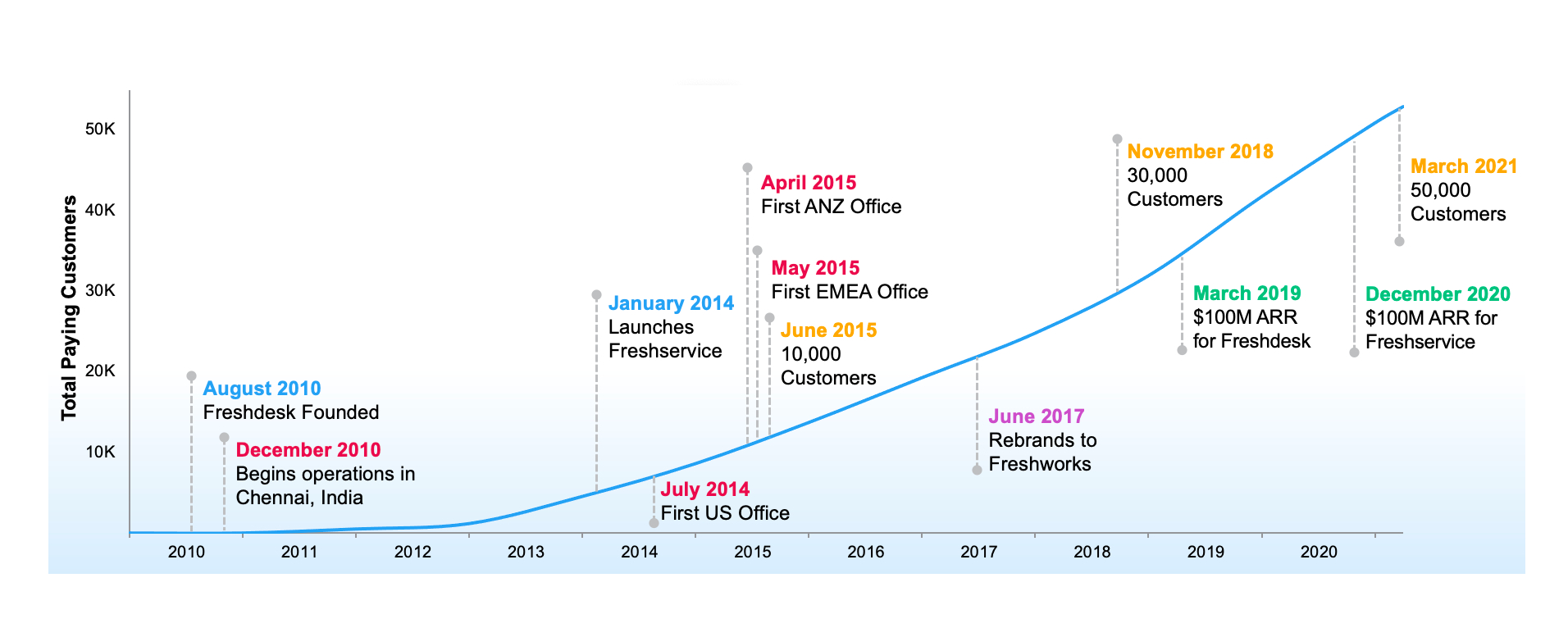
As of June 30, 2021, we had approximately 52,500 paying customers, compared to approximately 48,500 as of December 31, 2020 and approximately 40,000 as of December 31, 2019.
We focus our go-to-market motion on businesses based on their size:
- Small- and Mid-Sized Businesses (SMB) (organizations with 250 or fewer employees): We service our SMB customers through inbound and partner demand generation, which is low-cost, low-touch, and self-service
- Mid-Market (organizations with 251 to 5,000 employees): We service our mid-market customers through inbound, outbound, and partner demand generation
- Enterprise (organizations with 5,001 or more employees): We service our enterprise customers through inbound, outbound, and partner demand generation. We focus on serving divisions or departments within enterprises
We have three go-to-market motions to attract customers:
- Inbound motion: We rely on efficient search marketing and word of mouth to encourage individual users or small teams within an organization to discover, try, and purchase our products. Our inbound motion is the primary way we sell to organizations, regardless of the organization’s size or industry
- Outbound motion: This approach is focused on mid-market and enterprise organizations. We rely on three main groups to drive our outbound business: outbound marketing, sales development representatives, and field sales representatives
- Partner ecosystem: Our growing partner ecosystem enriches our offerings, scales our geographic coverage, and helps us reach a broader audience than we would be able to reach on our own, thus amplifying our go-to-market investments. Our partner ecosystem consists of channel partners, independent software vendors (ISV) partners, and our marketplace
Our Growth Strategy
Key elements of our growth strategy include:
- Continued Focus on Product-Led Growth. PLG increasingly governs the buying patterns of not just SMBs, but also mid-market and larger enterprises. Over time, as teams and divisions within larger organizations have discovered and embraced our products, Freshworks has been organically adopted by these enterprises, becoming the product of choice for CX, ITSM, and sales force and marketing automation products (Sales & Marketing). We will maintain focus on our PLG so that a significant portion of our user acquisition, expansion, conversion, and retention efforts are driven primarily by the product itself.
- Drive New Customer Sales. We believe that our market remains largely underserved. We intend to invest aggressively in our direct and indirect sales and marketing capabilities, including investments in our outbound sales motion teams, to continue to acquire new mid-market and enterprise customers. We also believe the ongoing tailwinds of cloud adoption and digital transformation will drive further adoption of our products by organizations of all sizes.
- Expand Within Existing Customers. Our customer base of approximately 52,500 organizations as of June 30, 2021 represents a significant growth opportunity for us. Expansion in these organizations is driven by adding users, adoption of our products by other departments within the organization, moving customers to more premium products and cross-selling additional products. We believe that our multi-product platform offers significant cross-sell opportunities that have been largely untapped to date.
- Innovate and Enhance Our Products and Platform. Since our founding, our journey to a multi-product strategy has expanded from CX, to employee and IT support, to messaging and cloud telephony, to a unified customer vision. We believe our continued innovation, including delivery of advanced AI and ML capabilities, will translate to a higher value proposition for our customers and increased adoption of our products by both new and existing customers
- Expand Our Partner Network. We are focused on expanding participation in our channel, ISV, and marketplace partner programs across geographies and industries to help us broaden our reach, and drive further customer acquisition and stickiness. Furthermore, we plan to leverage our leading technology partners like Amazon, Google, and Microsoft to explore additional go-to-market opportunities
- Build Upon Our Global Presence. We have been global from our earliest product sales and our global footprint continues to expand, with customers in more than 120 countries. Additionally, we support our products in eight languages. We plan to support more languages, recruit partners, hire sales and customer service personnel in additional countries as needed, and expand our presence in countries where we already operate.
Summary Risk Factors
Investing in our Class A common stock involves a high degree of risk because our business is subject to numerous risks and uncertainties, as fully described in the section titled “Risk Factors” immediately following this summary. These risks include, but are not limited to, the following:
- We have a history of losses, and we may not be able to achieve profitability or, if achieved, sustain profitability
- We have experienced rapid growth in recent periods, and our recent growth rates may not be indicative of our future growth
- We have a limited operating history at our current scale, which makes it difficult to evaluate our future prospects and may increase the risk that we will not be successful.
- We track certain key business metrics, which are subject to inherent challenges in measurement, and real or perceived inaccuracies in such metrics may harm our reputation and materially adversely affect our stock price, business, results of operations, and financial condition
- We believe our long-term value as a company will be greater if we focus on growth, which may negatively impact our profitability
- Our quarterly results may fluctuate significantly and may not meet our expectations or those of investors or securities analysts
- The COVID-19 pandemic has affected how we and our customers operate, including our productivity, and has adversely affected the global economy, and the duration of and extent to which the pandemic will affect our business, future results of operations, and financial condition remains uncertain
- If we are unable to attract new customers, convert customers using our trial versions into paying customers, and expand usage of our products within or across organizations, our revenue growth would be harmed.
- Our ability to attract new customers and increase revenue from existing customers depends on our ability to develop new features, integrations, capabilities, and enhancements and to partner with third parties to design complementary products
- We recognize revenue over the term of our customer contracts and, consequently, downturns or upturns in new subscriptions for our products may not be immediately reflected in our operating results and may be difficult to discern
- Our business depends substantially on our customers renewing their subscriptions and purchasing additional subscriptions from us, and any decline in our customer retention would harm our future operating results.
Summary Financials
Untitled Database
| Property | 2019 | 2020 | H12020 | H12021 |
|---|---|---|---|---|
| Revenue | 172,377 | 249,659 | 110,471 | 168,928 |
| Cost of revenue | 36,462 | 52,492 | 23,857 | 35,396 |
| Gross profit | 135,915 | 197,167 | 86,614 | 133,532 |
| Operating expense: | ||||
| Research and development | 38,559 | 69,210 | 39,813 | 34,290 |
| Sales and marketing | 111,115 | 133,277 | 61,184 | 91,370 |
| General and administrative | 15,911 | 50,792 | 38,395 | 16,026 |
| Total operating expenses | 165,585 | 253,279 | 139,392 | 141,686 |
| Loss from operations | -29,670 | -56,112 | -52,778 | -8,154 |
| Interest and other income (expense), net | 2,180 | 2,833 | -377 | 505 |
| Loss before income taxes | -27,490 | -53,279 | -53,155 | -7,649 |
| Provision for income taxes | 3,635 | 4,015 | 3,991 | 2,195 |
| Net loss | -31,125 | -57,294 | -57,146 | -9,844 |
| Accretion of redeemable convertible preferred stock | -553,339 | -1,560,524 | -102,164 | -381,824 |
| Deemed dividend distribution | -40,071 | — | — | — |
| Net loss attributable to common stockholders - basic and diluted | -624,535 | -1,617,818 | -159,310 | -391,668 |
Products and plans
Trend in paying customers
Subscription Plans
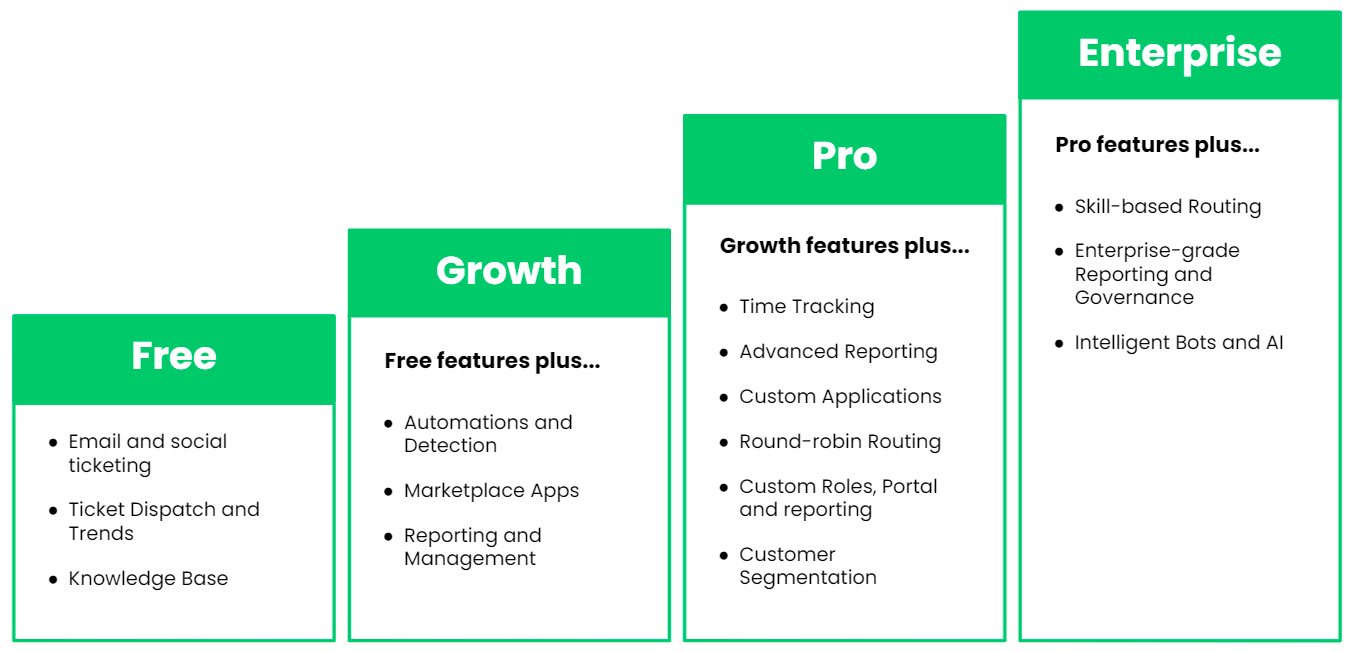
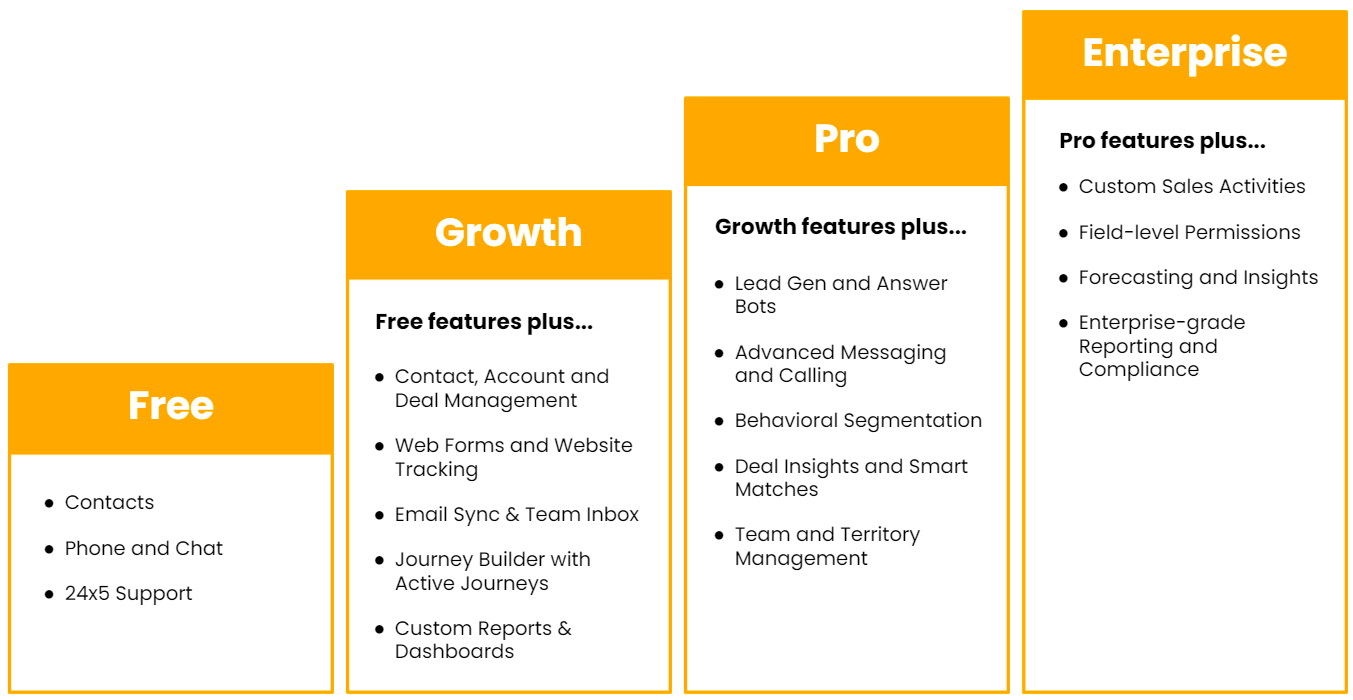
Subscriptions are priced primarily based on the number of agents or users. We offer different subscription plans to serve the varying needs of our customers within our three main product lines of Freshdesk, Freshservice, and Freshsales.
Freshdesk
For our Freshdesk family of products, we offer one free tier and three paid tiers of subscription plans for our Support Desk, Messaging and Contact Center products, which vary by the features provided. For the Growth, Pro and Enterprise tiers, we also offer Freshdesk Omnichannel Suite, which is an integrated suite of Support Desk, Messaging, and Contact Center. Customers have the ability to purchase add-ons like Field Service Management to both the Support Desk and Omnichannel Suite options for an additional cost. Customers can also purchase Day Passes that allow customers to add agents to their Freshdesk subscriptions on a temporary basis to meet spikes in demand. We had approximately 35,800 customers using our Freshdesk family of products as of December 31, 2020. As we have historically re-branded and re-packaged our products within product families from time to time, and may continue to do so in the future, we have not provided historical or interim customer count information by product family as this information would not be meaningful. Customers that use products from two or more of our main product lines are counted as a customer in each such product line.
Freshservice
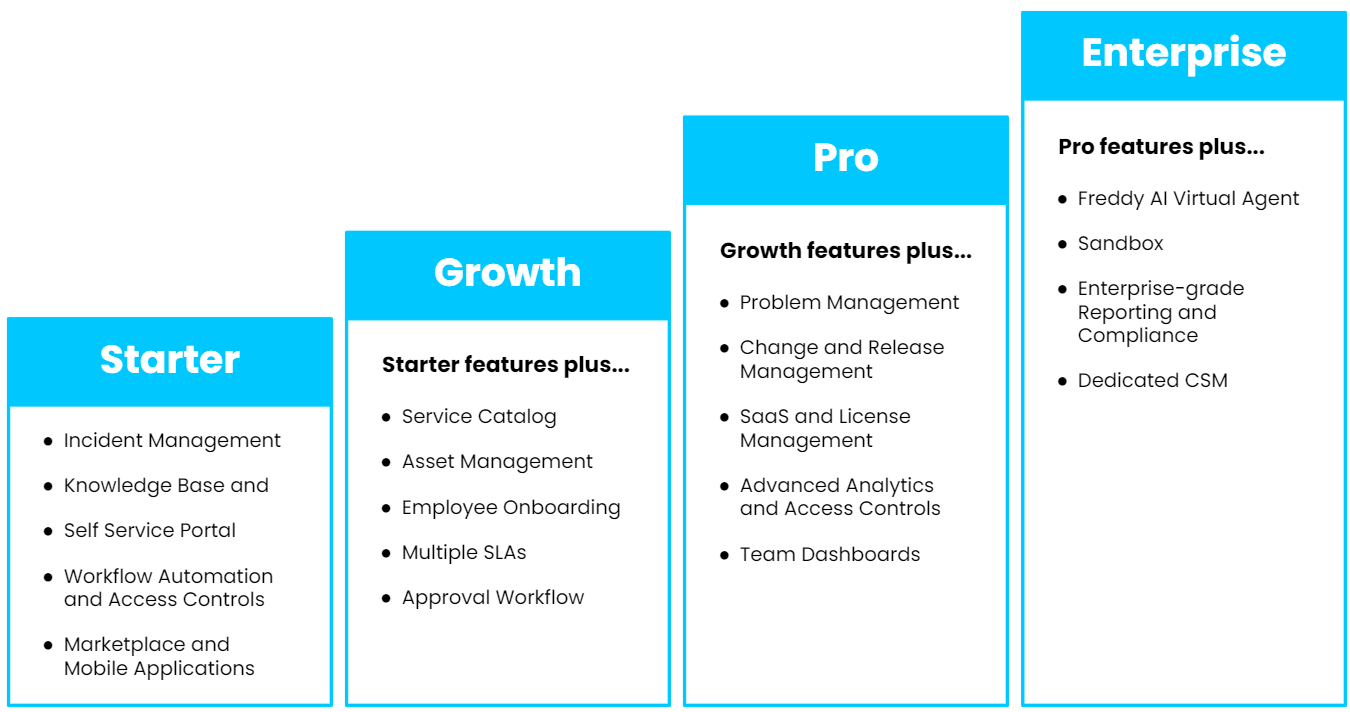
For our Freshservice product, we have four paid tiers of subscription plans, which vary by the features provided. Customers have the ability to purchase add-ons like orchestration transaction pack, assets pack, virtual agent suggestion pack, and SaaS management for an additional cost. We also offer Day Passes for Freshservice for any temporary spikes in demand. We had approximately 8,900 customers using our Freshservice product as of December 31, 2020.
Freshsales
For our Freshsales family of products, we have one free tier and three paid tiers of subscription plans, which vary by the features provided. Customers have the ability to purchase add-ons like marketing contacts, configure price quote (CPQ), conversion rate optimization, dedicated IP address, phone credits, WhatsApp business, and workflows for an additional cost. For customers who want to explore an individual sales or marketing product, we offer Freshsales and Freshmarketer products separately with three tiers of subscription options for each product. We had approximately 6,500 customers using our Freshsales family of products as of December 31, 2020.
General Terms
The terms of our subscription agreements are typically either annual or monthly, and we bill for the full term in advance or on a monthly basis, depending on the customer preference. We recognize subscription revenue ratably over the term of the subscription period. As our business has grown and we have increased the number of large organizations in our customer base, we have seen a larger proportion of annual subscriptions. As of December 31, 2019, June 30, 2020, December 31, 2020, and June 30, 2021, annual recurring revenue (defined below) generated from annual subscriptions was 54%, 58%, 59%, and 62%, respectively. Substantially all of our revenue was derived from subscriptions.
Other Key Numbers
As of June 30, 2021, we had approximately 52,500 paying customers, as compared to approximately 32,700, 35,100, 37,500, 40,000, 42,100, 44,400, 47,000, 48,500, and 50,500 as of March 31, 2019, June 30, 2019, September 30, 2019, December 31, 2019, March 31, 2020, June 30, 2020, September 30, 2020, December 31, 2020, and March 31, 2021, respectively.
As of June 30, 2021, 13,326 of our customers contributed more than $5,000 in ARR, demonstrating the broad appeal of our products to customers of all sizes and geographies, and as of December 31, 2019, December 31, 2020, and June 30, 2021, customers contributing more than $5,000 in ARR represented 78%, 82%, and 84% of total ARR, respectively. We believe that the number of customers that contribute more than $5,000 in ARR is an indicator of our success in expanding upmarket to larger businesses.
As of June 30, 2021, our net dollar retention rate was 118%. Our net dollar retention rate as of March 31, 2019, June 30, 2019, September 30, 2019, December 31, 2019, March 31, 2020, June 30, 2020, September 30, 2020, December 31, 2020, and March 31, 2021 was 110%, 113%, 113%, 115%, 113%, 107%, 109%, 111%, and 112%, respectively.
We had 1,164 customers each contributing $50,000 or more in ARR as of June 30, 2021, representing an increase of 79% year-over-year from 651 customers as of June 30, 2020. As of June 30, 2021, customers contributing more than $50,000 in ARR represented approximately 37% of total ARR. As of December 31, 2019 and 2020, we had 534 customers and 881 customers, respectively, contributing more than $50,000 in ARR demonstrating the appeal of our products to larger customers. As of December 31, 2019 and 2020, customers contributing more than $50,000 in ARR represented approximately 29% and 34% of total ARR, respectively.
No single customer accounted for more than 1% in ARR and our top 10 customers represented less than 5% in ARR as of December 31, 2020, and we have no significant concentration in a specific industry vertical or geography.
we have two primary products with over $100 million in ARR, Freshdesk and Freshservice
During the year ended December 31, 2020, 45%, 40%, and 15% of our revenue was derived from customers in North America; Europe, Middle East and Africa; and the rest of the world, respectively. During the six months ended June 30, 2021, 42%, 42%, and 16% of our revenue was derived from customers in North America; Europe, Middle East and Africa; and the rest of the world, respectively
Monthly subscriptions represented 32%, 31%, 28%, and 26% of ARR as of December 31, 2019, June 30, 2020, December 31, 2020, and June 30, 2021, respectively. The net dollar retention rate for customers on monthly contracts has generally been lower than our overall net dollar retention rate.