Expecting Better
Books
Highlights (not relevant for most people)
making good decisions – in business, and in life – requires two things. First, they need all the information about the decision – they need the right data. Second, they need to think about the right way to weigh the pluses and minuses of the decision
The numbers were not forthcoming. I asked my doctor about drinking. She said that one or two drinks a week was “probably fine”. “Probably fine” is not a number.
When it came time to think about whether or not to get an epidural, I was able to use data from randomised trials – the gold standard evidence in science – to figure out the risks and benefits.
Actually getting the numbers led me to a more relaxed place – a glass of wine every now and then, plenty of coffee, exercise if you want, or not.
More than even the actual recommendations, I found having numbers at all provided some reassurance. At some point I wondered about the risks of the baby arriving prematurely. I went to the data and got some idea of the chance of birth in each pregnancy week (and the foetal survival rate). There wasn’t any decision to be made – nothing to really do about this – but just knowing the numbers let me relax a bit.
The key to good decision-making is taking the information, the data, and combining it with your own estimates of pluses and minuses.
I looked at the evidence on the epidural, combined it with my own plus and minus preferences and decided not to have one. My friend Jane looked at the same evidence and decided to have one. In the end, I felt fine eating deli meats; my uni housemate Tricia looked at the evidence and decided she would avoid them. All of these are good decisions.
Researchers found that the chance of having any children was very similar for women who got married at any age between 20 and 35. Then it began to decline: women who got married between 35 and 39 were about 90 percent as likely to have a child as those who got married younger than 35; women who got married between 40 and 44 were only about 62 percent as likely; and women who got married between 45 and 49 were only 14 percent as likely.
After twelve cycles, the pregnancy rate was around 75 percent for women under 30, 62 percent for women 31 to 35 and 54 percent for women over 35. In this oldest group things were similar for women 36 to 40 and over 40. More than half of the over-40 women in the sample got pregnant within a year.
consistent with other studies, from the United States and elsewhere.3, 4 And the effects aren’t limited to outcomes during pregnancy. Obese women have a harder
was more “welcoming” to the sperm. The very good news, however, is that these effects are relatively short-lived. In the German study, virtually everyone had a normal cycle by nine months after going off the pill. For some women it is much faster: 60 percent of women in
The pill makes things more complicated. As my doctor noted, sometimes the cycle returns to normal straight away, but sometimes it takes a bit longer. The advantage of referring to the actual studies is that we can be more precise.
As with the pill, it takes a bit of time to recover fertility after using an IUD.
women who had just gone off an IUD took (on average) a month longer to get pregnant than those who had just stopped oral contraceptives, but 80 to 90 percent (depending on the study) were pregnant within one year.
There are three common ways to detect ovulation: temperature charting, checking cervical mucus and urine sticks.
For the first half of the month, your temperature will be low – typically below 37 degrees Celsius. The day after ovulation, it will jump up, usually at least a quarter of a degree and sometimes more. This is the sign that you ovulated. Your temperature will stay high through the rest of the month and then drop on the day your period starts, or (often) the day before.
how the baby develops at the very, very beginning. For the period between fertilisation (around ovulation or a day or two later) and your missed period, your baby is a mass of identical cells. Any of these cells could develop into any part of the baby. If you do something that kills one of these cells (such as heavy drinking or some kind of really bad prescription drug use), another cell can replace it and do exactly the same thing. The resulting baby is unaffected.
The other thing to think about: you might not want to know. Pregnancy loss is very, very common at this early stage. As women find out they are pregnant earlier, the number who will subsequently learn that they have lost their pregnancy goes up. And it might go up by a lot. Some researchers suggest that as many as 50 percent or more of fertilised eggs do not result in pregnancy;
Economists almost never have access to randomised trials. So we have developed techniques, statistical methods, to try to learn as much as possible from non-randomised data.
For alcohol, this means up to one drink a day in the second and third trimesters and a couple of drinks a week in the first.
Foetal alcohol spectrum disorders (FASD) refer to a range of mental and physical disabilities that can result from drinking during pregnancy. Physical symptoms include low birth weight, small head circumference and facial abnormalities (flattened cheekbones and small eye openings).
very heavy drinking during pregnancy is bad for your baby. Women who report binge drinking during pregnancy (that’s more than 5 drinks at a time) are more likely to have children with serious cognitive deficits.
Binge or heavy drinking in the first trimester can cause physical deformities and in the later trimesters, cognitive problems. These problems can occur even with infrequent binges. If you are binge drinking, stop.
continental Europe. Much of the continent is much more permissive about light drinking during pregnancy. Heavy drinking is frowned upon everywhere, but some places in Europe have recommendations suggesting that a few drinks a week are fine. An occasional glass of wine or beer is much more common there. Yet there is no evidence of more foetal alcohol syndrome in continental Europe; if anything, rates are higher in the United States.
When you drink, alcohol enters your digestive system and is passed into your bloodstream. Your liver processes the alcohol into a chemical called acetaldehyde and then into acetate. The acetaldehyde is toxic to other cells and depending on how quickly you drink, it can remain in your bloodstream. You share your blood with your baby through the placenta; acetaldehyde, which remains in your bloodstream, is therefore shared with the foetus. Your baby actually can process some alcohol, but not as much as an adult (obviously). If too much acetaldehyde is passed to the baby, it can get into his tissues and impact development.
If we want to learn about the impact of light drinking on pregnancy, we actually want to look at women who are light drinkers. We cannot look at studies of binge drinking and say, well, if five drinks at a time decreases your child’s IQ by ten points, then one drink will decrease it by two points. It simply doesn’t work like that.
Among the best studies of the behaviour issue is one published in 2010 in the British Journal of Obstetrics and Gynecology. There are a few things that make this a reliable study: it’s pretty large (3,000 women) and they collected information about maternal drinking during pregnancy (at 18 and 34 weeks). Asking people about their behaviour while they are doing it tends to be more reliable than asking them to remember later on. The study also followed the children of these women from birth through the age of 14; they looked at behaviour problems starting at age two.
it was run in Australia, where recommendations condone the occasional drink during pregnancy. Studies from the US are more problematic precisely because drinking in pregnancy is judged so harshly. We worry when relying on data from the United States that only women who are reckless in other ways continue to drink.
We know that nausea is a sign of a healthy pregnancy. At the same time, it also causes women to avoid coffee. But this means that women who drink a lot of coffee are probably those who are not experiencing nausea. These women are more likely to miscarry. But you might be wrong to conclude that coffee causes miscarriage; it may well be that lack of nausea causes both miscarriage and coffee drinking.
The first thing to say is that the researchers found no difference in miscarriage rates between women who drank no coffee and those who drank up to two cups a day. However, they did find higher miscarriage rates for those who drank more than two cups a day. The differences in this study are big: a 25 percent miscarriage rate for women who drank more than two cups, versus only about 13 percent for those who drank less.
decaffeinated coffee was as strongly linked to miscarriage as caffeinated coffee. Decaf coffee has the same nausea problem, but no caffeine. If the real problem were caffeine, why would decaf coffee matter? It didn’t prove the case, but it was pretty suggestive.
I ultimately concluded that the weight of the evidence didn’t support limiting my consumption very much. I decided the three to four cups a day I was having was fine. It’s possible you will read this evidence and decide that you would like to stay under two cups. There’s no reason to have less than that if you feel up to it.
The remaining concern with caffeine is that it might be linked to slow foetal growth or pre-term labour, both of which are serious complications.
women were given free instant coffee. Half of them were given free caffeinated instant coffee and half were given free decaffeinated instant coffee. The women did not know which type of coffee they received (the boxes looked the same). They were asked to replace their usual coffee with the instant coffee from the study.
The women given the caffeinated instant coffee consumed a lot more caffeine (not surprising!). They consumed about 200 milligrams more of caffeine than the decaf group. In all other ways these women looked the same (same age, same chance of being a smoker and so on).
they did not observe any differences, they could conclude that giving
In fact, this “lack of effect” is exactly what they found. Even though the caffeinated-coffee group drank a lot more caffeine, their babies looked exactly the same. The table below shows information about the children of women in this study.
| Children of Women Getting Decaffeinated Instant Coffee | Children of Women Getting Caffeinated Instant Coffee | |
|---|---|---|
| Birth Weight | 3.510kg | 3.523kg |
| Length at Birth | 51.8cm | 52cm |
| Gestational Age at Birth | 279.3 days | 280.2 days |
| Head Circumference | 35cm | 35cm |
The caffeinated-coffee women had babies of the same weight and length after the same number of days of gestation and with the same head size. Other, non-randomised studies have reached similar conclusions.
One study found an increased risk of miscarriage at high levels of caffeine consumption. Relative to those women who drank one cup or less per day, women who drank more than five cups a day were twice as likely to lose their baby.
The Bottom Line • In moderation, coffee is fine. • All evidence supports having up to two cups. • Much of the evidence supports having three to four cups. • Evidence on more than four cups a day is mixed; some links are seen with miscarriage, but it is possible that they are all due to the effects of nausea.
Smoking, the question in the case of pregnancy: is there any extra reason to quit while pregnant? The answer is a resounding yes. Smoking, even in moderate amounts, is bad for your baby. Women who smoke are at a higher risk for pre-term labour, problems with their placenta and low-birth-weight babies.
Tobacco contains a number of chemicals, but the two important ones are nicotine and carbon monoxide. Both of these restrict oxygen to the foetus. Less oxygen means less growth. Additionally, the blood vessel constriction caused by nicotine exposure can damage the placenta, which is the source of many pregnancy complications.
Maybe moderate smoking is okay? No, it is not. The study in Missouri showed that women smoking one to nine cigarettes a day had just as many extra complications as those smoking more than a pack.
smoking later in pregnancy had the largest effects on birth weight. The following graph shows baby birth weight for women who smoked before 18 weeks and after 25 weeks of pregnancy.
86 percent of cot deaths in the UK were among children of mothers who smoked.
Very occasional contact (a night with smokers, or walking by someone smoking on the street) is not a big deal.
the best option is to quit smoking cold turkey as soon as you find out you are pregnant, or, ideally, before. But what if you can’t just stop, or can’t stop without help? More specifically, is it a good idea to try nicotine replacement therapy (gum, patches, etc.), called NRTs?
There are, in fact, a number of randomised controlled trials of nicotine replacement therapies, but the evidence is not conclusive. The main problem is that most of these studies have no impact on smoking rates: women do not seem to stop smoking when given NRTs.
If things are developing normally, this ultrasound can be pretty amazing. You will almost certainly see some evidence of a baby by this point – an actual embryo, or at least evidence that the egg is implanted. If you are far enough along, you may actually hear (or, more likely, “see”) evidence of a heartbeat on the ultrasound.
The flip side of being able to see if things are developing normally is that doctors can also see at this point if there is a problem. If you have an ectopic pregnancy, this is probably when you would find out. They may also see that the embryo is simply not developing, a likely sign that you will miscarry.
It is estimated that 90 percent of miscarriages in the first trimester are a result of chromosomal problems. All my research thus far had suggested that, other than not smoking, there wasn’t much I could do to prevent this happening.
We all know that there is some risk of pregnancy loss in the first trimester and that it is lower after twelve weeks. But how high and how much lower?
Miscarriage risk falls as your pregnancy progresses, but there is no special drop-down at twelve weeks.
Before five or so weeks, a pregnancy is considered chemical, not clinical (just a reminder: pregnancy is counted from the first day of your last period, so five weeks is one week past your missed period). This is the period of time when you can detect the pregnancy with a test but you wouldn’t yet see it on an ultrasound.
After six weeks, when your doctors can see evidence of your pregnancy on an ultrasound (if they are looking), the pregnancy is clinical. This is around the time most women have their first antenatal check-up. Assuming that things look as they should at this first visit, miscarriage rates after that are low to moderate and they decrease as the pregnancy progresses.
you are seen at six weeks and things look normal, what is the overall chance that you will have a miscarriage? The data suggests about 11 percent. If you are seen later, say, at eight weeks and things look normal at that point, then the chance of miscarriage is lower, about 6 percent. By the eleventh week, it has dropped to less than 2 percent.
One factor is a previous history of miscarriage: having had one miscarriage, you are somewhat more likely to have another. A study in England showed that the chance of first-trimester miscarriage was around 4 to 5 percent for first pregnancies or women with a previous successful pregnancy. But for those with a previous miscarriage, it was around 25 percent.
second factor is age. Older women are more likely to miscarry (this is likely related to a higher rate of chromosomal problems). These effects are large. In one study the miscarriage rate was 4.4 percent for women under 20, 6.7 percent for women 20 to 35 and almost 19 percent for women over 35
pregnancies achieved via IVF seem also to be more likely to end in miscarriage. One large study reported a miscarriage rate of 30 percent for IVF pregnancies versus 19 percent for those achieved naturally.
there are a couple of symptoms during early pregnancy that correlate with miscarriage. One is vaginal bleeding. Bleeding is very common in the first trimester and most of the time is not something to worry about. However, it does indicate a slightly higher risk of miscarriage: in one study, 13 percent of women with bleeding ended up miscarrying versus only 4.2 percent of women without. A second is lack of nausea. Women who are not nauseous are more likely to miscarry than those who are.
The vast majority of pregnancy food restrictions arise from concerns about food contamination. If you undercook a burger and the meat comes from a meat-processing plant that is also home to a bacteria like E. coli, you will very likely be sorry the next day. If you use a raw egg in your Caesar dressing and the chicken that laid it had salmonella, you’re exposed to the bacteria and run the risk of illness.
But these things are true regardless of pregnancy. No doctor was pressuring Jesse to avoid a medium-rare burger, even though there was always the possibility that he could get ill as well.
If I ate the same way I normally did, was I more likely to get ill while pregnant? And if I did get ill, was there any risk to the baby?
The table below lists the common food restrictions during pregnancy (minus my beloved tuna, which is restricted for mercury reasons and I’ll talk about that later). For
Pregnancy Off-limits Food List
| Food Item | Diseases |
|---|---|
| Raw Eggs | Salmonella |
| Raw fish | Salmonella, Campylobacter |
| Raw shellffish | Salmonella, Campylobacter, Toxoplasmosis |
| Unwashed vegetables and fruits | Toxoplasmosis, E Coli |
| Raw/rare meat and poultry | Salmonella, Campylobacter, Toxoplasmosis, E. coli |
| Smoked Fish | Listeria |
| Pâté | Listeria |
| Unpasteurised (raw) milk | Listeria, campylobacter |
| Raw milk soft cheese | Listeria |
| Deli meats or cold-cured meats | Listeria |
Salmonella, E. coli and campylobacter: illnesses from these causes are not especially more likely during pregnancy, nor do they typically directly affect the foetus.
But both toxoplasmosis and Listeria are particular pregnancy concerns.
Toxoplasmosis is caused by a parasite – toxoplasma gondii – and concerns about this parasite are the reason pregnant women are told to avoid cleaning the litter box.
you are quite a bit more likely to get this from raw meat or unwashed vegetables than from cat litter (more on the feline source later). In non-pregnant people, toxoplasmosis infection is not usually an issue (it can cause flulike symptoms). The symptoms are similar during pregnancy. The big danger is that many people who are infected do not notice any symptoms at all; if you notice symptoms, you can be treated and reduce the chance of passing the parasite to your baby. But if you don’t notice them or the treatment doesn’t work, the foetus can become infected.
If your foetus becomes infected with the parasite, it may develop what is called congenital toxoplasmosis. This affects about 1 in 1,500 babies. The complications of congenital toxoplasmosis include mental retardation, blindness and epilepsy. The severity varies widely and is related to the timing of infection: infection early in pregnancy is worse than later.
Avoiding toxoplasmosis is not that difficult. It comes primarily from undercooked meats and possibly dried or cured meat (like prosciutto), although the latter is less common. Based on a study in Europe, about 10 percent of toxoplasmosis cases could be avoided by washing vegetables and fruits well before eating them. Another third to a half could be avoided by not eating raw or very undercooked meat. About a third of cases are of unknown origin. This makes a good case for washing your veggies and avoiding raw and undercooked meat, which would dramatically limit your exposure.
If you have already had this infection, there is no risk to your baby. Having had this in the past is not a problem and you cannot be re-infected. If you already carry the parasite, you are in the clear. If you are curious, your doctor can test for this at the start of pregnancy.
Listeria: Harmful and hard to avoid. Listeria in pregnancy is very dangerous. Listeria infection begins with standard stomach-flu symptoms but typically gets worse, including chills and muscle aches. It can be fatal even in healthy adults and pregnant women are much more susceptible: up to a third of all Listeria infections are in pregnant women.
Thankfully, Listeria is not that common: about 1 in 8,000 pregnancies a year are affected.
But if you are infected, the consequences are scary. Miscarriage, pre-term birth or stillbirth are common outcomes, occurring in between 10 and 50 percent of pregnant women who are infected. Complications for surviving infants include meningitis, neurological problems and other complications from premature delivery.
this may occur because the placenta becomes infected and then continually reinfects the mother; expelling the placenta (and the baby) may be the body’s natural protective response. Regardless of why it occurs, it’s a devastating outcome and scary to contemplate.
The last two major outbreaks in the US were in celery (in 2010) and cantaloupes (in 2011). The cantaloupe outbreak was large, covered many states and caused 29 deaths. In 2008 there was a large outbreak due to sprouts. The last confirmed Listeria outbreak due to deli meats was back in 2005. A lot of these outbreaks seemed pretty random. There was no way to know beforehand
One general rule: Listeria grows well at refrigerator temperatures, so any food that has been sitting around for a long time in the fridge should probably be avoided.
Mercury exposure is measured either through the amount of mercury in Mum’s hair or through testing umbilical cord blood. Averaging across a few studies, researchers found that a 1 microgram/gram increase in mercury level led to a decrease of 0.7 IQ points.
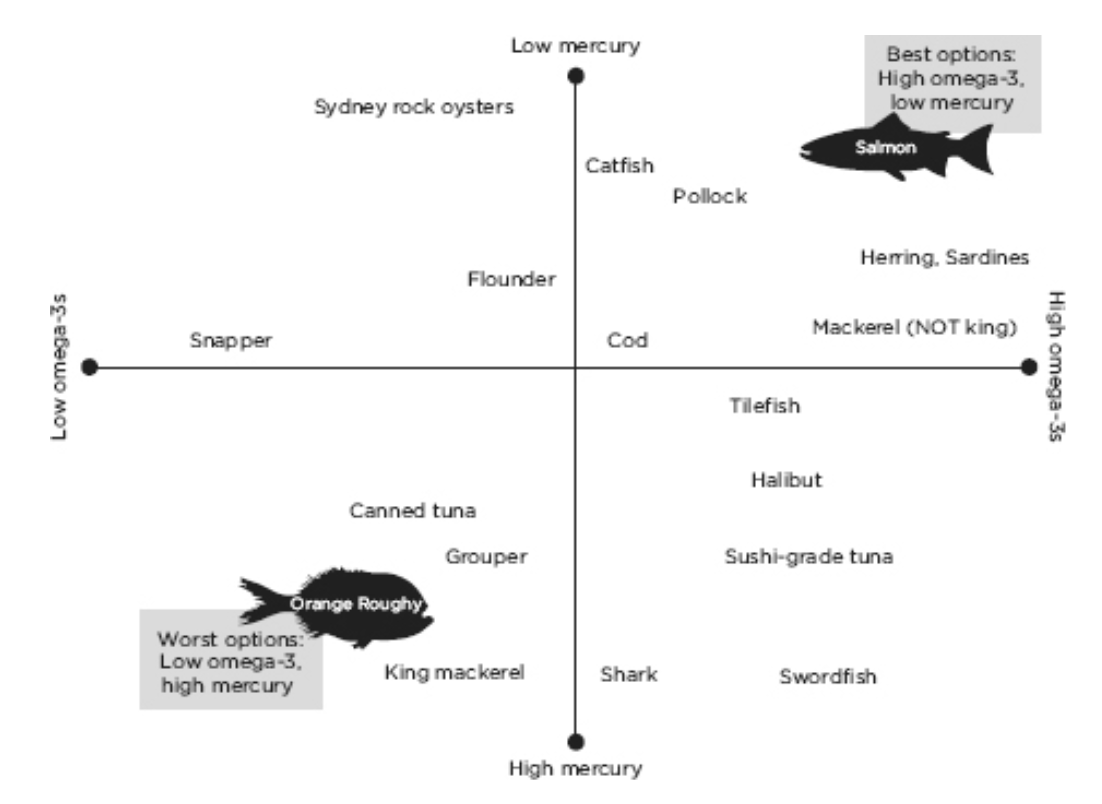
Fish – specifically, fish oils – contain very high rates of omega-3 fatty acids. These are great for your baby. In particular, they are great for brain development, exactly the thing that mercury is bad
these are fish that are high in omega-3s but low in mercury, such as herring and sardines (small, oily fish) and salmon. Eating more of these fish can be nothing but good.
Faced with a choice between tinned tuna and sushi tuna, the sushi-grade tuna is, surprisingly, probably a better choice. It’s a little higher in mercury, but a lot higher in DHA.
your best option is to stay in the upper-right quadrant. This is true during pregnancy, but also after: the same DHA exposure benefits your baby while you are breastfeeding. You may not be used to eating herring and sardines on a regular basis, but they are worth a shot.
it’s probably reassuring to know that for most women the nausea eventually goes away, this graph does suggest that the resolution isn’t immediate when you enter the second trimester. If you’ve been very ill for the first few weeks, you shouldn’t expect to feel great as soon as you hit week thirteen or fourteen, although things should be gradually improving at that point.
In one study of 2,500 women, at the worst point in her pregnancy, the average person was throwing up at least once a day and about 13 percent of them were throwing up at least three times a day.
I have a somewhat unpleasant cat named Captain Mittens. She terrorises our cleaning lady and hisses at the nanny. Naturally, she is Penelope’s favourite member of the household, so now we are stuck with her forever, if we weren’t before. The Captain, as we call her, is all my fault. I brought her into the marriage and I take care of her. Which includes cleaning the litter box. When I got pregnant, I received a large number of emails (from my mother, my friend Nancy, etc.) with dire warnings about the cat: “Do not clean the litter box!” Sometimes with multiple exclamation points.
Although uncooked meat is the primary source of toxoplasmosis, it is also possible to get it from cat faeces. If your cat has been eating uncooked meat, that is.
Cats are infected by eating something (like raw meat) that gives them the parasite. The first time they are exposed they excrete the parasite eggs in their faeces for several weeks; you can be infected through exposure to these. Once they are exposed once, they typically acquire immunity and are not exposed again.
you’re at risk if you’re exposed to a cat during their first exposure. If your cat is old, regardless of whether it lives outside, it probably has already had this.
you may want to be a little careful if you get a kitten for the first time while pregnant, especially if you feed it a lot of raw meat. In fact, one study in the United States did find that owning three or more kittens (although not owning one or two) was associated with higher toxoplasmosis rates.
although cat litter seems to have little risk, there is significant toxoplasmosis risk from gardening. That study in Europe that was reassuring on cats did find a strong association between toxoplasmosis and working with soil. This suggests that if you are planning to garden while pregnant you should use gloves and possibly consider a mask to avoid inhaling any particles.
anything that elevates your temperature increases that risk: fever, hot tub use, very hot baths and, yes, hot yoga.
The conclusion, perhaps, is that if it is 40 degrees out and you are 36 weeks pregnant, you should stay inside!
Prior to Penelope’s arrival I travelled a fair amount, mostly for work. My first flight while pregnant was about three days after conception. My last was at 34 weeks, for a friend’s birthday.
But before 36 weeks there are typically no restrictions put on air travel by your doctor or by the airlines. The American Congress of Obstetricians and Gynecologists takes the view that air travel is fine. They suggest you wear your seat belt and, if necessary, get a seat belt extender
Consistent with this, at least one study that compared infant outcomes for women who did and did not fly during their pregnancies found no difference in pre-term birth, foetal loss, or neonatal intensive care unit (NICU) admission.
I didn’t find weight to be such a big deal in the first trimester – like everyone else, I was too ill to eat much of anything – but around twelve or fourteen weeks I started noticing I was getting a bit bigger.
Mum’s Weight After Pregnancy The first concern about weight gain is that if you put it on you have to take it off and, in the long run, being overweight is bad for your health.
One study in the United Kingdom found that women who gained the recommended amount of weight during pregnancy ended up about 2.25 kilograms heavier than their pre-pregnancy weight 6 months postpartum and that those who gained more than the recommended amount ended up about 8 kilograms heavier.
If you typically have an easy time losing weight, it’ll probably be the same after the baby. If not, you may have a harder time.
Is it possible that higher rates of maternal weight gain during pregnancy have contributed to this increase? By eating those extra pancakes, are you dooming your child to a lifetime of dieting? Maybe.
The main biological mechanism through which this might occur is insulin resistance. It’s possible that excess weight gain during pregnancy could stimulate the foetus to produce more insulin, resulting in higher birth weight, limited sugar tolerance and later weight gain.
I wasn’t especially convinced that any of the studies of this showed causal evidence. But even if these effects were causal, it didn’t seem to matter. The effects were tiny. On the scale of everything else I am likely to do to impact my child’s weight, this just wasn’t very important.
Worrying about the long-term effect of pregnancy weight gain probably isn’t worth it. But weight could still matter for the short term. In fact, it does matter in one significant way: weight gain during pregnancy relates very closely to your baby’s birth weight. The more weight you gain, the larger your baby is likely to be relative to the timing of his birth.
All else being equal, the longer the baby sticks around in your womb, the larger he will be. A baby born at 42 weeks will be larger than he would have been if he were born at 37 weeks. This is normal and typically fine: there are a wide range of healthy weights for babies, from less than 2.75 kilograms to well over 4.5 kilograms.
In the United States, weight gain during pregnancy is often recorded on infant birth certificates and studies of this show a strong association with birth weight.
Small for Gestational Age (SGA): SGA babies are usually defined as those in the bottom 10 percent in terms of birth weight relative to their time in the womb; some studies take a more extreme definition and include only babies in the bottom 2.5 percent in terms of birth weight.
A study in Finland found that 42 percent of SGA babies had some complications. These included difficulty breathing, difficulty regulating blood sugar and abnormal neurological signs. For babies who are born prematurely, being small for gestational age is more serious.
Some studies suggest that babies who are born SGA have more long-term issues, including a higher risk for diabetes and lower cognitive skills.
Large for Gestational Age (LGA): Babies in the top 10 percent in terms of birth weight are classified as large for gestational age. Women with gestational diabetes often have LGA babies; gestational diabetes causes its own set of complications. For women who are not diabetic, the most significant complication associated with LGA babies is difficulty in delivery, including an increased chance of requiring a Caesarean and an increased risk of instrument-assisted delivery.
On its own, this probably means that you should be more concerned about gaining too little weight than too much weight.
The one overwhelming thing I took away from this was that it doesn’t matter very much. Gaining a couple of kilos, even 5 or 7, over the weight limit is not very important.
At one check-up I was informed that if I continued my current rate of gaining, I would be at 16.3 kilograms and the limit was 15.8, so I should try to cut down. Nothing – not evidence and not basic logic – supports this. So, basically, relax.
If I gained 14 kilograms, right in the middle of the recommended amount, the chance of either a too-small or too-big baby was 15 percent. If I gained 18 kilograms, it was 18 percent. If I gained only 9 kilograms, it was 23 percent. So my best bet for a normal-size baby was 14 kilograms of weight gain.
this logic seemed flawed. The complications associated with a very small baby are, on average, more severe than those associated with a very large baby. But the guidelines seemed to be focused on minimising the total number of too-large or too-small babies.
the two areas that everyone ultimately found problematic were exercise and sleep. As you get bigger and bigger, it’s just hard to keep doing either of these normally.
exercise doesn’t seem to have much of an impact on anything. No change in pre-term birth, or gestational age, or rate of Caesarean section, or foetal growth.
There is no evidence of a difference in baby APGAR scores or in the length of labour. So there is not a lot of reason to start exercising. There is also no reason to stop.
The biggest prohibition is on normal sit-ups or crunches, where you lie flat on your back. Usually these are prohibited after 20 weeks.
the possibility of restricted blood flow.
for most women this is fine and you’d know if it wasn’t fine for you because it would be uncomfortable. If you can do a sit-up, even after 20 weeks, go right ahead.
diastasis recti abdominis: separation of the abdominal muscles. This happens to a very large percentage of pregnant women (you’ll know if it happens to you).
It usually goes back to normal after pregnancy. A number of web sites will tell you that if this happens you should stop all abdominal exercises.
doctors tend to recommend that you avoid activities like skiing or rock-climbing, where falling is possible; most women have some trouble with balance during pregnancy, which makes falling more likely.
There is also some evidence that exercising really hard during pregnancy could (very temporarily, during the period of exercise) compromise blood flow to the baby.
when women exercised so hard that they pushed their heart rate to more than 90 percent of their maximum, there was some decreased blood flow to the baby.
Kegels Kegel exercises, or Kegels, get a lot of play in the world of pregnancy. In medical terms, these are called pelvic floor exercises.
Kegels are nothing more than exercises where you repeatedly squeeze those muscles to strengthen them.
it does turn out that strengthening these muscles during pregnancy has several benefits.
Nearly all women experience some urinary incontinence during late pregnancy or after delivery – most commonly when sneezing or coughing.
women experience more severe forms – they wee when laughing, during strenuous exercise, etc. – and this can continue for significant periods – years, even – postpartum. Kegels are extremely good for preventing this.
150 were assigned to do Kegel exercises and the other 150 were left to their own devices. The particular exercise was fairly standard: twice a day, women did three sets of eight Kegels, where they tightened and held for 6 seconds, with 2-minute breaks between each set. This is not that much; it amounts to maybe 15 or 20 minutes a day total.
Women who do Kegels regularly are significantly less likely to have urinary leakage. Of course, this is just like any other exercise: it works by building up your muscles. So there is no reason not to start even before you are pregnant, although these studies show you can get the benefits of the exercise even if you start midway through the pregnancy.
there is actually some evidence that antenatal yoga is beneficial on a variety of dimensions
One study of about 90 women in Taiwan showed that the women randomly assigned to a 12-week yoga programme experienced a reduction (from 43 percent to 38 percent) in discomfort in the last fortnight of pregnancy.
similar intervention in Thailand focused on 74 women and measured labour pain and labour duration.10 In this study, the women in the yoga group reported lower levels of pain at several different times during labour and much shorter first-stage (i.e., before pushing) labour. The effects on labour length were actually huge in this study: labour was two and a half hours shorter for the yoga group.
Both of these studies were small and there are not a lot of others to rely on,
sleeping normally during pregnancy is basically impossible.
Adding insult to injury, by the time you get to 20 weeks of pregnancy, your sleep position is significantly restricted. At my 20-week check-up, my obstetrician reminded me: no more sleeping on my back and ideally I should stay on my left
You’re not supposed to sleep on your back. The theory is that as the uterus gets larger (beyond 20 weeks or so), it can compress an important blood vessel. This decreases Mum’s blood pressure and can reduce blood flow to the placenta and the baby. That this occurs is something we know from physiology. What is the more relevant question for you is whether there is any evidence that this actually has risks for the baby.
As it turns out, very likely not.
there is a clear biological mechanism, the most obvious way is to try to see if that mechanism really works the way that is claimed. In one very nice study of this, researchers made women lie on their backs and measured the blood flow to the uterus. They found that lying down has no particularly bad impact on blood flow.
A couple of women in that study became uncomfortable, but felt better when they changed positions. The authors concluded that some women might be uncomfortable sleeping on their backs, but if you are not one of them, you should feel fine about it
Advising women to sleep or lie exclusively on the left side is not practical and is irrelevant to the vast majority of patients. Instead, women should be told that a small minority of pregnant women feel faint when lying flat. Women can easily determine whether lying flat has this effect on them and most will adopt a comfortable position that is likely to be a left supine position or variant thereof . . . since finding a comfortable position in bed in late pregnancy is not easy, physicians should refrain from providing impractical advice.
However, a recent study has questioned this and deserves some discussion. It shows a scary link between maternal sleep position and stillbirth.
It turns out that sleeping on the back or the right side was associated with a higher rate of stillbirth.
The effect is large: the stillbirth rate was about twice as high for women sleeping on their backs. This study wasn’t perfect. The sample size was small and the researchers were testing a lot of different theories, not just sleep position.
there isn’t anything obviously wrong with the paper that would lead one to fully discount the conclusions. We’re left in a frustrating but common position when it comes to academic debates: more research is needed.
Sleeping on your left side is unlikely to be bad, so that’s a good option if you can manage to get to sleep that way.
Drugs with really big molecules do not pass through the placenta to the foetus. An example of this is heparin, a blood-thinner. The heparin drug molecule is just so large and heavy that it literally cannot “fit” through the placenta. Think of the placenta as a sieve and heparin as a slightly-too-large piece of sand. This too-big issue can also happen with drugs that attach themselves to other substances and through this process become too big to fit through.
Obviously, this is a very appealing feature of these drugs (at least as far as pregnancy is concerned): no transfer through the placenta, no direct effect on the baby.
The other reason why drugs might not get through is that some of them can get stuck in the placenta. For reasons that are really not understood, for a small number of drugs the placenta acts as a “depot”. It just collects the drug and never passes it along.
These categories are exceptions. In most cases – things like painkillers, antibiotics or antidepressants – the baby consumes at least some of what you take. That can be a problem, but it isn’t necessarily a problem. It really depends on the drug. That’s where the FDA classification system comes in.
The FDA splits the drugs pregnant women might take into five categories: A, B, C, D and X. Category A drugs are the safest and Category X drugs are the most dangerous.
Categories A, B and C are all drugs for which there is no strong evidence of harm to human babies. The difference is in the quality of the evidence in people and the results of experiments in animals. Categories D and X are drugs that are contraindicated in pregnant women because studies have shown evidence of harm to babies from taking them.
Category A: “Adequate, well-controlled studies in pregnant women have failed to demonstrate a risk to the foetus in any trimester of pregnancy.”
was almost impossible to find an example of a Category A drug. The FDA obviously has a very high (read: insane) standard for a well-controlled study. Most of the vitamins in my antenatal vitamins are not even Category A! The one example I could find was folic acid.
Category B: “Adequate, well-controlled studies in pregnant women have not shown increased risk of foetal abnormalities despite adverse findings in animals or, in the absence of adequate human studies, animal studies show no foetal risk.”
most of the things in your antenatal vitamins are Category B: many millions of women have taken them for years and there is no evidence of adverse effects.
Other than antenatal vitamins, probably the most common Category B drug is paracetamol.
The United States classifications are significantly more stringent. As a result, few drugs even make it to Category B. Which brings us to the vast unwashed: Category C.
Category C: “Adequate, well-controlled studies in humans are lacking and animal studies have shown a risk to the foetus or there are not any animal studies. There is a chance of foetal harm if the drug is administered during pregnancy, but the potential benefits may outweigh the risk.”
drugs are characterised as Category C if there is no actual evidence of risk, but there is also no large-scale human data.
Category D: “Studies in humans or investigational or postmarking data have demonstrated foetal risk. Nevertheless, potential benefits may outweigh the risk.”
You really don’t want to take a Category D drug unless you have to. These are drugs for which studies have shown some demonstrated risk to the foetus. Usually those risks are relatively minor; if something has a major risk it usually gets put in Category
You really don’t want to take a Category D drug unless you have to. These are drugs for which studies have shown some demonstrated risk to the foetus. Usually those risks are relatively minor; if something has a major risk it usually gets put in Category X.
Category X: “Studies in animals or humans, or investigational or post-marking reports, have demonstrated positive evidence of foetal abnormalities or risk which clearly outweighs any potential benefit to the patient.” Category X drugs are strongly counterindicated during pregnancy. You shouldn’t take them. The negative outcomes for the baby are serious and likely and the benefits of these drugs during pregnancy do not outweigh them.
When I was at my parents’ house for Christmas, around 22 or 23 weeks, there was a day in which I didn’t feel Penelope move around at all. I’m told this is common – at that stage they are so small that if they get into an odd position you might not feel them
A premature birth is one that occurs before 37 weeks of pregnancy. As late as the 1960s, babies born even a few weeks premature frequently died. Among the most famous examples of this is John F. Kennedy’s son, Patrick, who was born at about 34½ weeks, weighing almost just over 2 kilos, yet died two days later from respiratory disease. At the time, this wasn’t a surprise. How things have changed: in 2005, 98.9 percent of babies born at that 34 months of gestational age and weight survived their first year.
Many of the advances in survival have been due to improvements in assisted ventilation. Lungs are among the last organs to develop (perhaps because they are not very useful when you are living in water), so babies born as late as 36 weeks can have serious trouble breathing.
Mechanical breathing machines can be used until the baby is able to breathe on his own.
In one study of five-year-olds born before 30 weeks of gestation, 75 percent of them had at least one disability (versus 27 percent among children born after 37 weeks). Their IQs were also 5 to 14 points lower, on average.
Moderate prematurity (32 to 36 weeks of gestation) also has had an impact on IQ in some studies, but these tend to be smaller and serious disabilities are less common.
The Natality Detail Files provide information on every birth in the United States, including gestational week at birth as well as probability of death in the first year of life.
Until 34 weeks, the chance of having a baby in any given week is less than 1 in 100. Before 30 weeks the chance in any given week is less than 1 in 500.
| Weeks of gestation | Percentage of births | Prob of death in 1st year |
|---|---|---|
| 22 | 0.05% | 77.1% |
| 23 | 0.06% | 62.6% |
| 24 | 0.09% | 39.3% |
| 25 | 0.10% | 26.0% |
| 26 | 0.11% | 18.1% |
| 27 | 0.12% | 13.6% |
| 28 | 0.17% | 7.5% |
| 29 | 0.20% | 5.5% |
| 30 | 0.28% | 4.0% |
| 31 | 0.36% | 3.2% |
| 32 | 0.51% | 2.1% |
| 33 | 0.78% | 1.5% |
| 34 | 1.39% | 1.1% |
| 35 | 2.33% | 0.8% |
| 36 | 4.37% | 0.6% |
| 37+ | 89.09% | 0.2% |
More than half of babies born at 24 weeks will survive the first year – 24 weeks are just 5½ months pregnant. By the time you get to 28 weeks, still only 6½ months into pregnancy, the survival rate is almost 95 percent. These statistics have improved a lot even since the early 1980s, when survival at 28 weeks was only about 80 percent.
Pre-term labour can also occur for no apparent reason and unfortunately modern medicine hasn’t made a lot of progress on preventing it or stopping birth once it starts. What doctors can do is give you one of a set of several tocolytic drugs (a common one is magnesium sulphate). These drugs will lessen contractions and can usually delay birth for a day or two (sometimes longer). What’s the point in delaying just a couple of days? Two things: location and steroids.
A hugely important determinant of survival among very pre-term infants is the quality of care they receive and the types of intervention that are available to them. This, in turn, depends on the “level” of the NICU in the hospital in which you give birth. NICU levels range from 1 to 3. The most advanced NICUs have the ability to do all types of neonatal surgery. They have ventilators and can often hook babies up to a heart-lung machine, which replicates the function of those two organs while they continue to develop.
Very premature babies are unlikely to survive without these interventions. Babies who are born very prematurely in hospitals without these capacities are typically transferred to more advanced hospitals once they are stable, but, if possible, it’s better to be born in one of these in the first place. If birth can be delayed for a few days it is often possible to transfer Mum (while still pregnant) to a more advanced hospital. This means the baby will have the best possible care from the first moment.
In addition to location, the other intervention that makes a very large difference in survival is administering steroids. Steroid shots given to Mum speed up foetal lung development. Even 24 hours of this treatment can make a huge difference: a recent review of randomised trials shows that steroids resulted in a 30 percent decrease in foetal death.
Delaying birth for even a day or two lets doctors administer these drugs for long enough to make a difference.
There is little difference between 36½ and 37 weeks and it’s better for your baby to be born at 39 or 40 weeks rather than 37. But these differences are all small; infant mortality in the United Kingdom for full-term babies is just under 2 in 1,000 births.
Bed rest is very frequently prescribed for pre-term labour. It’s also common to prescribe it for a number of specific conditions – pre-eclampsia, for example, or cervical incompetence – that can lead to premature birth.
Perhaps as many as 20 percent of women will be on bed rest for some of their pregnancy.
Many women who are put on bed rest go on to have their babies at a normal time. But and I cannot stress this enough, that is not evidence that it works. You don’t know what would have happened
Many women who are put on bed rest go on to have their babies at a normal time. But and I cannot stress this enough, that is not evidence that it works. You don’t know what would have happened if those women had engaged in normal activities.
In fact, there is no compelling evidence to suggest that bed rest is effective in preventing pre-term labour.
Everyone agrees that more randomised evidence, with larger studies, would be better. But at the moment we simply have no evidence suggesting that bed rest works in improving outcomes for babies.
there are actually medical risks to bed rest – bone loss, muscle atrophy, weight loss and, in some studies, decreased infant birth weight.11 There is some suggestion that it increases the risk of blood clots (to avoid this, women on bed rest sometimes wear compression socks).
Usually when we consider a medical treatment with no demonstrated benefits and large demonstrated risks, we think it’s a bad idea. In fact, that’s the strong consensus in the medical literature. And, even more surprising, many doctors seem to know this is a waste of time. A 2009 article that reported on a survey of practising obstetricians and GPs shows that more than half of them said that bed rest has no or minimal benefit for any of these conditions.
When I hit 28 weeks of pregnancy, doctor appointments started coming every fortnight (and then, soon after, every week).
around this time that the doctor was paying a bit more attention to how my belly was growing, listening more closely to the baby’s heartbeat and asking more probing questions about whether I was having any contractions.
it’s often during the third trimester of pregnancy that problems start to emerge.
Doctors are better at detecting problems and they are also better at fixing them. I had one pregnancy “issue”: RH incompatibility. This is now so treatable that you might not even know you are being treated for it (just another of many shots). But as late as 1960 this was a major source of infant anaemia, heart failure and death.
If you end up with a high-risk-pregnancy condition, your doctor is going to be your best resource. The treatments tend to be very specific to the individual – to your case and the particular details of your baby.
if they do happen in a first pregnancy, a natural question is whether they are likely to happen again in later pregnancies. Unfortunately, the answer is generally yes.
these risks are linked to some genetic or physiological feature of particular women. This means that if you have a complication once, it is an indication that you are the type of woman who is at higher risk for that complication.
PLACENTA PREVIA Placenta partially or fully covers the cervix Possible consequences • Vaginal bleeding with potential for significant blood loss • Pre-term birth Possible management/treatments • Need for Caesarean delivery • Vast majority resolve on their own • Follow-up ultrasound after initial diagnosis to confirm • If condition continues to term, Caesarean delivery typically around 36 to 37 weeks
PLACENTAL ABRUPTION Placenta detaches, partially or fully, from the wall of the uterus Possible consequences • Painful contractions and vaginal bleeding with potential for significant blood loss • Pre-term birth • Foetal growth restriction • Need for Caesarean delivery Possible management/treatments • If full term, treatment is delivery • If pre-term, management varies with degree of abruption • If there is concern about the foetal or maternal condition, delivery may be indicated even if the baby is pre-term
GESTATIONAL DIABETES Diabetes diagnosed during pregnancy Possible consequences • Possibility of a very large baby, which leads to: Obstetric risks – need for instruments or Caesarean Foetal/neonatal risks – stillbirth, shoulder stuck in delivery, metabolic problems Possible managment/treatment • Glucose monitoring and control through diet and exercise modification, or with medications if needed
RH ALLOIMMUNISATION Baby has positive blood type; Mum has negative Possible consequences • If the maternal body is exposed to the foetus’s Rh(D)-positive red blood cells, antibodies are produced that can cross the placenta and flag the foetus’s red blood cells for destruction • Can result in severe foetal and neonatal anaemia and hyperbilirubinaemia Possible managment/treatment • Anti D shot given at 28 weeks and after delivery – a simple triumph of modern
CERVICAL INSUFFICIENCY Painless dilation of the cervix Possible consequences • Can cause second trimester miscarriage or very pre-term birth Possible managment/treatment • Cervical length screening, progesterone treatment or need for a cerclage – putting a stitch in the cervix to keep it closed
FOETAL GROWTH RESTRICTION A foetus that is small and not reaching its growth potential. Risk factors may include smoking, malnutrition, placental problems or intrinsic foetal problems. Possible consequences • Very low birth weight, pre-term birth, stillbirth or neonatal death, metabolic and breathing problems Possible managment/treatment • Continual evaluation of foetal growth, behaviour, amniotic fluid and blood flow in foetal vessels • May need early delivery when the baby would be better off outside the womb
PRE-ECLAMPSIA, ECLAMPSIA, HELLP SYNDROME Related disorders that involve high blood pressure, with an increased amount of protein in the urine. Occurs after 20 weeks of pregnancy. Possible symptoms may include headache, visual disturbances, abdominal pain and sudden weight gain. Possible consequences • Eclampsia is a complication of pre-eclampsia that involves seizures • HELLP is a complication that results in haemolysis (destruction of red blood cells), elevated liver enzymes (liver dysfunction) and low platelets • Death of mother or baby if not treated Possible managment/treatment • Evaluation includes assessment of blood pressure, blood tests, urine collection for protein measurement and how well the baby is doing and growing • Magnesium sulphate +/- blood pressure medications are used to prevent seizure or stroke • Treatment is delivery of baby and placenta • Pre-term delivery may be needed in severe cases
PLACENTA ACCRETA Abnormal invasion of the placenta into the wall of the uterus. There is increased risk of having this if you have placenta previa or have had prior Caesarean deliveries. Possible consequences • Massive haemorrhage at the time of delivery, especially if not diagnosed prior to delivery Possible management/treatment • Delivery by Caesarean section, immediately followed by hysterectomy
According to at least one study, without any intervention, the average woman pregnant with her first child goes into labour a full eight days after her supposed “due date”.
Doctors are better at detecting problems and they are also better at fixing them. I had one pregnancy “issue”: RH incompatibility. This is now so treatable that you might not even know you are being treated for it (just another of many shots). But as late as 1960 this was a major source of infant anaemia, heart failure and death.
If you end up with a high-risk-pregnancy condition, your doctor is going to be your best resource. The treatments tend to be very specific to the individual – to your case and the particular details of your baby.
if they do happen in a first pregnancy, a natural question is whether they are likely to happen again in later pregnancies. Unfortunately, the answer is generally yes.
these risks are linked to some genetic or physiological feature of particular women. This means that if you have a complication once, it is an indication that you are the type of woman who is at higher risk for that complication.
According to at least one study, without any intervention, the average woman pregnant with her first child goes into labour a full eight days after her supposed “due date”.
You are most likely to have your baby in your 39th week of pregnancy: close to 30 percent of babies are born in this week. The next most common week is week 38 (18 percent), followed by the 40th week (17 percent). About 70 percent of babies are born before their due date. This includes all births; first births and those that are not induced tend to be a bit later.
If you get to your due date without a baby, there is a 60 percent chance you’ll have the baby in the next seven days. If you haven’t had the baby by 41 weeks, there is about a 60 percent chance you’ll go into labour spontaneously. At 42 weeks the vast majority of doctors will induce labour.
This is just an average. Around this time, the doctor check-ups ramp up to at least once a week – sometimes twice a week. My doctor, at least, also started in with the cervical checks. The idea behind these checks is to give a sense of whether you are progressing towards labour. Normally, your cervix is closed. In the time leading up to labour and, mostly, during labour, the cervix opens to 10 centimetres.
It also undergoes other changes – it softens and shortens and thins. At the same time, the baby moves down in your pelvis. This movement of the baby (dropping, or lightening) usually occurs a few days or weeks (or a couple of months, even) prior to labour (it can also occur during labour). For some people, the opening, softening and thinning of the cervix also starts to occur in the days or weeks before labour starts.
In practice, although your doctor is more likely to tell you about dilation, cervical length (effacement) is probably a better predictor of labour onset.
Your doctor is measuring this at the same time that she is measuring whether you are dilated, so it’s reasonable to ask her about it if she is doing a cervical check. It’s usually reported as a percentage (“You are 50 percent effaced,” for example), which captures how far you have gone between the normal non-pregnant situation (0 percent effaced) and what will happen at delivery (100 percent effaced).
The most precise data I could find on this comes from one study in the United Kingdom that measured this effacement by ultrasound at 37 weeks and then recorded the chance of going into labour by the due date.
When my friend Heather was expecting her second baby, her plan was to fly her mother in to take care of baby number one while she and her husband were in hospital. At 37 weeks she was 1 centimetre dilated and 80 percent effaced. She took a look at this graph and moved her mother’s flight up by ten days. Not a moment too soon: her mother arrived on a Thursday afternoon
and baby boy followed on Saturday night. Evidence in action!
In addition to cervical length on its own, there is a more comprehensive measure of how far you have progressed, called the Bishop score. This is a number (between 0 and 13) that takes into account various things about the cervix (its position, how effaced you are, how dilated you are) and the position of the baby (very high up, or low down). A high Bishop score implies that you are further along. It also indicates an increased chance of a vaginal delivery; usually a score of 6 or above is seen as fairly advanced.
A final note. Both the Bishop score and cervical length alone are very predictive of the outcome of induced labour: the more ready you are, the more likely the induction will lead to a vaginal delivery (versus a Caesarean). This is another reason to pay attention to them. If you do end up considering a medical induction but you want to avoid a Caesarean, they can give you a good sense of the risks.
My obstetrician started talking about labour induction around 39 weeks of pregnancy. She wasn’t pushy about it, but she wanted to start a dialogue about when we would schedule it. A few days after the due date?
I told her I wasn’t interested and that was it for the moment. She said we could revisit it when I was a few days overdue (Penelope had fortunately arrived by then). In fact, my obstetrician’s practice was fairly lenient on this; they told me they’d let me go to 42 weeks,
Other friends at other practices had their doctors pushing induction starting at the due date and insisting on it at 41 weeks.
In 1990 (the first year in which this is recorded in the national data), fewer than 10 percent of births followed medical induction of labour. By 2008 the number had grown to 25 percent.
Inductions done before the due date have actually changed the length of pregnancy in the United States. In 1980, 55 percent of births occurred on or after the stated due date and by 2008 this figure had dropped to just 33 percent.
There are two ways that induction can be done. If your cervix is starting to soften and dilate on its own, induction is done with Syntocinon, a synthetic version of the natural hormone oxytocin, which starts contractions.
If your cervix is not ready on its own, doctors will often start with a prostaglandin drug (misoprostol is an example) or an apparatus called a balloon catheter. The drug softens the cervix; the balloon just stretches it out. These are likely to be combined with Syntocinon. The advantage of either (over Syntocinon alone) is that the induction is less likely to lead to a Caesarean.
What my doctor was offering me was, in essence, an elective induction. I could choose to have the baby at 40 weeks rather than wait for her to arrive on her own. And by 39 weeks I was definitely tired of being pregnant and Penelope was big enough. And yet I wanted nothing to do with this. There were basically two reasons.
Firstly, use of Syntocinon may increase pain in labour.
My mother had three children, all without an epidural and reported that the labour she had with my youngest brother after she was induced was the worst, despite the fact that he was the third kid.
researchers find that women who are induced with Syntocinon are more likely to use an epidural; increased use of pain relief probably points to increased pain (at least before the epidural was administered!).
Secondly, there is both direct and indirect evidence that induction can increase the risk of a C-section. This seems to be most true when Syntocinon is used alone. Of course, C-sections are safe and common, but recovery from them still tends to be harder than recovery from a vaginal delivery.
babies who come out on their own at 37 weeks do pretty much just as well as those who arrive on their own at 40 weeks (one measure of this is the percentage of babies with low APGAR scores: 9 in 1,000 at 37 weeks and 8 in 1,000 at 40 weeks). But this is only among babies who arrive on their own. Among induced births, those at 37 weeks do worse than those at 40.
your water breaks, labour will often start on its own, but if it doesn’t, induction limits the risk of an infection to the baby (more on this later). And, of course, if your own health is at risk, that is a very good reason to induce.
Inside your uterus your baby swims around in a large pool of amniotic fluid. If the pool gets too low, you can develop a condition called oligohydraminos which just means low amniotic fluid. The danger is that if the fluid level gets too low, the umbilical cord can get compressed. Think about it like a pool: as the water gets lower, you are more likely to be pressed up against the side rather than floating. If the cord is caught between the baby and the side of the uterus, it’s harder for blood to flow through it. Low fluid can also indicate that the placenta isn’t doing its job correctly, which could point to other problems.
This is a real and significant concern. Babies born to mothers with consistently low fluid readings are more likely to need time in intensive care and their mortality rates are higher.5 Low fluid can also be a marker for other problems, like foetal growth restriction.
you have a low fluid reading there is good reason to do other tests (like the non-stress test described below) to make sure nothing else is going on with the baby. If there are other signs that the baby is not doing well, especially at full term, inducing labour is generally recommended.
But not all low fluid readings indicate a problem. Low fluid in the absence of any other problem is called isolated oligohydraminos. This would be a case where everything else about the baby looks normal – good size on the ultrasound; moving well in a non-stress test – and the only issue is a low fluid level. It is common for doctors to induce labour in this case,
Yet a third article, this one about detection of this issue before 37 weeks of pregnancy, argued that babies with this condition did worse but mostly because the mothers were induced early! When the authors limited to women who were diagnosed with oligohydraminos but chose not to induce, their babies looked quite similar to those with normal fluid levels.
One couple I know ended up inducing in this situation even though the father was a doctor and a medical researcher and aware of the literature. The pressure from the doctor was just too strong.
I am always up for a fight (especially with evidence on my side!), but it seemed like the best option was to avoid having low fluid in the first place. It turns out there are a few ways to do this. The first is to make sure your doctor is measuring the fluid in the most reliable way. Fluid levels are measured on an ultrasound. The ultrasound tech takes a few measurements and uses them to calculate how much fluid there is. They can report the amount of fluid in two ways: total fluid volume (also called AFI) or the depth of the “deepest vertical pocket”.
Once again, imagine your uterus as a pool, this time with a deep end and a shallow end. The total fluid volume measures the amount of water in the pool; the deepest vertical pocket measures the depth of water in the deepest part of the deep end.
As measurements go, the deepest-vertical-pocket measure is much better. It captures the same number of truly problematic situations but is much better at not identifying cases where there is nothing wrong.
your baby has a choice of where to hang out in the uterus, so as long as there is an area of the deep end of the pool with enough water, it’s really not that important how high the water is in the shallow end. Although it is more common to use the total amount of fluid, it makes sense to push them to take both measurements.
The second solution, even easier, is hydration. In several randomised trials it has been shown that having women drink two litres of water before their ultrasound dramatically increases their fluid levels. This is a lot of water and you’re really going to have to wee afterwards, but it’s not a complicated intervention!
Finally, if your readings are borderline, you may want to push for a repeat measurement rather than agreeing to an immediate induction.
The non-stress test, or NST, continually measures the foetal heart rate. Babies who are moving around should show variation over time in their heart rate. It’s similar to how this would work in adults. If you are just lying around, your heart rate is fairly constant; when you start to move around, it accelerates.
The only problem with this test is that it doesn’t work well (or really at all) when the baby is asleep. Which is actually quite a lot of the time. About 30 percent of NSTs are what is called non-reactive, which means that although you can hear the heartbeat fine, it’s not changing much.
If your baby fails this test, it could be that she is sleeping (which would be fine) or that she is in trouble (which would not be fine). One simple way to increase the precision of these tests is to do them at night, when babies are more likely to be awake (as you presumably know from waking up at 4 a.m. to find that your baby is having a uterus party).
But most doctors don’t schedule 4 a.m. visits.
Given that such a large percentage of babies fail these tests due to sleeping, doctors will usually do a number of things to try to wake up the baby before they start to worry. Among the most effective of these interventions is a very simple one: clapping.13 In one study, 485 women were given these tests and initially 143 of them failed. For these women, the researcher then clapped loudly three to five times right on top of the abdomen. This got the attention of most babies: 92 percent of the babies who were previously asleep had a normal test result after the clapping.
Many doctors will also suggest sugar. Tasty, but evidence suggests it is completely ineffective.14 Clapping is a better bet.
A final note: if your baby doesn’t respond to clapping and other attempts to wake him up, it is definitely time to take action. Truly non-reactive NSTs, are often associated with foetal distress. In the clapping study, of the eleven foetuses who didn’t respond to clapping, five of them responded after being given oxygen. But of the remaining six truly nonresponsive babies, half of them really were in distress and would have been in trouble without an emergency Caesarean.
Nipple Stimulation: Finally, something that might actually work. Breast stimulation causes your uterus to contract and there is evidence that this can induce labour. A review article reported on four studies that randomised full-term pregnant women into a “breast stimulation” or “no breast stimulation” group and recorded whether they had gone into labour three days later. Of the breast stimulation group, 37 percent were in labour by three days versus only 6 percent of those without breast stimulation! This is a large effect and was very consistent across all studies. There was also some reduction in the risk of postnatal haemorrhage, a significant postbirth complication.
The women in these studies were asked to massage their breasts for at least an hour a day for three-days; in two cases, it was an hour three times a day.
Labour is definitely the most “medical” part of pregnancy, it involves a huge number of decisions (by you and also possibly by your doctor) and it’s, frankly, a little scary.
Jesse and I went to just one day of labour “prep” at the hospital where I had Penelope.
By the end, both the baby and the placenta are out and the uterus is starting to contract back to its normal size. The timeline above gives a rough sense of the three stages.
The first stage of labour is the dilation part: your cervix goes from closed to 10 centimetres open. This stage is by far the longest; it can in principle last for days and
it is itself divided into three parts: early labour, active labour and transition. Early labour is the period where you go from a closed cervix to about 3 centimetres.
This stage of labour tends to be comparatively easy, with mild and fairly infrequent contractions. Many women go through at least some of this stage of labour over a period of days or even weeks, often without knowing it.
After this, you move into active labour, which is more intense and typically not possible to ignore. During this period, the cervix dilates from 3 to 7 centimetres. Active labour can be slow or fast, depending on the woman and usually involves more frequent contractions. The final part of the first stage is called transition and is the period in which the cervix completes the dilation from 7 to 10 centimetres.
For most women, this is the most difficult period of labour. Contractions may come every two minutes and last 90 seconds, leaving little room to rest between them. On the plus side, transition tends to be short.
Once you are fully dilated, it’s time for the second stage: pushing. This tends to be shorter, although there is a lot of variation. It can be as short as a few minutes (more common for second- or third-time moms) or as long as a few hours. This stage ends when the baby arrives.
You might think that this means you are done, but after the baby you still have to deliver the placenta. This typically occurs immediately after the baby and with all the excitement and hormones it can be a bit of a blur. It can also be surprisingly painful – the doctor will sometimes push on your stomach to get the placenta out – but it’s over quickly.
The first part of labour (the 0 to 3ish centimetres) can take a very long time. There is really no predicting it. Many women dilate to this level over a period of weeks, often without noticing. There’s no sense worrying about timing here.
Once you hit active labour – and you’ll know because the contractions will get more regular and more painful – the timing is a bit more predictable (although only a bit). The standard story – the one discussed in the leading obstetrics textbook, for example – is that labour should progress at the rate of at least 1 centimetre an hour. Their view is that most women will go faster than this, and, in fact, you should start to worry if you progress more slowly. With this kind of timing we would expect active labour to take six hours or less. When I first read this I found it surprising, as nearly everyone I knew had labour that lasted longer than that.
When I looked into it a bit more, this information started to seem a little outdated. The source of this figure is a study of 500 women published in 1955.1
In fact, in a 2002 paper, researchers in Hawaii did just that, studying the labours of 1,300 women and updating the earlier conclusions.2 Their findings were pretty different. These researchers found that during active labour, women dilate on average about 1 to 2 centimetres per hour (note that this is the average – the earlier study said that 1 centimetre was the cut-off for being too slow). This speeds up as you go forwards: the average woman will take almost six hours to go from 3 to 7 centimetres, but will go from 7 to 10 centimetres in 90 minutes or less (this is that transition period). The newer data also shows that before 7 centimetres, it would not be uncommon for women to go two or even three hours without any apparent change in dilation.
This may be helpful to know because going for long periods with no progress can be frustrating and cause women (and sometimes their doctors) to question whether the process will ever progress.
The data on timing actually also answered part of my second question about labour problems. One of the major problems in labour is that the cervix opens too slowly or not at all. This can lead to a need for various interventions (Syntocinon, for example) and can be an indication for a Caesarean if the baby is in distress (for example, if its heart rate is dropping).
The second common labour problem is that women have trouble pushing the baby out in the second stage of labour. This can happen if the baby is very large or Mum’s pelvis is very small. It can also happen if Mum is having trouble with knowing how to push – as it turns out, it can be hard to figure out what it means to “push” the baby out.
A third possibility is that the baby might be facing the wrong way. It’s easier (not easy, just easier) to give birth if the baby is facing towards your back. If the baby is facing up (sometimes called back-to-back), it can be harder to push her out. Which direction the baby is facing can (and often does) change during labour, so this is not something you can predict based on pre-birth ultrasounds (although you can see what is going on in an ultrasound during labour).
Caesareans are generally safe and they are common (about 25 percent of births in the United Kingdom). But obstetricians generally agree, for good reason, that they are not the preferred mode of delivery. A Caesarean is major abdominal surgery.
Recovery varies across women, but is generally slower than after a vaginal delivery.
The first thing Jesse and I did was take a walk to the coffee shop. I actually drove us all home from hospital.
Having the option to have a Caesarean if things go wrong is great; this has undoubtedly saved countless lives. But it shouldn’t be the first choice for the mode of delivery.
One exception to this, probably, is if your baby is breech. The majority of babies come out headfirst; this is the way that birth is designed. In order for this to happen, of course, they have to be head-down at the start of labour. Saying a baby is breech means he is in some other position. In fact there is a variety of kinds of breech. Some babies have their bums down and their legs folded up (in diving this would be called a pike position; for a foetus, it is referred to as frank breech). Others are cross-legged.
Still others have just one leg hanging down. In this case (called footling breech), if your water breaks you can sometimes actually feel a foot come out into your vagina.
Before 36 weeks, your baby being breech is absolutely nothing to worry about. Babies move about all the time. Even closer to your due date, it is usually not anything to worry about. Almost all babies will figure out the right positioning on their own and will rotate.
At 28 weeks, perhaps 25 percent of babies are breech; by delivery, it’s only 3 to 4 percent. Much of this rotation occurs before 32 weeks. In one study in Sweden only about 7 percent of babies were still breech by 32 weeks; half of those turned on their own by delivery. If your baby still hasn’t turned around on its own by 37 weeks, there is an option to try to turn the baby manually.
This is called an ECV: external cephalic version. The concept is simple. They give you some medicine to relax your uterus and then try to muscle the baby around by pushing from the outside. Obviously this is all done with extensive monitoring to make sure the baby is handling it well and at a hospital so that if something does go wrong they can deliver right away.
If this doesn’t work and your baby is still breech when you get to labour, you will almost certainly have a scheduled Caesarean. This wasn’t always the case and it is, in fact, possible to have a breech baby vaginally (this is especially true for frank breech). But large randomised studies have shown that vaginal delivery of breech babies is slightly riskier than a planned Caesarean.
If you are dead set on a vaginal delivery with a breech baby, you’ll likely have to search for a private doctor who is willing to do it.
The other common cause of a scheduled Caesarean is if you’ve had one before. Women who have given birth once by Caesarean are very often advised to have future babies in the same way. Having a vaginal birth after a Caesarean is possible (it’s often called a VBAC, for vaginal birth after Caesarean) but not usually the default.
Local pain relief – of which the epidural is one version – was first used in the early 1900s; it initially contained cocaine. Modern versions of the epidural (no cocaine) began to gain in popularity in the 1960s and today the vast majority of labour pain relief is of this type.
Narcotic pain relief (like Pethidine or Meptid) is occasionally used but much less commonly. This is for two reasons. Firstly, it doesn’t work as well – it dulls the pain but doesn’t get rid of it – and secondly, if it is administered late in labour, it can impact the baby’s breathing after birth. Narcotics, therefore, tend to be reserved for early labour pain relief.
You probably have some basic sense of how the epidural works. To greatly simplify, it numbs your lower half, which includes the uterus area. Once you’re numb, you may not feel contractions at all – the pain during the pushing part of labour is also lessened or eliminated.
An epidural is administered during the first stage of labour – the part where the cervix is dilating. It is sometimes (but not always) turned off during the pushing, because pushing is often harder if you are completely numb.
a needle is inserted into your back, into the membrane that surrounds the spine and a catheter is threaded in. Anaesthesia is delivered through the catheter. This numbs the lower half of your body, either partially or fully, depending on the dose. The procedure itself might sound painful (or just creepy), but they typically give you a local anaesthetic first and most women don’t have any pain after
it was used in about two-thirds of births in the United States in 2008 and in the UK, about 30 percent of women have an epidural. At the hospital where I had Penelope, the epidural rate is 90 percent. Before I got pregnant, I expected I would use an epidural. Frankly, I thought natural childbirth was for hippies who didn’t believe in medicine (to be fair, that is one group who favours drug-free childbirth).
I came to conclude that the use of an epidural complicates the process of birth and probably makes the recovery a bit harder (on average).
there are very good reasons to get the epidural.
It is really, really good pain relief.
If it works as it should, many women have virtually no pain during the dilation part of labour. During the pushing part, there is generally some discomfort associated with pressure more than pain, but clearly less than if you were unmedicated.
Because it limits or eliminates the pain, the epidural can also help you to get some much needed rest. The pushing part of labour is physically taxing with or without pain relief. Having an epidural can let you sleep for a few hours of labour and then be at least slightly better prepared for the most physical part.
There are many randomised, controlled trials that evaluated the impact of epidurals. The basic design of these studies is very simple. Women entering the study (either before or during labour) were randomly assigned to have an epidural or not.
Primary conclusion: from the standpoint of the baby, the epidural mostly doesn’t matter. Babies who are born to mums who have an epidural are no more likely to spend time in the NICU and no more likely to have low APGAR scores (meaning they are not more likely to be “lethargic”, which is one concern that is bandied about).
the epidural had no impact on the timing of lactation. At the very least, we can say there is no affirmative evidence that nursing is impacted by the epidural.
The one negative consequence of an epidural for the baby is related to a maternal complication. For some reason (possibly due to the inability to sweat enough when nerves are blocked), women who get an epidural are much more likely to run a fever during labour. The fever is a known side effect of the epidural, but doctors can’t tell if it’s a real fever (due to an infection) or just a side effect. This leads them to react as if Mum has an infection, which often means treating the baby with antibiotics.
In one study, 90 percent of babies born to women with a fever during labour were given antibiotics versus only 7 percent of babies born to women without a fever. In the end, none of the babies in either group actually needed the drugs.
The bigger risks of the epidural are for Mum. The epidural changes the labour experience pretty dramatically.
There are a number of negatives. The first among these is an increase in the use of forceps or a vacuum extractor during delivery. These are both used to help get the baby out in cases where it seems to be stuck.
These are both quite safe for the baby, which is kind of amazing when you see them. During the birth of my nephew, my sister-in-law reported that all it took was just seeing the vacuum extractor for her to finally push him out (after four hours).
But instruments do increase the chance of vaginal tearing for Mum. They can also lead to some bruising around the baby’s head, which can look scary but heals quickly.
The epidural seems to lengthen labour just a bit, mainly by lengthening the pushing stage. It also seems to increase the chance that the baby is born face-up (the “wrong” way).
This might be due to the fact that in most cases once you have the epidural you don’t move around much. Without an epidural, you want to move around during labour – your body is telling you to walk, to switch positions, etc.
The other big concern for many women is that an epidural will increase the chance of a Caesarean. The results in the trials for this are ambiguous. On the one hand, on average the studies here show no impact on the Caesarean rate (10.7 percent for those with the epidural versus 9.7 percent for those without).
Done correctly, the epidural needle goes into the membrane around your spine, not into the spinal fluid itself. Of course, these are right next to each other and it’s possible to accidentally go into the spinal fluid. If this happens, it’s called a dural tap and you have about a 40 percent chance of developing a postdural puncture headache in the few days after labour. Basically, it’s a really, really terrible headache lasting for several days.
This dural tap is reasonably common: about 1 in 200 procedures, even at good hospitals.
It seems crystal clear that epidural lengthens labour, increases fever risk and worsens foetal position, very likely that it increases instrumentation and probably that it increases Caesarean. It’s harder for me to judge the headache issue without more hospital-specific information, but I agree it doesn’t help the case.
This meant the choice was really about me. I’d summarise it as: harder labour versus easier recovery.
He could see, from an evidence-driven standpoint, why I might choose not to do it. But if it were him, he’d still do it for sure.
I decided against it – or, at least, I’d try to go without it. This isn’t an especially common decision and some people definitely thought I was crazy. My mother, who had three children in a period when epidurals were not widely used, was especially incredulous.
“They have drugs now!” she kept telling me, before launching into a description of her 96-hour unmedicated labour with me, which concluded with (in her telling) four orderlies pushing down on her stomach to get me out.
A routine episiotomy is a bad idea and that’s true with an epidural or not.
In the service of this, I also came to think a birth plan was a good idea. Ours was a bullet-pointed list (with references, naturally).
Once you have been through labour, the idea that you might have planned for it is laughable.
I talked with a friend who already had two kids who said the plan should be labour for one hour, no pain, baby slides right out. I mean, as long as you’re making a plan, why not go for optimism?
Obstetricians and labour-and-delivery nurses also tend to be a little resistant to birth plans, for some of the same reasons. They worry that if you aren’t flexible, they won’t have the freedom to make decisions that might be necessary in the moment.
But having thought about some of these decisions before labour actually starts is almost certainly a good idea. Writing them down gives you (or at least gave me) something concrete to discuss with the doctor.
you do this far enough in advance, you can ideally have that conversation in a quiet moment at 36 weeks pregnant, rather than between contractions.
With her first child, my friend Heather described an experience where her water broke and then 30 seconds later she was in such intense pain that she couldn’t speak. This is atypical (her daughter was born just four hours later – lightning-fast in first-baby terms), but the vast majority of women are in labour within twelve hours of their water breaking.
But if you’re not one of these women, standard practice is to induce labour. Most doctors will strongly encourage this. Their big concern is with infection.
If water breaks before contractions start, our preference is to wait twelve hours and induce if labour has not started. Unless necessary, digital vaginal exams should be avoided during this period.
The basic fear is gastric aspiration and it’s related to why you shouldn’t eat, in general, before any operation. If you are under general anaesthesia and you vomit, it is possible to inhale your stomach contents into the lungs and suffocate.
In a review article from 2009, researchers looked at almost 12,000 women who ate and drank what they wanted during labour. Even though some of these women did need emergency Caesareans (one of the few times when you might be under a general anaesthesia), there were no problems reported associated with aspiration. This is true even for the 22 percent of women who ate solid food.
And yet the ban on food remains. This is despite the fact that having some calories during labour seems to help women keep up their energy.
I went into labour at midday on my due date. I had a small lunch, some yoghurt and fruit, before I realised that all that regular cramping meant something. Jesse came home in the middle of the afternoon and decided we needed something more substantial. I got myself an egg and cheese bagel, which I highly recommend as a pre-labour meal.
It was good that I ate at home, because even my relatively lenient obstetrician practice wasn’t into the idea of solid foods in the delivery room. This is common: birthing centres might be different, but most hospitals will not allow you to bring much in the way of snacks.
A good alternative, one that we used, is sports drinks and clear juices
Research shows these to have a similar upside in terms of energy and none of the (claimed) risks.
Planning for juice or sports drinks may be a good idea for another reason: once labour gets going, you probably are not going to feel like eating. Marathon runners don’t typically stop for a ham sandwich and you probably won’t want to take a break for one either.
Oster Birth Plan, Bullet Point 2: • I will be drinking water and clear fluids during labour.
If your plan is to avoid the epidural, they tell you to stay home as long as possible. Home tends to be more comfortable and once you’re in hospital and they start offering you the drugs, people tend to take them.
We stuck around in the house until midnight, at which point I’d been in “real” labour for four or five hours and the contractions were three minutes apart and lasting one minute.
When we got there, as at most hospitals, the first thing they did was hook me up to a foetal monitor. This is the same machine used for the non-stress test described earlier. Usually there are two belts that go around your belly and provide continuous data on the foetal heart rate.
Sometimes you’ll have the option for a portable monitor so you can walk around. If the doctor can’t get a good read on the external monitor, they often use an internal monitor. This is threaded up through the cervix and screwed into the baby’s scalp. Yes, you read that correctly.
The point of the monitor is to let the doctor see if the baby is in distress. It records the heart rate and lets doctors see how much it dips down during contractions. If it drops too much, they’ll give you oxygen,
I have a lot of personal animosity about this monitoring. When we first arrived at hospital, they left me immobile on this thing for about 40 minutes in triage. Labouring on your back has got to be among the least comfortable positions – my contractions slowed down and I got cranky.
Once I was in the actual delivery room they gave me a portable monitor, which in principle allowed me to move around, but this wasn’t much better. When I moved around (presumably the point of the monitor being portable!), the straps moved around also. This meant that about every other contraction, the monitor stopped recording the baby. This caused two problems. Firstly, I freaked out. Secondly, it meant that as I was trying to work through the contraction, the nurse was fiddling around with the straps. Melina finally told them they’d better turn the volume down or she was taking it off.
researchers compared continuous monitoring, where you are hooked up to the machine all the time, to intermittent or occasional listening. Intermittent listening is typically done with a stethoscope or a foetal Doppler (like the one they use in your doctor’s office at your normal antenatal check-ups). Every little while (20 minutes, an hour, etc.) the doctor or nurse checks the baby’s heartbeat. The advantage of the continuous monitoring, in principle, is that it might identify babies who are in trouble more quickly, because it’s measuring the heart rate all the time.
The review article found that women who underwent continuous monitoring were much more likely to have interventions. They were 1.6 times as likely to have a Caesarean. If you focus in particular on Caesareans that were done because of a concern about the heart rate, you find that women with continuous monitoring were 2.4 times as likely to have a Caesarean for this particular reason. Use of instruments (forceps or a vacuum) was also more likely for women with continuous monitoring.9 In principle, this outcome could be good or bad.
There was no difference across babies in APGAR scores, admissions to the NICU, length of time spent in the NICU, or foetal death. The one place that researchers found a difference was in neonatal seizures – these were more likely in the group without continuous monitoring – but they occurred in only 7 of 32,000 births, so the overall risk level is very low.
It’s worth asking whether your obstetrician is okay with intermittent monitoring, where you are hooked up to the machine for 10 or 20 minutes every hour but free to move around the rest of the time.
Oster Birth Plan, Bullet Point 4: • Intermittent (ideal) or mobile foetal monitoring.
My labour was pretty close to textbook. I was 5 centimetres dilated when I arrived at hospital, four hours later I was fully dilated and two hours after that Penelope was here. If you’re doing the division, you’ll see that is a bit faster than 1 centimetre an hour. That’s right around what the old “standard” labour curve would view as the slow end of normal. As I said before, that is pretty outdated and many labours go more slowly, or at least more fitfully, than that. That is fine, normal.
But if your labour is going really slowly and really has stalled, there are two common interventions. One is to use Syntocinon, the same drug you would use to induce labour in the first place. This speeds up the frequency and intensity of contractions, which moves labour along. The second is to break your water if it hasn’t already broken – sometimes called an ARM (artificial rupture of membranes). This is done with a device that looks very much like a crochet hook. Like the Syntocinon, this tends to speed things up. Evidence suggests that either or both of these interventions (sometimes they are done together) will speed up labour and they do not generally have other complications (no changes in Caesarean rates, or bad outcomes for the baby).10 Doctors will often do the amniotomy first, as your water is going to break sometime anyway and move to drugs if that isn’t successful.
If labour progression is slow during active labour, our preference for augmentation is (in this order): (1) ARM (breaking water) and (2) Syntocinon.
Something I didn’t realise before labour is that your doctor is actually not there most of the time. For hours it was just Jesse, me, Melina and Nurse Tera. I’ve been told that if I had had the epidural, the nurse wouldn’t even have been there most of the time. The doctor swoops in when you are ready to push. She will basically take over at that point.
Usually everything goes fine, but this is the part of labour when the physical doctor skills can really come in handy. The big concern here is that the baby will get stuck. Until you try it, it’s hard to know how things are going to work out. It’s difficult to visualise the size of Mum’s pelvis (contrary to what I thought, having observably good “birthing hips” doesn’t really relate) and ultrasound estimates of the baby’s size are often misleading.
Most babies don’t actually get stuck, but it is very common for women, especially with their first baby, to have some vaginal tearing. At some point, doctors got the (I guess not crazy) idea that babies would be less likely to be stuck and there would be less tearing, if they just widened the opening a little bit. This led to adoption of a procedure called an episiotomy.
Oster Birth Plan, Bullet Point 6: • No routine episiotomy.
one place where I really broke with the whole no-drug camp was in the question of Syntocinon after birth. Significant blood loss after birth is one of the most common complications of delivery; in the developing world, it is a common cause or contributor to maternal mortality. In the developed world, better medical technologies make the mortality risks vastly lower, but significant blood loss still requires treatment.
It has long been known that drugs that cause uterine contractions (like Syntocinon) can be used to stop blood loss once it starts, but more recently, randomised trials have noted that using these drugs before any blood loss occurs can dramatically decrease the risk of this complication.
A final word. Mostly, childbirth doesn’t go quite like you expect it to. I was told that labour would start with contractions 5 to 10 minutes apart and gradually get closer. Instead, they started 2 minutes apart and stayed that way for twelve hours. I expected to push for 20 to 30 minutes – an hour at the absolute most! – but found myself still pushing two hours in. One friend went to her obstetrician at 39 weeks only to be told that her fluid was low and her baby was breech and she needed an immediate Caesarean. Another spent five hours moving from 5 to 6 centimetres, finally got an epidural and was fully dilated and pushing 45 minutes later.
When I looked into it a bit more, I found that whether this is a good idea depends on the baby’s prematurity and the conditions into which he is born. For premature infants (those born before 37 weeks of pregnancy), delayed cord clamping seems to be a good idea.1 It roughly halves the need for a blood transfusion for anaemia and has an even bigger effect on the need for blood transfusions for low blood pressure. Basically, it seems like pre-term babies need more blood and this is an easy, natural way to get it to them.
For babies born full term, the evidence is more mixed, but increasingly it also seems to favour delayed clamping.2 On the plus side, just as with pre-term infants, delayed clamping is associated with higher iron levels (less anaemia) that persist for at least six months. On the negative side, some studies (although not all) have shown that delayed clamping is associated with a 40 percent increase in the risk of somewhat serious jaundice.
In the pre-term infant, the need for blood is greater, so you get the positives without the negative.
This is where the location of birth matters. Anaemia is not very common in the United Kingdom or United States because our nutrition is fairly good. This means that delayed clamping is perhaps less beneficial. In the developing world, anaemia is much more common and the benefits likely outweigh the risks.
If you do decide to store your cord blood, the blood from the umbilical cord will be drained into a container for storage and taken away and frozen for later use. It typically costs a few thousand pounds.