Content-driven growth (SEO and Virality)
Types of growth strategies
What are all the ways that content can drive growth? There’s obviously SEO. There are also viral blog posts, user-generated-content (UGC), editorially produced blog posts, data-generated pages, and so on. What other strategies are there, and how do they all fit together?
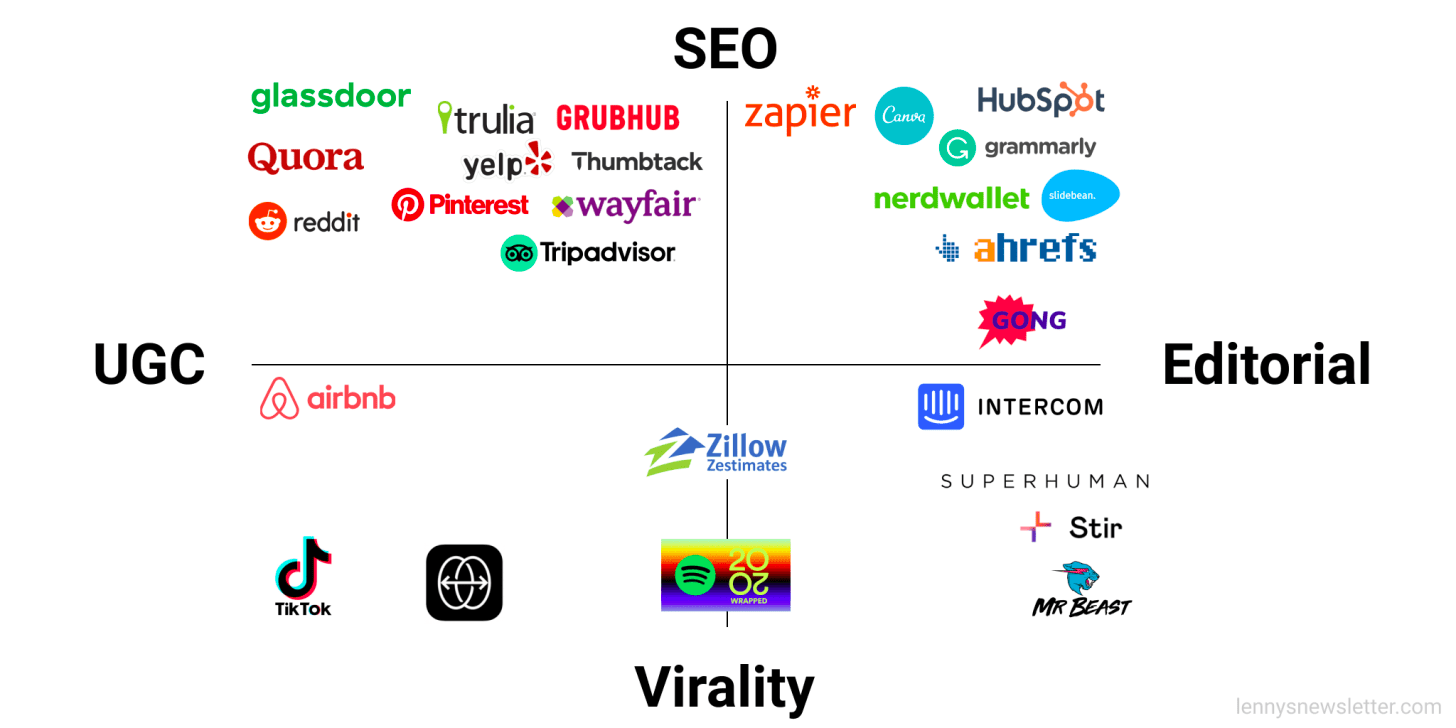
5 content-driven growth strategies
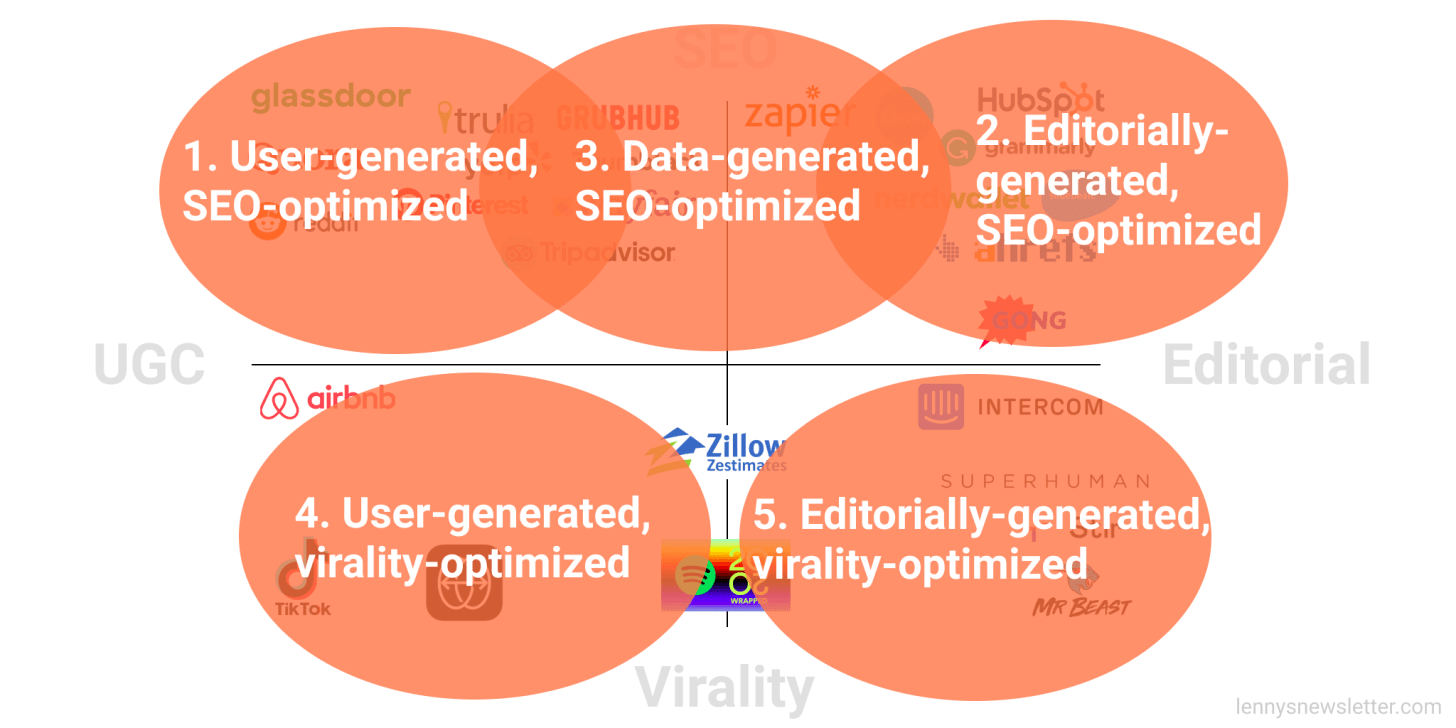
- User-Generated SEO-Optimized (UGSO): Your users generate public content which Google finds and surfaces in organic search. This primarily drives the growth of companies like **Quora, Glassdoor,** and Reddit.
- Editorially-Generated SEO-Optimized (EGSO): Employees (or contractors) of the company create content with the goal of ranking higher for certain keywords. This primarily drives the growth of companies like **Ahrefs, Slidebean,** and HubSpot.
- Data-Generated SEO-Optimized (DGSO): This strategy is the combination of UGC and Editorial – your company auto-magically generates thousands of individual pages off on your UGC and proprietary data. This primarily drives the growth of companies like **Thumbtack, Zapier, TripAdvisor, Yelp, and Grubhub**.
- User-Generated Virality-Optimized (UGVO): UGC content leads to users sharing that content with their friends, which then pulls those friends into the product. TikTok is the ultimate example of this (users sharing watermarked videos with each other), as is the Reface app. The edges of this zone include Airbnb listings (that users share with each other) and Zillow’s Zestimate (which home-owners pass around).
- Editorially-Generated Virality-Optimized (EGVO): Employees/founders make one-off viral content — also known as thought leadership or brand building. Content that the founder/company creates with the goal of having that content spread through WOM. This includes Spotify Unwrapped, along with virality-oriented creators like Mr. Beast, Stir’s one-off drops, and Superhuman’s early blog posts.
Editorially-Generated, SEO-optimized content
Asked companies that do this well (intercom, hubspot, slidebean, ahrefs) the following questions:
- What convinced them to put resources behind creating content?
- What kind of resources did they put into content initially?
- What do the content team and resources look like now?
- How do they operationalize the content creation?
- What advice would they give companies pursuing content-driven growth now?
High-level takeaways
- Start small: Start scrappy and play around with platform, topic, and style until you find something that works.
- Align on a clear goal: Is your goal to bring SEO traffic, to drive virality, to build your brand, or to enable sales? Make sure you’re clear on this.
- Hunt for opportunity: Research topics where searchers are underserved, and create content that delivers compelling, valuable, and differentiated value to those searchers.
- Give the reigns to someone who cares: The best content will be produced by people go truly care about the product/business/topic. Normally, the founders or a passionate full-time employee.
- Think long-term: Make sure there’s a clear path to this investment making a significant dent in your growth. Is the upside even worth it?
- Build a dedicated team: Eventually, you’ll need 5+ dedicated to this effort. Even more, if you’re doing video.
- Be patient: It took years for each company chronicled below to see significant payoff.
Stats:
**Ahrefs:** Have published 300+ posts with 1.5m visits/month. Most popular content:
- Top 100 Most Visited Websites by Search Traffic (2021)
- Affiliate Marketing for Beginners: 7 Steps to Success
- Top Google Searches (2021)
Slidebean: Have published 250+ videos with 160K visits/month. Most popular content:
- Boosted Boards: from flight risk to $70 million failure
- Zoom company story: How Eric Yuan defeated Skype
- How Spotify beat Apple at their own game
Intercom: Have published 870 posts and 262 podcasts, with 100k+ visits/month and 75K+ listeners/month, respectively. Most popular content:
- RICE: Simple prioritization for product managers
- Design workshops that work: how to get better at brainstorming
- What is a product manager and what do they do?
HubSpot: In HubSpot's early days, +30% of their customers would come from demand generated by our blogs. Also, if you look at their web traffic (organic, direct, referral), it’s bigger than a lot of other online business publications like TechCrunch, etc. It’s why they always think of their competition for online attention as other media outlets vs. other SaaS brands.
1. What convinced you to put resources behind creating content?
Slidebean:
“We noticed that the traffic coming from the “pitch-deck” keyword on SEM, was clearly our best type of lead. We doubled-down and very quickly, we maxed out the SEM keyword and were already the first result across our target geos. The problem was, of course, SEM traffic is expensive, and not enough (only about 5% of searches). So we started focusing on SEO, around startup-related keywords. This was the first major marketing breakthrough for the company.
That year, we produced a lot of content (~150 articles), and after a few months managed to get to 3-5 SERP rankings for most of the keywords we had focused on.
For the next two years, that traffic drove our growth. Eventually, though, we realized that getting to 1-2 rank was probably not going to happen regardless of how many articles we published, so we figured we had to find 'the next' search engine: YouTube.
Our first strategy on YouTube was SEO: creating videos that answer questions people are looking for (ie pitch deck).
Once we built an audience, we produce content focused on the YouTube algorithm: focused on high CTRs, high watch time, topics that appeal to broad audiences, and sharing. The thing with sharing is that we have little control on that decision.
Hubspot:
“HubSpot started publishing before they even had a product to sell.
At that time, Dharmesh had been creating content and building a community through Onstartups. Through that site's success, both Dharmesh and Brian saw how much of an audience you could grow to your content if it provided value. It's how Inbound marketing came to be — create assets of value for your audience vs. pay money to interrupt them via traditional advertising.
HubSpot grew through inbound marketing, creating things of value for our audience. There are two parts to our media strategy:
- Content to educate. People find this content through search, typically a blog post. Some of those people signup to get a more comprehensive piece of content - ebook, template, course.
- Content to influence. We create original stories for our audience around business trends, stories, and case studies featuring successful companies. These are across channels like video and podcasts. Our goal is to get a large audience for these stories”
Ahrefs:
“I'm not sure that this was a single well-thought-out decision to start producing content and allocate a certain amount of resources there. If I remember correctly, the process of ramping up our content operations was very gradual.
When I joined Ahrefs back in 2015 I inherited their already existing blog, which wasn't too popular back in the day even though they had a team of outsourced writers and published content a few times per week.
And because I always thought of myself as a "blogger" and "content marketer" I naturally started looking into ways we could make our blog better. And then it just kept escalating :)”
Intercom:
“For the four co-founders Intercom was not their first startup. They had come up through the Web 2.0 era so blogging and sharing lessons learned was just part of their DNA, particularly for Eoghan and Des. They were regularly sharing opinionated takes on what they had learned building software products and growing Intercom and other businesses. When I joined to establish a formal content team, about 2.5 years after Intercom was founded, they had built up a sizable reputation and audience with that strategy. Des wrote the first ~100 posts.
We initially focused on high-quality editorial content as a way to stand out from the SEO-driven approach which was the norm at the time. People were happy to promote and share that kind of content and on the flip side the customers who came to us through the blog and podcast spent more and hung around for longer, as they bought into the product and business philosophy we shared through our content. We gate some content as a way to generate leads but we always make sure it’s a fair value exchange i.e. for sharing your email you’re going to get a book that teaches you something meaningful about customer support and is well written and designed.
More recently we’ve been focused on enablement — making sure that the kind of content you see on the blog or hear on the podcast is available in the formats that are needed by our Sales team and other Marketing functions like account based marketing and paid acquisition.”
2. What kind of resources did you put into content initially?
Intercom:
“For the first year I was the entire team (some of the engineers used to jokingly call me “team blog”) but I had a lot of support from our brand design team and everyone at the company was incentivized to create content - whether that was writing blog posts, speaking at events, hosting podcasts, etc. We didn’t pay people or anything but by e.g. adding content creation to personal and team goals it was clear it was part of your job as a product manager/designer/engineer and benefited you in terms of career growth. So while I was the only person with content in my job title, we invested significant time and resources into it.”
Slidebean:
“Our YouTube team goes like this:Content/Strategy Manager: me.1 Lead Digital Animator, 2 Jr Animators — all full time2x screenwriters, who mostly take care of the research pieces (Company Forensics)Community Manager in charge of engaging with the Youtube audience and publishing the videosWe are publishing a video this week on how much we spent on video production- it came to ~$125K for 2020.”
Slidebean
“The first YouTube videos were edited by me, so they only cost a bit of time. We were lucky to have a couple of people on the team who had a background in video production, so we all carved out some time to experiment. This made video experiments very cheap. For the first year or so our videos sucked, and they didn't get any traffic at all, but we didn't suffer because we had spent very little money to produce them. This allowed us to do a trial-error game with Youtube for over 18 months until we finally found the format that worked.”
Ahrefs:
“Initially I had some budget to find proper talent to create content for our blog, plus I could "distract" our designers to make the pages of our blog look better.I can’t recall any tipping points when we decided to double down on our content marketing. We were moving in small steps and gradually improved things here and there.”
HubSpot:
“HubSpot's marketing strategy was 'inbound marketing,' so all early hires focused on creating some form of content - blogs, social posts, webinars, etc.”
3. What do the content team and resources look like now?
Slidebean:
“Our YouTube team goes like this:
- Content/Strategy Manager: me
- 1 Lead Digital Animator, 2 Jr Animators — all full time
- 2x screenwriters, who mostly take care of the research pieces (Company Forensics)
- Community Manager in charge of engaging with the Youtube audience and publishing the videos
We are publishing a video this week on how much we spent on video production- it came to ~$125K for 2020.”
HubSpot:
"We're very ambitious about having a real media company within HubSpot. Inbound/Media has always been how we've differentiated ourselves from most other SaaS brands.
We're so serious about this we bought a media company.
We break our media out across teams who educate and teams who build influence. We have teams for:
- HubSpot's Blogs (a mix of education and influence)
- HubSpot Content Offers (ebooks, templates, courses)
- HubSpot Stories (original stories featuring business trends, case studies, and in-depth breakdowns of successful companies)
- HubSpot Youtube (a mix of education and influence)
- HubSpot Audio (podcasts, Clubhouse).
- Daily Newsletter (ran by The Hustle)
- Trends (premium content subscription ran by the Hustle)
- Distribution (to ensure we have the right promotion plan for the above assets)”
Intercom
“We’re a team of 10 based in Dublin, Ireland (with 3 additional positions opening this quarter ).
There’s 3 pillars or sub-teams within the team:
- The Audiences pillar think about who we’re actually selling our products to which is mostly customer support and customer success leaders these days. Their job is to create great top of funnel content that will attract that audience but also to really understand where they get their information from, what conferences they attend, who are they influenced by etc.
- The Enablement pillar are focused on taking that content and reworking it for the needs of Sales and other Marketing teams e.g. taking a research report we’ve commissioned and turning it into slides that account execs can use in pitch decks. Enablement also looks after all our customer evidence - from the full blown customer stories we publish on the website to securing permission for logo usage in our other marketing materials.
- The Channels pillar are the specialist functions that work across both audiences and enablements - right now that's SEO and our podcast.”
Ahrefs
“We have Josh, who is in charge of our blog content and two in-house marketers who are creating content together with Josh: SQ and Michal.
Patrick is responsible for slightly more technical content on our blog, but he does it part-time, since he also belongs to our product team and his feedback is needed there too.
We also have Sam, who is in charge of our video content.
He has three people helping him with video production.
And we have one graphic designer, who takes care of all the needs of our marketing team.”
4. How do you operationalize the content creation
HubSpot:
“We've created a pretty great model around how SEO-orientated content works.
We have full-time analysts that help us build quarterly editorial calendars across all blogs. Those editorial calendars include a mix of search-first posts and posts focused on garnering influence.
We know how much net new search traffic is available for new editorial calendars, so we know roughly how much net new traffic we can expect to acquire. Think of this as a quarterly TAM, so we know if/when we're running out of net new traffic we can acquire on certain content topics.
We also have a team that gets notified about posts that are falling in traffic and then optimizes them to improve their traffic and conversions.”
Slidebean:
“These days we use this tool to decide what videos to make. I partially summarized how we got started and how we operate today in these two YouTube videos:”
5. What advice would you give companies pursuing content-driven growth?
Ahrefs:
“I would advise them to contemplate the difference between “viral content” and "SEO content" and decide which type would work better for them.
In my opinion “SEO content” is a lot easier than “viral content.” And the primary reason for that is finding topics to write about. With “SEO content” you find your topics via keyword research, where the popularity of Google searches helps you decide what to write about. While with "viral content" you don't have such a straightforward source of content ideas. And your success largely depends on your creativity and ability to come up with unique ideas that would resonate with your industry.”
Hubspot:
“A company early in their growth, looking at our media group above, might feel a little defeated, "how can I ever compete with that?"
HubSpot started with a blog, and that was our core focus for a long-time, years. We invested in new channels as we mastered existing ones.
There is always room to be better or different. You need to decide on the media channel that best maps to your audience and then work on your 'better or different’.
The thing brands need to realize is they're not only competing with direct competitors. They're competing with every tweet, post, podcast that is vying for some of their audience's precious time.
You need to publish media that is great. Good no longer gets you results.
I would also be intentional about the goals you want your media efforts to serve. Most companies I speak with initially care about how media can drive demand for their products or services. But, they're unsure of how to quantify what impact it could have.
For example, if you want to generate demand through blogging, most of it will come via search. You can do a rough model to see how much search traffic is available for topics you'll cover, and using rough conversion rates, what's the TAM of demand for those topics.
Being intentional about the goals ensures everyone is aligned on the purpose of the different media you'll create. Maybe you want a podcast with a large following to help influence your audience. Maybe you want a successful blog because you think it can equate to 20% of the demand you need to generate for your product or service. And so on.
Once you've decided on those goals, invest in being great at one thing, mastering it, being better or different, and then continuing to build upon that success with new channels.”
Intercom
“Content marketing initiatives don’t generate returns as quickly as other forms of marketing, so be sure to hold your nerve. But once you start to see an audience engage with a particular format or channel, double down on it quickly. And don’t be afraid to focus on that particular medium rather than trying to do everything at once i.e. if you’ve started to have some success with a podcast don’t suddenly start to try spinning up a YouTube channel.. As I like to say content is a super-tanker not a speedboat.
Slidebean
“Video content is expensive, and a long-term bet! It will take months to create an audience, and that means dozens of videos. If you have to hire someone for the production, it will be an expensive bet and one that few companies will be able to afford. Even if you're doing it internally/yourself, it's going to take away a big chunk of your time. Most startups need customers faster, in a way they can more directly control for scale, and Youtube is not ideal for that.
When it's working, it's a real beauty. We've seen people engage and recall our brand better than ever (look at what happened with your tweet, which drove ~5K visits to our website, THANKS!). That power of a brand is something that we hadn't really seen with our own eyes until now, and we probably should have focused on it a lot sooner.”
🎁 Bonus: How Webflow uses video content to increase new user activation
The four companies we looked at above use content with primarily one goal: drive top-of-funnel traffic. Webflow does this too, however, even more interestingly, they use content in a very different way: to increase new user success. They create compelling videos to help users be successful with Webflow.
What’s interesting about this strategy is that unlike SEO-based growth, any (B2B) company can leverage video to increase activation or conversion. There’s a lot to learn from Webflow’s success with video content.
To learn about Webflow’s approach, I got in touch with Mischa Vaughn, Director of Content & Communications at Webflow, who very generously agreed to share learnings on behalf of the Education team at Webflow. Thanks Mischa and the Education team!
Q: Why did Webflow invest in content so early?
“Webflow's visual interface gives designers the same control over the same exact CSS properties used by Apple, Google, Stripe, etc. It's no watered-down interface. We know that. Thus we made a big investment into our content when we created Webflow University, to help designers of all skill levels learn to use our powerful platform for free.”
Q: What inspired you to invest in video specifically?
“Video was always a high priority for Webflow. Even on the day we launched, one of the founders created a full-site build walkthrough that was crucial in onboarding customers. But one day in 2016 a passionate member of our community posted his own tutorial video that was at a much higher production caliber, and we immediately knew from the community's positive reaction that this was a direction we needed to adopt. Eventually, we hired this person to lead our Education team.Webflow University's course structure creates a natural progression to becoming more and more of an expert in using Webflow.”
Q: What was the video content team like initially?
“One person (a power user) was hired to run Education and video was always part of it. It was one person full-time, but he also worked closely with a few other folks in support to write documentation and guides.”
Q: What impact have these courses had on growth?
“The people who enroll in our courses are much more likely to become subscribers to the service. New courses help us find new people and help them take on specific use cases or introduce them to new features.”We've also made sure our non-tutorial content features inspirational examples of the product and helpful advice and resources for designers (our target audience). We keep our social channels fun and engaging, with the idea of presenting the brand as a friend you want to hang around. This mix of value and an engaging tone have helped make a compelling case for the millions of people that use Webflow.”
Q: What does the content team look like now?
“Since 2016 we devoted a substantial budget and headcount to our Education efforts. This includes building out a devoted team, modern camera and recording equipment, a sound-proof studio, and custom music and animation. Our Education team features a mix of producers, editors, and designers. Our content marketing team works with a mix of freelancers and agencies, and we have plans to double this team's headcount in the coming year.”
Q: Any advice for companies thinking about pursuing this?
“If you're going to invest in content, especially video, you need a devoted team with a clear charter. Find someone to lead this team, build a distinct vision and voice, and give them plenty of support.”
Increasing virality
You should only invest in virality if you are confident that virality will be your primary growth engine for your product. As opposed to (1) performance marketing, (2) content, or (3) sales. As I’ve written about previously, most companies find the vast majority of their growth from just one of those four growth engines, and until you’ve scaled your core engine, time spent optimizing a secondary or tertiary engine is rarely time well spent.
How do you know if your product is well-suited for virality?
Virality is a natural fit for your product if:
- Your product is better with friends or colleagues (e.g. Snapchat, Slack)
- The product is innately fun or rewarding to share (e.g. travel photos, homes for sale, incidents nearby)
- Your product is remarkable — something worth remarking about.
Performance Marketing is a natural fit for your product if:
- You generate revenue directly from new users (e.g. purchasing a product, subscribing to a service), which you can then use to fund more marketing
- Customers are not naturally going to be looking for your product, and thus you have to come to them (e.g. a new DTC brand)
Content is a natural fit for your product if:
- Your users naturally generate public content (e.g. reviews or answers to questions) when using your product, which you can use to attract new users
- You have a lot of unique data (e.g. restaurants in Seattle, plumbers in Phoenix), which you can turn into rich auto-generated pages
Sales is a natural fit for your product:
- Customers have high average order values and high LTV
- Your product requires hand-holding to be successful with
What is virality?
Virality is simply growth that stems from your existing users. Each user brings in on average more than one additional user (directly or indirectly) and thus creates exponential growth.
To put it another way, the fuel for your future growth is existing users (vs. money, or content). Classic examples of products that grew primarily through virality are Facebook (inviting friends), Tinder (word-of-mouth), and Dropbox (incentives).
Virality of often measured by something called the “K-factor” which is a fancy term for measuring the number of new users that each existing user drives:
i = number of invites sent by each customer c = percent conversion of each invite k = i * c
Note, there’s one additional implicit variable in this formula: the number of active users. Your active users are the fuel for the viral growth engine (i.e. they send the invites), which will become important when we look at increasing virality later.
Different types of virality
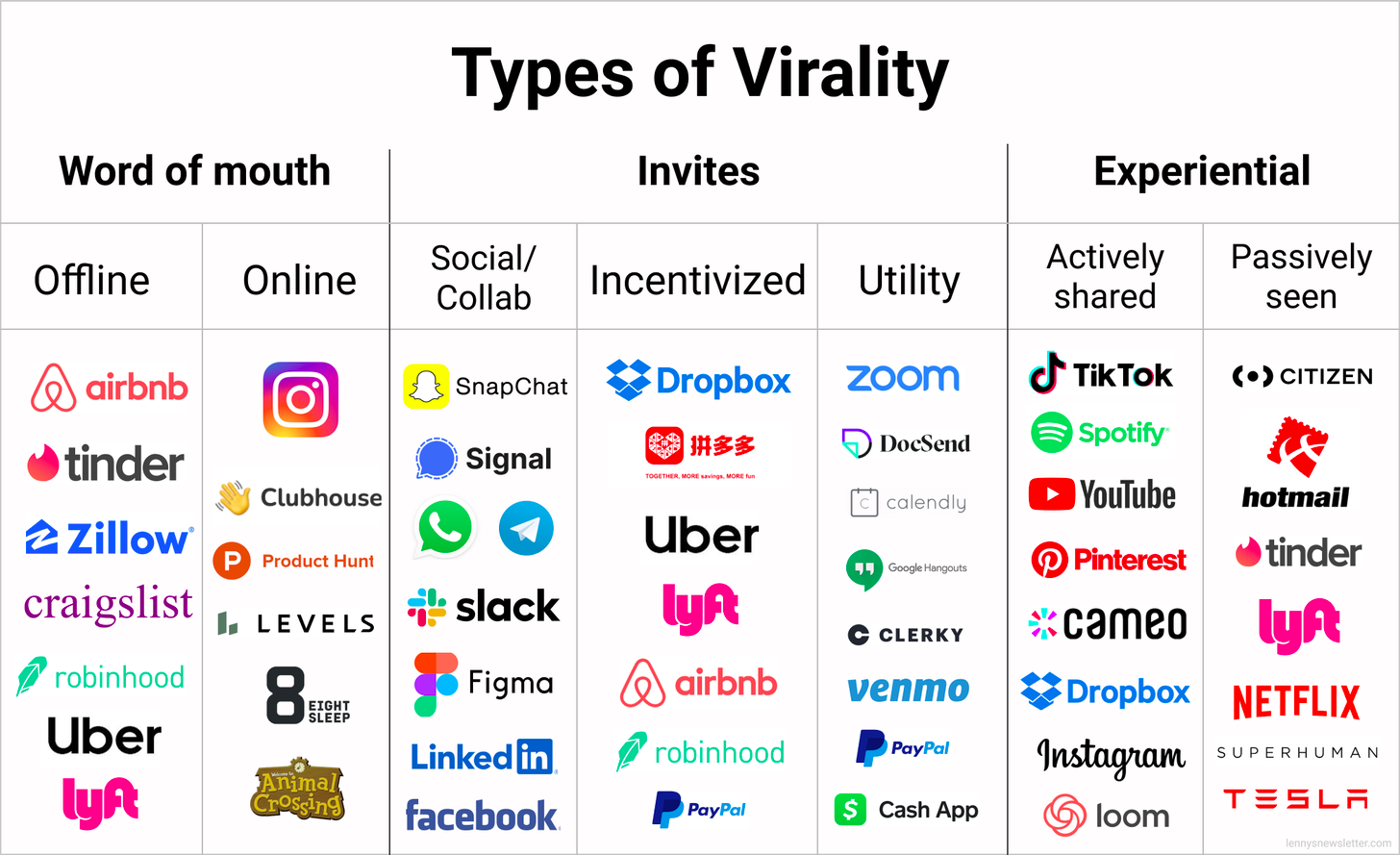
When you think virality, you probably think about getting asked to invite your friends, like Snapchat. But the concept of virality is broader. Any mechanic that gets your existing users to bring in new users is a form of virality. There are three forms of virality, with 2-3 versions of each, for a total of seven types of virality:
- Word of mouth virality – hearing about it from friends or colleagues
- Offline: while chatting with a friend or colleague, eg Airbnb
- Online: seeing it mentioned on social media, eg Clubhouse
- Invitation virality: being actively invited by friends/colleagues
- Social/Collaboration: to connect with friends or colleagues, eg WhatsApp, Figma
- Incentivized: Because one of both sides will benefit, eg Pinduoduo
- Utility: To accomplish something on-off with friends or colleagues, eg Calendly
- Experiential virality: seeing the product in action
- Passively: seeing the product as you go about your day (eg: Citizen)
- Actively: Being sent a piece of content from the product, which leads you to the product
How to increase your product's virality?
you have three levers at your disposal:
- Increasing sharing rate: More word-of-mouth, invitations, or experiential serendipity
- Increasing conversion rate: Getting new users through your funnel at a higher rate
- Increasing engaged users: Getting more users, and re-engage existing users
Of these three, the first bucket is the most interesting, so let’s focus there.
Get your users to share your product more often
In order to get your users to share your product more often, I’ve found six distinct strategies:
- Nurture organic word-of-mouth
- Incentivize word-of-mouth and inviting
- Make the product better when more friends or colleagues use it
- Make the product only useful when using it with friends or colleagues
- Generate content that users want to share with friends
- Increase experiential serendipity
Let’s explore each of these tactics one-by-one.
1. Nurture organic word-of-mouth
Examples of word-of-mouth virality:
- Tinder: Users tell their friends about Tinder after finding great single people on it
- Airbnb: Guests share their travel stories/pictures, mention they stayed in an Airbnb
- Zillow: Homeowners tell their homeowner friends that you can track the price of your home on the site for free
- Clubhouse: Users constantly posting about what they heard in a room
- Levels: Customers constantly posting about what they learned about their body
To optimize organic word-of-mouth virality:
Word-of-mouth is primarily driven by remarkable experiences (an experience worth remarking about), so start there.
- How might you create a remarkable experience for your users?
- How might you get non-users with a large following to experience your remarkable product? e.g. free accounts for influencers
- How might you make your users feel special or high-status by showing off they have the product? e.g. waitlists, invites
- How might you make it easier for your users to spread the word? e.g. share buttons, easy to find links
- How might you simply ask people to spread the word? e.g. try adding copy to the product
2. Incentivize word-of-mouth and inviting
Examples of incentivized word-of-mouth and/or invites:
- Pinduoduo: The more friends you invite, the higher the discount
- Uber, Lyft, Airbnb: Free credits for referring new users
- Robinhood: Move up the waitlist by inviting friends
- Dropbox: Free storage space for you and your friend
- PayPal: Free money for inviting new users
To optimize incentives virality:
People respond to incentives — what’s it in for them to spread the good word about your product?
- How might you create a selfish incentive for users to bring in new users? e.g. free money, free storage
- How might you create an altruistic incentive for users bringing in new users? e.g. save your friend money
- How might you create FOMO which motivated users to send invites? e.g. a limited number of invites like Gmail, Clubhouse, Spotify, Superhuman, OnePlus
- How might you increase an existing incentive? e.g. double your existing bonus
- How might you surface your existing incentives more prominently? e.g. a large banner, more entry points
- How might you make it easier for your users to know who to invite? e.g. import contact list, connect to Twitter to find friends
3. Make the product better when more friends or colleagues use it
Examples of products that are better with more friends/colleagues
- Slack, Figma, Datadog: Colleagues invite colleagues to get work done
- Snapchat, WhatsApp, Signal: Friends invite friends to communicate in this new way
- Facebook, LinkedIn, Instagram: Friends invite friends to share content
- Venmo, Paypal, Cash app: Friends invite friends to be able to send/get money
- Reclaim, Clockwise: Colleagues invite colleagues to optimize their calendars.
- Airbnb: Allowing you to add guests to an itinerary so that they can all see the details.
To optimize product experience with friends/colleagues virality:
This is the most classic way to create viral growth and is hard to engineer after the fact. But there are certainly ways to optimize it.
- How might you make the user’s life easier if their friends or colleagues were also using it? e.g. easier to share content, a secure communication channel
- How might you make the user’s life more enjoyable if their friends or colleagues were also using it? e.g. fun way to share content
- How might you remind the user about the benefits of their friends/colleagues being users? e.g. show missing friends/colleagues
- How might you make it easier to invite friends? e.g. import contact list, collect to LDAP
- How might you make it easier to figure out who to invite? e.g. smart sorting of potential friends
4. Make the product only useful when using it with friends or colleagues
Examples of products that are only useful with friends/colleagues
To optimize a multi-player product virality:
This includes products that are utilitarian, and is even harder to engineer after the fact. But it is worth thinking about this when you’re in the idea stage.
- How might you make a single-player product multi-player?
- How might you better promote your product to the receiving user?
- How might you make it easier for new users to try out your product?
5. Generate content that users want to share with friends
Examples:
- TikTok videos (with a watermark or link to TikTok)
- Instagram photos, hosted on Instagram
- YouTube videos, hosted on YouTube
- Pinterest boards, hosted on Pinterest
- Spotify Wrapped, pointing to Spotify
- Reface, with a watermark
- Airbnb listing, pointing to Airbnb
To optimize content-driven virality:
This form of virality comes from content generated through the product, which your users can’t help but share with their friends.
- How might you enable your users to create remarkable content, e.g. TikTok creator tools
- How might you create remarkable content for your users yourself, e.g. Spotify Wrapped
- How might you make it easier to share the content you already have, e.g. share buttons, Twitch clips, Spotify Wrapped adding a "share to Instagram Story" feature
- How might you make it clearer where the content came from, e.g. adding a watermark or a link back
- How might you make your content available publicly, e.g. FB making posts public by default
6. Increase experiential serendipity
Examples of products that grow through experiential serendipity:
- Citizen: A notification comes up about something happening nearby, which you show your friends.
- Hotmail, iPhone, Superhuman: A signature in the emails, e.g. “sent by iPhone“
- Tinder: A match appears while you’re hanging out, and you ask your friends for their opinion.
- Netflix: You and your friends watch a show together at someone’s house.
- Uber, Lyft: Sending your friends your ETA in-app, and Lyft pink mustaches.
- Spotify: Sharing “What I'm listening to” to your Facebook feed
- Dropbox: Making it easy to share a URL to a local file
To optimize experiential serendipity virality:
This form of virality is when people see the product in action during the normal course of events.
- How might you publicly show that a friend or colleague is using the product? e.g. inline signature block, pink mustaches
- How might you allow users to share interesting information from the app? e.g. their location
- How might you send interesting push notifications during the day?
- How might you make your product bring people together in the real world?
Increasing Conversion Rate
What you want to focus on here is the funnel of a (1) mention or invite being sent —> (2) all the way to that receiving user sharing their own invite or mention.
Increase Engaged Users
One final strategy for increasing viral growth is to increase the number of engaged users — users who in turn will bring in new users. You’re essentially putting more fuel on the fire.
Examples of increasing user engagement:
- Facebook’s People You May Know, which increased the engagement of both users
- Facebook letting you to tag friends in photos, which pulled those friends back into Facebook
- TikTok duets feature, making it easier to create multi-player content
- Venmo social feed, keeping users checking the app
- Stories, across Snapchat, Instagram, Twitter, etc.
Winning at SEO
How should early-stage founders overcome the SEO advantages of incumbents?
The strategy is actually simple: Create many valuable web pages in a scalable and cheap way.
Let’s break this down:
1. Create many valuable web pages
SEO is all about creating web pages. Lots of web pages. But not just any web pages. The secret is to create pages that are as helpful to search engines as they are to your users. At the end of the day, SEO is creating a product for a pretty stupid bot. Give it the content it wants and make it as easy as possible for it to consume it.
2. Make it scalable and cheap
Blog posts, title tag tweaks, and keyword stuffing aren’t scalable and require a ton of manual effort and upkeep. Instead, you’ll want to create pages programmatically, full of content that Google is expecting – engaging, targeted, and fast.
To do these two things well, you’ll need to answer three questions:
- What kind of pages should I create?
- How do I create these pages programmatically?
- What features do I need to create on each page for Google to love it?
Let’s tackle each of these one-by-one.
What kind of pages should I create?
To answer this question, start by asking yourself: What are people on Google searching for that my business is uniquely able to answer?
Write down all of the unique pieces of information that your business has access to. Strava has popular running routes, Airbnb has unique listings, Pinterest has user-generated images. What do you have?
What you are looking for is unique and valuable data points that your business/product already has that can be turned into useful web pages. For example, Thumbtack has thousands of pages like the best electricians in Seattle, using data that their pros input.
As an example, say we’re a startup that sells flowers (let’s call it “Petal to the Metal”). We should not be trying to rank for keywords such as “flowers” or “red roses”. Not only are those terrible keywords because they have no user intent, they’re also extremely competitive. Instead, you want to create pages that capture a specific and valuable user intent. SEO isn’t about capturing the top keywords — it’s about capturing the long-tail of keywords.
Sure, you won’t catch the white whale of “flowers”, but if you can capture all of the keywords that follow a common formula such as “{flower type} for sale in {location}”, you’re going to be capturing valuable, high converting traffic and see a much higher ROI. Your goal should be to niche down when you start, and as you grow in authority, create more pages and move into new keyword spaces.
So, as a next step, figure out what niches and keyword spaces could work best for your business. How? Creativity, imagination, and stealing ideas from your competitors. Some of the keyword spaces you’ll want to move into are going to be painfully obvious. In the case of Upsolve, which is a non-profit startup that helps individuals file bankruptcy for free, the obvious space we wanted to move into was “how to file for bankruptcy in {state}”. When it’s not obvious, you’ll have to get creative with the data that you have at hand, and figure out what type of searches users are performing that (1) you can answer and (2) will lead to intentful actions (e.g. sign up, book, purchase).
When you consider different keyword spaces, it’s important to look at search volumes for those keywords. A few tools I recommend are Google Keyword Planner (free), SEMRush ($), or Ahrefs ($).
How do I create high-quality pages programatically?
There’s an oft-repeated, and accurate, phrase in SEO circles: Content is king. Simply put, the more high-quality content that you have, the more traffic that you get. There’s a reason why Nerdwallet’s entire SEO strategy is centered around producing extremely high-quality content.
There’s also a reason why every single recipe website you’ve ever visited has that long and obnoxious intro text about the recipe — text is the primary signal that Google uses to rank your pages.
Every page on your website is a piece of content, and your goal is to produce as many high-quality pieces of content as possible. But, unlike Nerdwallet or recipe websites, you don’t have the time or resources to write detailed blog posts and long-winded stories about how much your dog loves your lemon crinkle cookies.
Instead, you’ll want to create the content programmatically, using the data points that you’ve outlined in the previous exercise, and then apply it to the keywords that you’re targeting. Think of your page as a very elaborate page from a Mad Libs, and you’re using internal and publicly available data to fill in the blanks.
Using the data points you noted in the previous step, sketch out your ideal web page. Create a page that has all of the information you have at your disposal, for the keyword that you’re trying to target. Here’s a sketch I made for our flower startup:
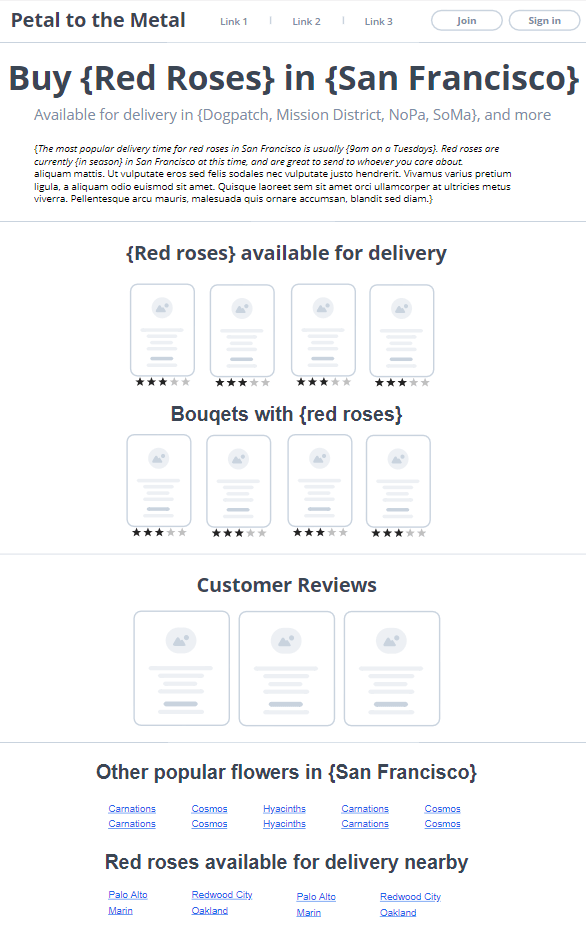
If you have access to user-generated content, this is the best kind of content to use — it provides natural, keyword-rich content that is useful to both your users and Google.
As you create this page, make sure to think about how these pages scale based on the quality of the data that you have. Since we’re creating one template to generate potentially hundreds or thousands of pages, you need to think about what the pages look like in the best AND worst-case scenario. For example, Strava’s San Francisco running routes page is going to look a hell of a lot better than their Fresno one, because of the amount of quality data that they’ll have from their users. You’ll want to make sure that you can maintain a good bar of quality on your lesser popular pages. If the pages don’t meet your minimum bar of quality, cut them out by blocking Google from accessing them
What features do I need to create on each page for Google to love it?
As important as content is to SEO, there are also a couple of important SEO tricks to keep in mind when designing your pages. This section will be more prescriptive and tactical than previous sections, but will introduce some SEO fundamentals that will help you avoid the most common SEO mistakes:
- Title tags: You should always have a relevant and unique title tag on every single page. This is literally the most important SEO tag that you can have. It’s also one of your primary levers of optimization if your pages aren’t performing well. Your title tag is usually going to be whatever keyword space that you were designing for in the previous exercises.
- Internal linking: This is far and away the most overlooked SEO feature. This is the biggest optimization recommendation that I make to every company that I’ve ever consulted for. Internal links are links that you have on your page that point to a different page that is still on your domain. This is extremely important, as Google uses internal linking as a means of determining the hierarchy of information on your site (the more internal links pointing to a page, the more important it is), and how they discover new pages on your site. It doesn’t matter how great your content is if Google can’t find the page. Typical solutions to internal linking are recommended products, nearby locations, and “other {thing} people liked.”
- Robots.txt: The robots.txt is used to tell crawlers where they’re allowed to crawl and not crawl on your site. This is important because you probably don’t want Google crawling every single page of your website. More pages are better, but not all pages bring in valuable traffic. Make use of the robots.txt to set up guardrail where Google is allowed to crawl. The more time that Google spends on the pages that you care about, the better you usually perform. After all, Google has a finite amount of resources it will spend to crawl your page. If it’s wasting all of its time crawling a useless set of pages (such as user profile pages), it won’t have time to get to the pages that matter.
- Javascript rendering: Google has the easiest time reading a page if it’s served in plain HTML. There’s quite a bit of debate in the SEO community about how well Google is able to render Javascript, but the way I see it, you want to make it as easy as possible for Google to crawl your pages. Making Google put in extra effort to view the content on your page is just a bad idea. If you care about SEO at all, figure out a way to make sure that your logged-out pages are served server-side. You can do your fancy Javascript stuff once a user signs in.
- Schema markup: If you’ve ever wondered how search results sometimes include fancy features on the result pages, such as the number of stars your product has, inventory, or the number of reviews, it is done through schema markup. There are possible many enhancements, so I’ll just point you to Google’s official documentation.
There’s a lot more to consider when working on SEO, but I’ve touched on what I believe are the most important and impactful elements to get right. To go deeper, definitely do your own research, starting with Google’s documentation.
Closing Thoughts
Don’t overcomplicate your SEO strategy. Your goal should be to get from 0 - 80%, and that’s usually more than enough to get competitive in your space. Get your pages live and out there, make sure you’re targeting the correct keywords, and get your SEO fundamentals in place (e.g. title tags, internal linking, high-quality content). With this, you’ll be on your way to winning organic search.
A few final tips and reminders:
- Not all keyword spaces are winnable. Know which ones aren’t (travel), and hold off on a serious SEO strategy until you’re further along.
- Create pages that are niche, and once you have a foothold go up the funnel.
- SEO is creating high-quality content at scale. Maintain that minimum quality bar, and do it cheaply. Your time is valuable, spend it wisely.
- Simple is better. Don’t overcomplicate.
- Traffic is a vanity metric. Traffic that converts is what you’re after. It’s easy to forget when you’re chasing traffic highs.
- The faster your site is, the better. Your users don’t like slow websites, Google doesn’t like slow websites.
Bonus: SEO myths
- You don't need to build backlinks: Don’t worry about backlinks. They’re probably not holding you back (lol), and they’re unlikely to be the game-changer that you think they’ll be.
- It’ll take not 6 months for SEO to work: This number is probably closer to 3 months, but if you’re doing things right and are in the right space, you’ll see progress within a month.
- You don't need to hire a full-time SEO to get it right: You don’t. SEO is not that hard. Especially if you’re a small startup with complete control of your entire site. Find a trustworthy consultant that can point you in the right direction and have them meet with your engineering team. Some of the most impactful experiments and features that I’ve helped launch came from the designers and engineers on our team. Get your hands dirty, and I assure you that it’s easier than it seems.
- You can run SEO experiments: Here are two great references for SEO experimentation. Keep in mind that just because you can run experiments, doesn’t mean that you should. Experiments are run when you’re unsure about a change or trying to optimize something. If your SEO isn’t in good shape, it’s smarter just to ship.