Answering the "Why Now" question
Source: here
Is "Why now" important?
Short answer:
It gives you a better shot at building a large and enduring business, but it isn’t absolutely essential. Companies like SpaceX, Airbnb, Pinterest, DoorDash, Instacart, Facebook, and Netflix had little why now. But these companies all executed like crazy in a large market, and in many cases succeeded because they rode a new trend later in their life (e.g. Netflix and broadband).
Long answer:
With the help of a bunch of smart investors, Twitter, and my own research, I’ve collected why nows for dozens of businesses (see below), and through this research, I’ve come to some unexpected conclusions:
- You can build a massive business without an immediate why now
- A why now is helpful because it creates two distinct advantages
- There are five sources of why now
- Your why now can emerge later
- You can still absolutely fail with an amazing why now
Why now for successful companies?
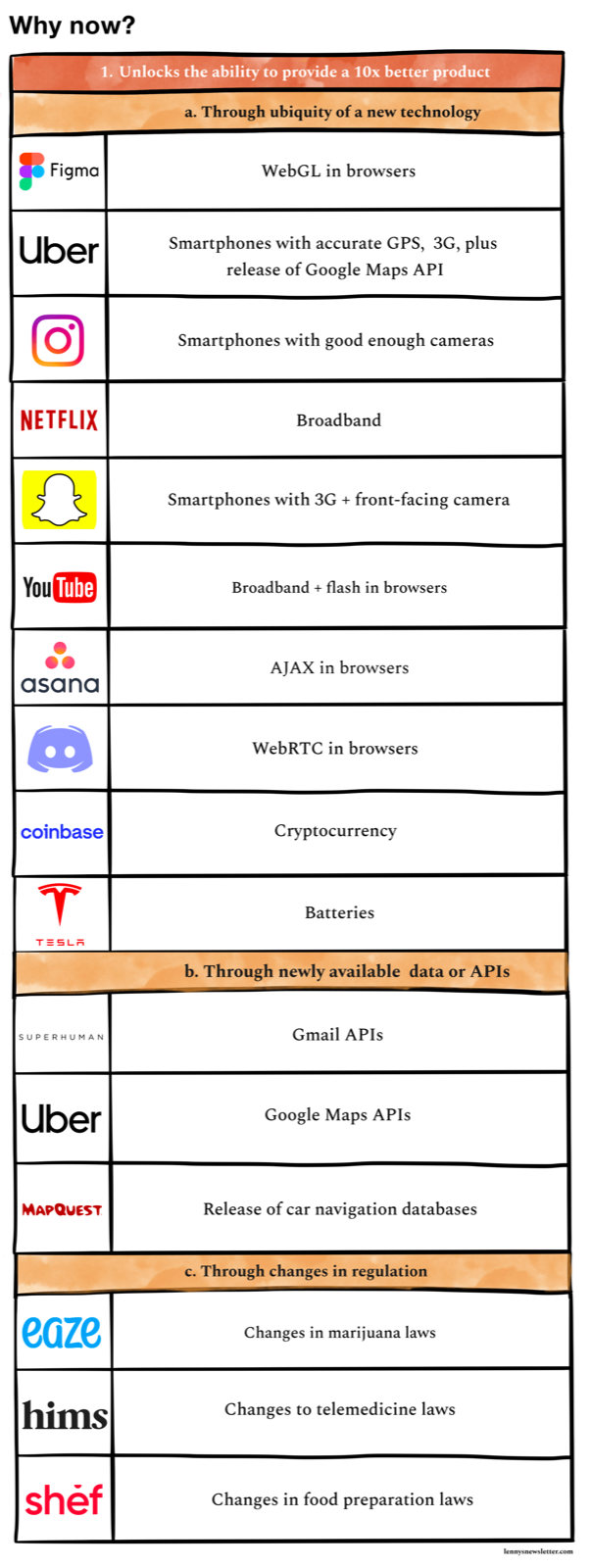
A strong 'why now' creates two advantages
1. It can unlock the ability to provide a 10x better product
- WebGL in browsers: Figma
- Adoption of fast broadband in homes: Netflix, Twitch, YouTube
- Smartphones with accurate GPS, 3G, and release of Google Maps API: Uber and Lyft
- Good enough camera on smartphones: Instagram
- Changes in legality of marijuana: Eaze
- Release of Gmail APIs: Superhuman
- Release of car navigation databases: MapQuest
- Advancements in battery technology: Tesla
2. It can create a new untapped market need
- Acceleration of fintech: Plaid
- Acceleration of e-commerce: Shopify, Etsy, Pinduoduo
- Acceleration of the number of online businesses: Stripe, Google, AWS
- Acceleration of e-sports: Twitch
- Increase in devices per person: Dropbox
- COVID-19: Zoom, Peloton, Clubhouse, Hopin, OnlyFans, etc.
“I think of markets like currents, not whether or not they are big bodies of water. The stronger the current, the higher your chance of success. ‘Why now’ is often a description of a current— a macro one. The move to cloud, the employment/cultural trends driving the creator economy, etc. are all tremendous why nows.” – Sarah Travel, Benchmark
BUT, you can build a massive business without an immediate why now
Many successful companies had no strong why now when they got started, and instead succeeded mostly through the sheer will of their founders and great execution:
- SpaceX
- Airbnb
- DoorDash
- Instacart
- GitLab
- Cameo
- Duolingo
- TripActions
- Netflix (DVD version)
“Of course any startup benefits from the tightest definition of why now—if the company literally couldn’t have existed without the ‘why now.’ Platform, technology, regulatory shifts are all examples of this. Uber would not have been possible without smartphones + GPS. Salesforce wouldn’t have been possible without maturity of web browsers + widespread broadband.
But great companies can also just ride one or more trends to success. The company clearly could’ve existed without these trends but wouldn’t have been nearly as successful.”
—Bill Trenchard, First Round Capital
Of the companies with weak why nows above, they each succeeded in large part because they were able to build a 10x better product, irrespective of timing:
- Airbnb: Cheaper and more interesting accommodations
- DoorDash: Better way to get food
- Instacart: Better way to get groceries
- Pinterest: Better way to organize design ideas
- SpaceX: Better and cheaper way to go to space
“At the highest level, truly disruptive startups typically differentiate or innovate across one or more of three dimensions:
- Product - Most common thing investors anchor on is product or technology innovation
- Business model - Less appreciated, the way that a company charges for or monetizes a product or service
- Distribution - How the product gets in the hands of customers
Just doing one really well will generally lead to success. If you can innovate on two or three simultaneously, you often become a truly transformative company.”
– Bill Trenchard, First Round Capital
Your why now can emerge later
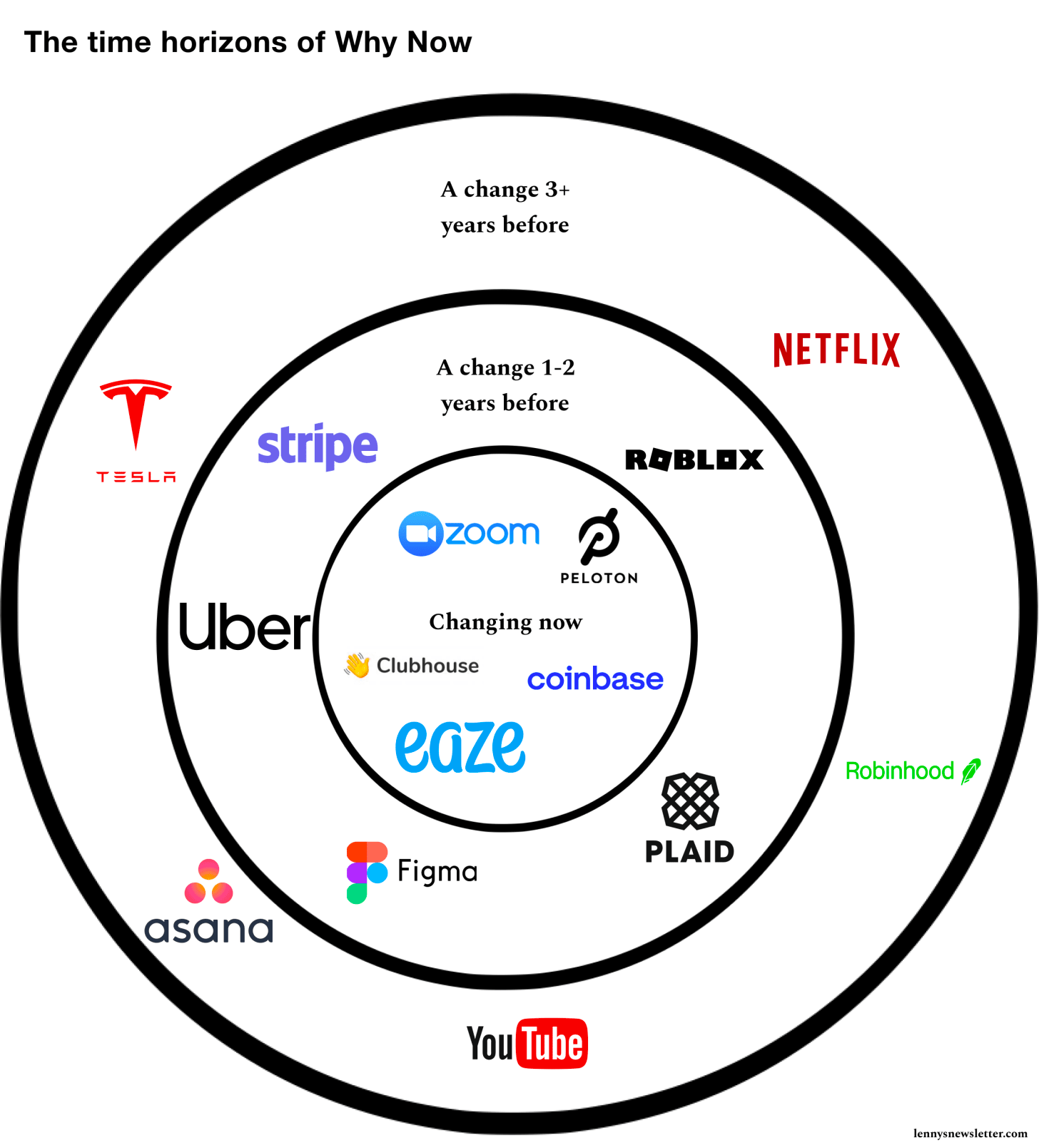
For many companies, there was no real why now when they got started, but the world changed around them and gave them a huge wave to ride.
PayPal started as a way to transfer money between PalmPilots, but during the course of building it, just one feature stood out: web payments. The PalmPilot apps were just an excuse to start and build, giving them a chance to discover this bigger opportunity. The random walk to product market fit does happen.” —Garry Tan, Initialized Capital
Additional examples:
- Netflix, and broadband adoption
- Facebook, and growing digital camera adoption among college students
- Airbnb, and the 2008 recession
- Zoom/Peloton/Shopify/Instacart, and COVID-19
There are five sources of why now
Building on the two distinct advantages that a strong why nows bring, it appears that there are five sources of why now:
Unlocks the ability to provide a 10x better product:
- Ubiquity of new technology (e.g. Figma and WebGL, Netflix and broadband, Tesla and batteries)
- Newly available data or APIs (e.g. MapQuest and navigation databases, Superhuman and Gmail APIs)
- Changes in regulation (e.g. Eaze and marijuana regulation, Cerebral and loosening telemedicine restrictions)
Creates a growing untapped market need:
- Change in people’s behavior (e.g. Shopify and the rise of e-commerce, Plaid and the rise of fintech)
- Change in people’s beliefs (e.g. Coinbase and belief in crypto, Robinhood and the lack of trust in big banks)
You can absolutely fail even with an amazing why now
“As an example, a lot of people (me included) thought that there was an inflection point happening with respect to drones back in 2010. I forgot that the FAA’s regulatory hurdles would keep adoption properly in check, so even though we were seeing dramatic changes to product capability and even business model possibilities, there was not going to be exponential increase in adoption until some of the regulatory hurdles were taken down.”
- Ann Miura-Ko, Floodgate Capital