7 Powers - Commoncog Members Only Summary
Books · Business · Source
7 Powers is arguably the best book on business strategy currently available today.
This is a summary of a 🌳 tree book, arguably the best book on business strategy currently available. 7 Powers is very good, remarkably well written, but deceptively easy to read; the framework that the book develops is ‘simple without being simplistic’. To my mind, 7 Powers supplants Michael Porter, shores up several holes in Clayton Christensen’s disruption theory, outshines Bruce Greenwald’s Competition Demystified, and makes Richard Rumelt look like a child playing with strategy toys. If you must read only one book on business strategy, make it this one.
This book summary is part of a members-only series on competitive arbitrage.
The central problem that business strategy is supposed to solve is easy to state: how do you prevent your business from sucking?
Most businesses in most industries eventually suck. We’ve already covered the fundamental reason why: the short — if simplistic! — answer is ‘because competitive arbitrage’ — good businesses have high profit margins; high profit margins attract competitors and copycats who are willing to reduce prices; over time, the increased pressure from competitors drives prices and margins down to the opportunity cost of capital.
The question business strategy is supposed to answer is ‘how do you prevent that from happening?’ In the absence of strategy, the simple — if naive — answer is to run harder and innovate better and work longer hours than your competition. But then it’s only a matter of time before you (or one of your successors) trip up. A better answer is to find a ‘moat’; some … thing that helps you run less hard and work less hours, while still maintaining your profit margins.
Helmer’s book proposes there are really only seven types of moats. He calls these moats ‘powers’, because it literally gives you Power against margin compression. The book is structured in the following manner:
- Helmer spends one chapter doing definitions and setup.
- He spends the next seven chapters explaining each type of Power.
- He then describes how to find Power for your business. The most important point he makes here is that you cannot discover Power through analysis alone; you have to discover Power through trial and error.
That last bit is why I think 7 Powers is the best book on strategy available today — simply put, Helmer’s theory is pragmatic. He recognises that business operators rarely discover Power through thoughtful analysis; they nearly always discover it through action. And so the contribution of 7 Powers is that it helps you recognise sources of power when you see them; Helmer has said that the usefulness of 7 Powers lies in the fact that it turns strategy into a ‘multiple choice question, not an essay question’. His hope is that you would use his theory to make your trial and error cycles more deliberate.
This approach to strategy is something that I can get behind.
Why Power is Something You Can Feel
Like Helmer, I’ll need to do some setup before we get into the Powers properly.
Helmer defines the following terms in the following manner:
- Strategy (big ‘S’) is the study of the fundamental determinants of potential business value.
- Power is the set of conditions creating the potential for persistent differential returns.
- strategy (small ‘s’) is a route to continuing Power in significant markets.
Those of you who are familiar with the field of business strategy should notice that there is a very particular setup going on here. Helmer is extremely rigorous in his thinking, and he wants to be precise when he lays out the definitions above. For instance, what does it mean when he says ‘potential business value’? Obviously a business that resists competitive arbitrage is better than a business that doesn’t, but how do you evaluate that? What proxy might you use?
Helmer picks the most commonly accepted definition: business value is fundamental shareholder value. This works well enough for our purposes, since a business is worth whatever you are able to sell it for, and shareholder value is a well-studied expression of that idea. In the broader business literature, shareholder value is usually measured using the proxy of the net present value (NPV) of expected future free cash flows. This wonky definition actually serves a practical purpose — Helmer establishes we may also talk about the NPV of free cash flows in terms of the following equivalent formula:
NPV = $M_0 * g * \overline s * \overline m$
where:
- $M_0$ is the current market size
- $g$ is the discounted market growth factor
- $\overline s$ is the long term market share of your business, and
- $\overline m$ is the long term differential margin (to be more precise, this is the net profit margin in excess of that needed to cover the cost of capital)
Helmer calls this the ‘Fundamental Equation of Strategy’. This is a fancy name for an equation that is saying something rather simple.
What Helmer is trying to say with his equation is that Power is whatever allows you to maintain or grow your market share ($\overline s$), and maintain differential profit margins ($\overline m$) in the face of competition, in a growing market ($M_0*g$) that is either already large, or will become large. This is useful because it puts some guardrails around our discussion. In the past, strategy authors have been all over the place about the goals of strategy.
To take one example, in his book Competition Demystified Bruce Greenwald argues that strategy is exclusively about defending against new entrants, and his book places ‘protecting market share’ with ‘high barriers to entry’ as the ultimate goal of business strategy. Helmer asserts that Greenwald’s argument — along with the arguments of every other strategy author that have come before him — are insufficient. Real world businesses are able to create value even if they lose market share to the competition (think iPhone vs Android phones). In fact, valuable business have been built in all of the following scenarios:
- In a rapidly growing market, the business manages to maintain its market share over a small subsection of the market, but retains extremely good differential margins (think: iPhones vs other smartphones).
- In a mature, slowly growing market, the business is able to take market share away from its competitors, while maintaining its deliberately small but still defensible profit margins (think: Amazon vs traditional retailers).
- In a mature, slowly growing market, the business manages to maintain its market share but increases its differential profit margins (think: SAP selling other products into its captive install base).
- In a rapidly growing market, the business manages to rapidly grow its market share of the rapidly growing market, after which it enjoys monopolistic profit margins (think: Google).
- In certain markets, a new business may be able to influence the growth of that market directly by creating compelling value (think: Facebook), while capturing most of that value in the form of differential margins for itself.
Helmer is essentially arguing: look, there are all sorts of ways to win in business, you can grow market share or maintain market share in a growing or mature market; you should pick a path that allows you to keep differential margins compared to the rest of the players in your market as you do so; which path you pick really depends on the type of market you’re in, and if you accept this fact and agree with me that the goal is to increase NPV, then I’m going to show you that there are really only seven ways to do so.
(Or, more concisely, NPV = $M_0 * g * \overline s * \overline m$; heh.)
💡 Management consulting types like to sell ‘strategy’ as the set of smart moves that you can do to clinch victory from the jaws of defeat
Helmer also sidesteps a bunch of thorny issues related to the study of strategy. For instance, management consulting types like to sell ‘strategy’ as the set of smart moves that you can do to clinch victory from the jaws of defeat — no matter the business or its industry or the starting position the business finds itself in. This is a different question than what Helmer is interested in. Helmer believes that reducing the study of business strategy to ‘how do I get to a point where I can resist margin compression?’ is a more useful framing to use; not every business can be saved if it is already in the grip of secular decline. Helmer also wants to distance himself from the study of strategy in game theory, because the goal of business strategy is really to deliver durable, differentiated returns, not to fall into some theoretical optimal equilibrium between adversaries.
Helmer introduces a few more caveats, and two of them have interesting implications:
- For the sake of brevity, 7 Powers is concerned with strategy at the level of the single business unit, not necessarily the overall corporation. So, think: Google Ads as a business unit, not Google as a whole; the Apple Watch as a business unit, not Apple as a whole. Naturally, this implies that there’s also strategy when you’re operating at the level of a corporation — a corporation can, for instance, use the cash flow generated from one business unit to subsidise the costs of another. Helmer deliberately excludes this set of tactics for the sake of simplicity, saying that he hopes to write a follow-up book to tackle this question. Naturally, this means that when Helmer says ‘fundamental shareholder value’, he specifically means the ongoing enterprise value that shareholders attribute to a particular business unit in the overall company.
- Helmer also takes pains to highlight that Power is relative, not absolute. Helmer argues that good strategy (note: small ‘s’) is about assessing and building Power with respect to each competitor — and there may be many competitors for a given business. For instance, with Netflix, some of its competitors may be direct (think Netflix vs Disney+) or functional (think: Netflix vs Starz, the content owner from which it licenses a large collection of shows). To quote Helmer: “Any such players could be the source of the arbitrage you are trying to circumvent, and any one arbitrageur is enough to drive down differential margins.”
I think what is most interesting about 7 Powers is just how universal the concepts are. You’ll find these ideas almost everywhere in the business literature, once you know how to look. My favourite version of the ‘businessperson discovers the notion of Power’ story is probably Charlie Munger’s — who realises, sometime in the 70s, that some businesses are good and you may take money out of them, and some of them are bad, and require that you keep ploughing profits back to keep them afloat. He says, in Poor Charlie’s Almanack:
There are two kinds of businesses: The first earns twelve percent, and you can take the profits out at the end of the year. The second earns twelve percent, but all the excess cash must be reinvested — there’s never any cash. It reminds me of the guy who sells construction equipment— he looks at his used machines, taken in as customers bought new ones, and says, ‘There’s all of my profit, rusting in my yard.’ We hate that kind of business.
This is completely intuitive. After all, what is the point of owning a business? You want to own a business because you want an asset that generates cash for you — cash that you can take out and use for other things. Your business is considerably suckier if you have to continually reinvest cash into it.
Of course, in Helmer’s parlance, the construction equipment business has no Power — over time, it will not be able to defend its profit margins, and it has no way to expand or even maintain its market share. The net result: the business throws off no excess cash, so the net present value of expected future free cash flows will likely be low; the business is probably worth no more than the book value of the assets it currently owns.
💡 After awhile you’d realise that all they’re doing is a Valuation + Power calculation in their heads
Indeed, if you talk to anyone who has spent enough time in business, you’ll realise that they all eventually gain an intuitive grasp of ‘Power’. Even uneducated, traditional Chinese businessmen types are able to say “eh, that feels like a bad business” — and after awhile you’d realise that all they’re doing is a Valuation+Power calculation in their heads, even if they can’t articulate it as cogently as Helmer does.
Why is that the case? I think the answer is simple: bad businesses — the ones lack Power — feel different from good ones. Because competitive arbitrage slowly pushes margins downwards, operators of bad businesses will often feel like they have to run faster and faster each year in order to stay in the same place.
I don’t want to understate this point — an entrepreneur might grok what I am saying because they have a window into the business’s finances, but an employee wouldn’t normally have visibility into any of that, and would not know that Power affects them as well. To most people working in a bad company, you would simply feel that the company gets less and less nice to work at. You’d watch perks vanish, find that KPIs become ever more onerous year on year, and you’d think that maybe this is normal and reflects the natural state of the world, right up to the point where management gets so tightfisted it refuses to buy a new coffee machine to replace the one that Bob broke, and the old one sits mouldy and unused in the corner of the office kitchenette and serves as an ugly reminder of the state of the business.
💡 Businesses that lack Power also feel horrible because they become ripe for abuse
Businesses that lack Power also feel horrible because they become ripe for abuse. Here’s a story to illustrate this: a friend of mine was a founding employee of a last-mile logistics company. Over time, fulfilment of Alibaba orders grew to represent 90% of the company’s overall earnings, and the giant began to ask for more and more unreasonable things. The Alibaba ops department would subject my friend’s team to ridiculous invoicing practices, unreasonable KPIs, and increasingly long payment terms. The philosophy was “squeeze all our suppliers right above the point where they break”; my friend eventually burnt out. He left shortly after. His company didn’t have leverage — it couldn’t renegotiate contracts with Alibaba, it couldn’t push back because Alibaba represented 90% of their revenue, and it couldn’t invest any money to get out from under Alibaba’s thumb, because cash flow was bad and margins were so thin anyway — where would they have gotten the cash to do anything else? In a sentence, they didn’t have Power, and my friend suffered for this.
Experienced businessmen — even uneducated ones — understand this, and deeply. And the interesting thing is that if you read biographies of self-made businessmen, you would see the same pattern again and again: over time, successful businesspeople learn that certain businesses can have Power, while others do not; they learn this because their first few businesses were terrible to run.
The Powers
My summary of the seven powers will go like this:
- I’ll describe the Power, and give one or two examples that are picked from the book.
- I’ll describe the Benefit and the Barrier for that Power. Helmer asserts that each Power may be decomposed into a Benefit and a Barrier; of the two, the Barrier is more important. To be more concrete, Benefits help the company by improving its cash flows in one or more of three different ways: via a) reduced costs, b) enhanced pricing, or c) decreased investment requirements; Barriers help the company by keeping competitors at bay — which more concretely means preventing margin compression from happening. Helmer’s thesis is that lots of things exist that can give you Benefits; only a few things come with a Barrier.
- Finally, but most importantly, I’ll summarise Helmer’s equation for that specific Power. This is probably the most useful bit of Helmer’s book — anyone who has passing familiarity with these competitive advantages will know that each Power lies on a spectrum (for instance, Facebook has stronger network effects than Uber — but why? How do you reason about one company’s network effect being stronger than another?) Helmer lays out the contributing factors for moat strength at the end of each chapter, in the form of an equation.
In my view, Helmer’s biggest contribution is that he formalises these contributing factors. You don’t have to go ‘hmm’ when discussing questions like “Facebook has stronger network effects than Slack, and Slack has stronger network effects than Uber — but why?” or “Coca Cola has a stronger brand than Away suitcases”; Helmer has already done the work for you — you simply have to look at the equation he includes at the end of each Power. That equation tells you what set of factors you should focus on when analysing moat strength; Helmer has taken care to reduce it to only the most important factors.
(The fact that he includes it as an equation is a little bizarre, but then Helmer admits that he was trained as an economist. Some habits die hard …)
Power One: Scale Economies
The first power that Helmer covers is Scale Economies. This one is fairly straightforward — if you have lots of customers, your unit cost per customer will be lower than a smaller competitors’s. Netflix’s investment into content may be amortised across its entire subscriber base, which means that if it spends $100M for House of Cards and its subscriber base is 30M customers, it pays $3 per subscriber. A competitor with only 1M subscribers would have to pay $100 per subscriber to create something equivalent.

Netflix Originals: turning scale into an advantage.
This dynamic is commonly referred to as a ‘scale advantage’, and the particular flavour at play with Netflix is that its fixed costs are amortised across its entire customer base. Scale advantages come in a few other flavours:
- Purchasing economies — If you are larger, you may purchase your input supplies in bulk and demand lower prices, thus lowering your costs.
- Volume/area relationships — Certain businesses have production costs that go up the more area they need — for instance, milk production requires lots of space for bulk milk tanks, so the larger the volume of milk you want to produce, the higher the total area costs. But at higher volumes, your per-volume costs go down.
- Distribution network density — As the density of a distribution network increases to accommodate more customers per area, delivery costs should decline because routes become more economical to service. So, for example, a new competitor to UPS should face this difficulty, and expect to burn a lot of money in the process of building that density.
- Learning economies — In 1936, Theodore Paul Wright discovered that every time total aircraft production doubled, the required labour time for a new aircraft would fall by 20%. In other words, the more you produce, the more you are able to discover new ways to reduce production costs. For a sense of what this might feel like in practice, read Henry Ford’s My Life and Work; alternatively, read Wikipedia for a good summary of the effect.
The generalised pattern here is ‘a business in which per unit cost declines as production volume increases’. This Power decomposes to:
- Benefit: Reduced costs.
- Barrier: The prohibitive costs of share gains. To grok this: imagine what happens when a competitor goes after Netflix. Netflix isn’t going to stand still — it would observe the challenger attempting to take market share, and slash its prices in response. Because the per-unit costs of Netflix’s content business is lower than the smaller competitor’s, Netflix should be able to stick to that lower price-point for longer, eventually forcing its challenger to give up.
How do you evaluate the strength of a scale economy moat? Helmer offers the following formula:
Surplus Leader Margin = $\frac{C}{LeaderSales}*(\frac{LeaderSales}{FollowerSales}-1)$
Where C = fixed costs, and ‘surplus leader margin’ refers to the margins that the business with Power (the ‘leader’) can expect to have if pricing is such that its competitor’s profits are zero.
In other words, imagine that the challenger and the leader are engaged in a price war. If we reuse an earlier example, let’s say that a challenger with a smaller subscriber base goes after Netflix and offers a competing service at a lower price point. Netflix sees this and cuts its prices too. One way to think about the strength of Netflix’s scale moat is how much margin it has left when they’ve taken their prices down to the absolute floor — the point where the challenger has zero profits left. The bigger this margin, the stronger the moat.
Is this science? No, it isn’t. In reality there are plenty of confounding factors that might interfere with this analysis — for instance, let’s say that the challenger has access to cheaper capital than Netflix does (Amazon Prime). Or let’s say that the challenger has an equally compelling content library (Disney+). The point of this formula is merely to capture the nature of the scale moat, so you have a way to evaluate the relative power against a specific competitor.
Helmer points out that the first term in the formula is tied to the economic structure of the industry (the intensity of the scale economy — which is experienced by all firms in that industry) while the second term represents the scale advantage of the leader relative to the follower. Both terms must be significantly positive for Power to exist. This should be intuitive:
- If $\frac{C}{LeaderSales}$ isn’t significantly positive, this means there are negligible benefits to scale in this particular industry.
- If $\frac{LeaderSales}{FollowerSales}-1$ isn’t significantly positive, it means there isn’t much of a scale differential between the two businesses, so no scale moat can exist.
Power Two: Network Economies
The glib way of describing network economies is that you can’t start another social network today because everyone is already on Facebook.

Facebook: winner takes all.
Of course, there is endless nuance with the idea. Like with Scale Economies, Network Economies come in various flavours. IBM mainframes have network economies, for instance, as do operating systems, Steinway Pianos, and ride-hailing apps like Uber and Lyft.
Industries with strong Network Economies tend to have the following properties:
- Winner takes all — In a market with strong network effects, its common to have a tipping point where a single firm achieves a certain degree of leadership, and then all the other firms just give up.
- Boundedness — The nature of the network determines the boundary of the Barrier. For instance, LinkedIn can co-exist with Facebook because its Network Economics are bounded to professional networks; Facebook is in turn bounded to personal networks.
- Decisive early product — When you have strong tipping point dynamics, the network that grows the fastest usually wins a decisive victory.
In a sentence, Network Economies exists in businesses where the value realised by a customer increases as the installed base increases. The way that value increases as the installed base increases determines many features of the Power itself — for instance, in a strong Network Economy business like Instagram, value increases somewhat linearly with each additional user; meanwhile, ride-hailing apps like Uber have only local network effects (an additional car in Washington wouldn’t matter that much to a customer in New York). The Power itself decomposes to:
- Benefit: A company with Network Economies may charge higher prices than its competitors, due to the higher value as a result of more users.
- Barrier: There is an extremely unattractive cost/benefit ratio for gaining share against a leader that has already won in the space. This is intuitive: if the value is in the network, then building that network is expensive, given that a winning network already exists elsewhere.
How do you evaluate the strength of a network effect? Helmer lays out most of his thinking with the following equation:
Surplus Leader Margin = $1-\frac{1}{1+\delta(N_s-N_w)}$
Where:
- $\delta$ is the benefit which accrues to each existing network member when one more member joins the network, divided by the variable cost per unit of production.
- $N_s$ is the installed base of the leader (s is for ‘strong’)
- $N_w$ is the installed base of the follower (w is for ‘weak’)
Helmer assumes that all the costs here are variable, so the challenger’s profit is zero when the price equals those variable costs. The strength of the Network Economy, then, is measured by the amount that the leader may charge above the variable costs it has, commensurate to the greater network benefit it offers.
From there, Helmer makes the following points:
- First, 𝛿 represents the intensity of the Network Economies in this particular industry. This is a subjective judgment that you must make. For instance, in a field like the mobile operating systems market, the benefits that accrue from added users mostly shows up as an increase in apps developed for that platform. (In business parlance, this is known as a ‘complement’). So the increase in value for users of iOS, say, isn’t linear with the growth of the installed base, since that value increases only when more developers flock to the platform. We may say that 𝛿 is lower for mobile OSes as compared to true social networks.
- Second, 𝑁𝑠−𝑁𝑤 represents the leader’s absolute advantage in installed base compared to the follower’s installed base. As the difference approaches zero, the Surplus Leader Margin also approaches zero, even if the industry has strong Network Economies! To put this in simpler terms: if for some reason Facebook and another network grew neck-to-neck, we may well live in a world with two dominant social networks, instead of one.
- Third, and most interestingly, it is totally possible for there to be positive network effects, but no potential for Power. Helmer points out that his chosen definition for 𝛿 is deliberate: 𝛿 is the benefit that accrues to each new user divided by the variable costs, 𝑐. This means that if strong network effects exists, but do not outstrip 𝑐, then there is no path to profitability. To put this in simpler terms: we may imagine a business where there are strong, positive network effects, but the cost of servicing each user is higher than the profits that may possibly be generated from that user. So you do have a nice network effect service, but you have zero way to make money — and therefore you don’t have a business.
Power Three: Counter-Positioning
In-N-Out: counter-positioned against McDonald's

Counter-Positioning is Helmer’s favourite Power, partly because he was the first to articulate it, and partly because it is fundamentally contrarian in nature. The basic structure of Counter-Positioning goes like this:
- An upstart develops a superior, heterodox business model (or offering).
- That business model (or offering) is able to successfully challenge well-entrenched and formidable incumbents.
- The upstart accumulates customers steadily, all while the incumbent remains seemingly paralysed and unable to respond.
This is a rather common business pattern, originally described in Clayton Christensen’s The Innovator’s Dilemma. Helmer points out that the broad pattern appears in many industries: Vanguard (index funds) vs the active mutual fund establishment, Dell vs Compaq, Nokia vs Apple, Amazon vs Borders, In-N-Out vs McDonalds, Charles Schwab vs Merill Lynch, Netflix vs Blockbuster, and so on. In nearly all of these stories, the same outcome occurs: the incumbent responds either not at all or too late.
In a sentence, Counter-Positioning occurs when a newcomer adopts a new, superior business model which the incumbent does not mimic due to anticipated damage to their existing business. The Power decomposes in the following manner:
- Benefit: The new business model is superior to the incumbent’s model due to lower costs and/or the ability to charge higher prices. (Examples: in the case of Vanguard’s index funds, the advantage is cost; in the example of Apple vs other smartphones, the advantage is higher prices).
- Barrier: The barrier for Counter-Positioning is that the incumbent would be harmed if they go after the challenger. The interesting nuance with Counter-Positioning is that it is not an exclusive barrier — unlike with Scale or Network Economies, where only the largest player wins. Instead, it is possible to have multiple counter-positioned challengers to the incumbent. (Think of In-and-Out and Five Guys vs McDonald's, for instance.)
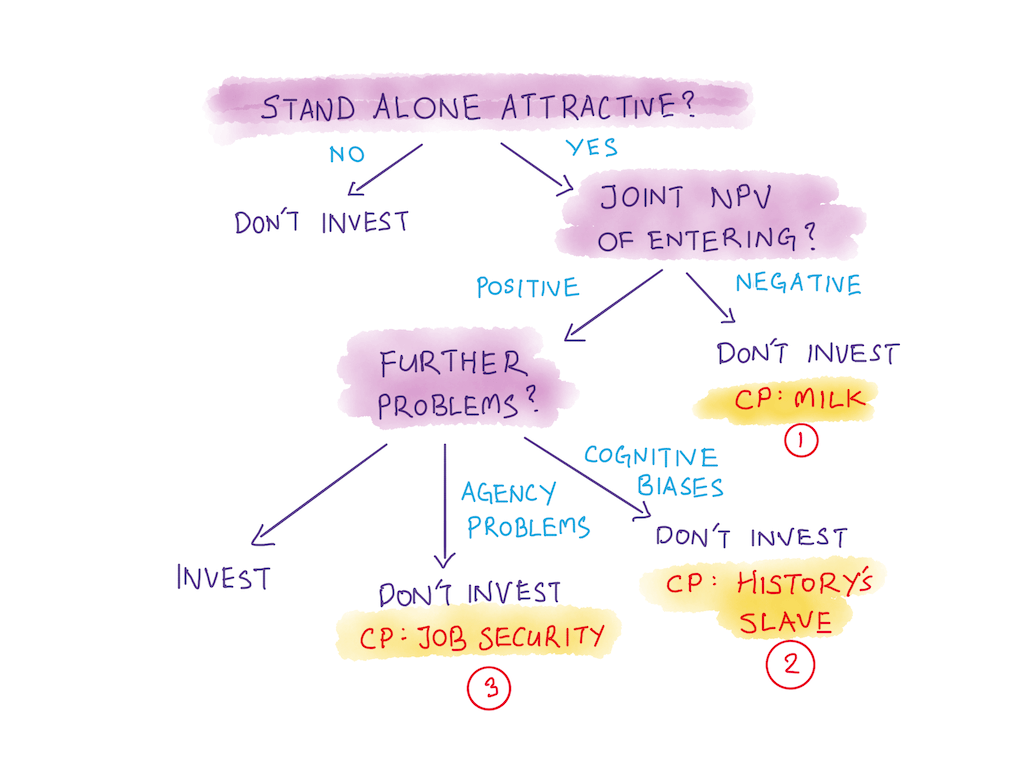
Helmer is more rigorous than just ‘oh, the incumbent would be harmed if they go after the challenger’. He breaks it down further, saying there are basically three flavours of Counter-Positioning. All three flow from the following question, posed by an incumbent faced against a counter-positioned challenger: “Am I better off staying the course, or should I adopt the new model?” The exact breakdown of questions are as follows:
- “Is this new business model an attractive stand-alone business?” If no, then there’s no counter-position to be had. If yes, then:
- “If we adopt this new business model, would the joint NPV (that is, value) of our overall company be positive or negative?” If it is negative, then the incumbent would not be willing to enter the new business model. This is the flavour of Counter-Positioning that Fidelity faced against Vanguard — it had the capability to enter the index fund business by itself, but it didn’t want to, because that would have cannibalised the high fees it made from its actively managed funds. Helmer calls this flavour of Counter-Positioning the ‘Milk’ flavour, since the incumbent is more willing to milk an existing declining business instead of entering a new one.
- If the answer to the previous question is that the joint NPV is positive, then the next question to ask is: “Can we accept the consequences of accepting this new business model?” This is where business leaves the realm of the concrete and enters the realm of the psychological. Helmer says that in his experience, management teams can fail in one of two ways: first, they may be a slave to history, because the new business model is uncertain, and the incumbent has ‘always done things a certain way’, and management believes ‘this is how the world works’. If the incumbent falls into this trap, then Helmer calls this Counter-Positioning flavour ‘History’s Slave’. The second way they might fail is if the incumbent’s management incentives are set up for the old world. In this case, the CEO would not be willing to go to the board and throw out his or her incentive structure, in exchange for unknowable upside in pursuing this new business model. Helmer identifies this as an agency problem, and calls this flavour of Counter-Positioning ‘Job Security’.
The full flowchart is captured with the following diagram:
At this point you might ask: “wait, this sounds like Clayton Christen’s disruptive theory!” But Helmer demurs. Consider, for instance, the following examples:
- Kodak vs digital photography. **This is Disruptive Technology, but not Counter-Positioning. (Kodak’s primary business — chemicals — would not have been damaged by entering the digital photography space, so there is no Counter-Positioning at play here. Rather, Kodark’s management was reluctant to do so because it had no natural source of Power against its competitors in digital photography, and it knew that investing in semiconductors would just lead to building a commodity business).
- In-N-Out vs McDonalds. This is Counter-Positioning, but not Disruptive Technology (there is no new technology involved).
- Netflix streaming vs HBO’s cable business. This is both Counter-Positioning and Disruptive Technology.
Helmer then argues that Disruptive Innovation is an orthogonal theory:
As evinced by the list, the concepts are not at all synonymous. Or more formally, there is a many-to-many mapping. This is also true more generally: there is a many-to-many mapping of all Power Types to Disruptive Technologies. Because Disruptive Technologies tell us nothing about Power they do not inform us about value. (emphasis mine) Because of this, the subject is only a sidebar in the Statics of Strategy.
How do you evaluate the strength of Counter-Positioning? Arguably, Helmer’s formula for this Power isn’t as important as the rest. For the sake of completeness, I’ll include it here, but note that the analysis for this formula is more stylised than the others; the true value is in the qualitative explanation above.
Let’s assume that Profits = $(P-c)Q$
Where:
- 𝑃 is price per unit,
- 𝑐 is variable cost per unit,
- 𝑄 is unit volume
And let’s say that there are two business models, where Old is 𝑂 and New is 𝑁. We say that 𝑁 is a superior business model because $c_N < c_O$, which then means that it can cannibalise 𝑂 because $P_N < P_O$.
The Surplus Leader Margin for the counter-positioned challenger, then, is calculated SLM, $m_N = m_O * (\frac{P_O}{P_N})*\delta$
Where:
- $m_O$ is the margin in the old business model.
- 𝛿 is the induced cannibalisation ratio of 𝑂 into 𝑁
- $\delta = \frac{-\Delta Q_O}{Q_N}$; basically if 𝛿 is high, then the collateral damage to the incumbent’s business model is large; if 𝛿 is 0, then no collateral damage will occur.
The simplest way to understand this equation is that SLM is the margin the counter-positioned challenger will have if the incremental profitability for the incumbent to enter 𝑁 is zero. Again, this equation is highly stylised; if you want the full derivation you should read Chapter 3 of the book.
There are two other nuances to this Power:
- Because Power is a relative concept, Counter-Positioning is only a partial moat. You may be successfully counter-positioned against an incumbent, but this doesn’t help you against other challengers. Think: In-N-Out Burgers vs McDonalds and In-N-Out vs Shake Shack.
- Over time, as the induced cannibalisation ratio 𝛿 goes down (perhaps because the incumbent has been whipped by the challenger over many years), the perceived collateral damage to the incumbent will also go down. This means that there will come a time when the incumbent decides to adopt the new business model themselves, because there is less reason to hold out.
Power Four: Switching Costs

In his chapter on Switching Costs, Helmer opens with the story of Christina Hanger, Hewlett Packard’s SVP of American Operations. In 2004, Hanger attempted to do a switchover from Compaq’s legacy order-entry system to HP’s SAP system. The switchover was a nightmare:
Starting when the system went live at the beginning of June and continuing throughout the rest of the month, as many as 20 percent of customer orders for servers stopped dead in their tracks between the legacy order-entry system and the SAP system. (…) In her conference call with analysts HP CEO Carly Fiorina later stated that this snafu resulted in a $160M financial hit.
This story illustrates the incredible Switching Costs of an ERP system. Helmer notes that a survey of 588 SAP customers found that ‘43% were unhappy with SAP software response times (…) nearly all felt that SAP performance problems would result in financial risks, and 50% felt unable to predict SAP performance.’ But 89% of customers ‘expected to continue paying the annual maintenance fees for SAP in the near future.’ In other words, everyone seemed to hate SAP, but nobody could stop using it:
SAP’s paradoxical combination of high retention and low satisfaction reflects the economic reality of a software product of great value to a corporation but one that also comes with high Switching Costs. Once a customer has bought in, they are hopelessly hooked, enabling SAP to then reap the rewards of a future stream of revenues for annual maintenance charges, upgrades, add-on services, software and consulting. More, a company like SAP, profiting from the indenture of its clients, has all incentive to hike the prices of such services.
Which is an incredible paragraph, if you think about it — SAP is as addictive as cigarettes! Helmer’s one sentence definition for Switching Costs is ‘the value loss expected by a customer that would be incurred from switching to an alternate supplier for additional purchases.’
Helmer notes that there are three basic flavours of switching costs (though businesses may enjoy more than one at the same time, naturally):
- Financial — This is the ERP systems example, above — switching from one ERP system to another might result in huge financial losses.
- Procedural — When employees have invested time and effort to learn the particulars of a certain product, there can be a significant cost to retraining them in a different system. This cost includes both organisational discontent and the cost of potential errors.
- Relational — In some businesses, switching from one product to another would mean severing ties with with other product users, service providers, and sales or customer service staff members. This is basically the ‘community moat’ that people in open source circles talk about; it is also the case whenever a customer develops affection for a product (or builds their identity as a user around it).
This Power decomposes to:
- Benefit: A company with high Switching Costs embedded in its customers can charge higher prices than competitors. This Benefit only accrues if you sell follow-on products to your current customers; no Benefit accrues with potential customers, or if there are no follow-on products.
- Barrier: To take you out, a competitor must compensate customers for their Switching Costs. The Power-holder may also reduce their prices temporarily until you stop going after their customers.
An interesting nuance of Switching Costs is that it is a non-exclusive Power type — just like with Counter-Positioning. To use SAP as an example, IBM and Oracle are competitors to SAP in the ERP software space, and they also benefit from high customer retention rates and Switching Costs. So you could say that the enterprise ERP market sits at sort of a stalemate — at least with regard to existing, locked-in customers. The other interesting nuance to this is that you gain no financial benefit if no additional related sales are made to the customer!
The net result is that whenever you have a high Switching Costs environment, you’ll get:
- A land-grab for new customers as the market is growing,
- And then a switch to a build or buy strategy for integrated add-on products, to sell to your captive install base. This explains why SAP and Oracle become hugely acquisitive in their later years — and why they buy so many adjacent enterprise software products to sell to their customers.
In a podcast interview with Patrick O’Shaughnessy, Helmer adds the following bit of nuance:
Hamilton: And so I would say it's very, very rare to be able to, once you have a business up and running, to then introduce Switching Costs because what happens is that customers at that point are smart and they realise what you're up to. For them to go into that relationship, or more to the point, competitive arbitrage works like this, is that every business who then tries to do that will then understand that, with these Switching Costs, there is a payoff. The payoff for high Switching Costs is you can charge more, you can charge the differential that is less than that extra pain of switching. And they'll start to try and acquire customers, and they'll offer discounts and freebies to start and all this stuff, and that will arbitrage out the cash flow stream that comes from it. And so it sort of equalises over time.
So it's hard to establish it after the fact. And so that's why usually for Switching Costs businesses, you need to get customers during the takeoff phase when things are growing so rapidly that customers are just worried about, "Can they get the product?" (emphasis added) And they're not worried about all the things associated with it, like Switching Costs. And so the value of that is not fully arbitraged out in the price.
Patrick: So perhaps the way to think about Switching Costs would be, you can get them eventually, by being a part of someone that's going through a paradigm shift. So when someone adopted Oracle or SAP or an ERP system long ago, that was a whole new thing, but then if there's not a whole new thing to replace the ERP, that is 10X better, no one's going to do it. (emphasis added) So it's a fulcrum thing.
Hamilton: (…) yeah, in that early phase, people are just wanting to get the product, and they're not too concerned about it. I mean, this will date me but when I got my first iPod, I didn't really worry about Apple's proprietary song format that much, but guess what, if I tried to take those songs and put them on another device, they disappear.
The equation for the Switching Costs Power is very simple:
Surplus Leader Margin = Δ, which represents the switching cost per unit. The advantage that accrues to the winner is simply the number of units sold or number of customers that it has locked up.
Power Five: Branding
Branding should be a familiar concept to most of us. One glib definition of branding is “the amount of money a consumer would pay for a brand above and beyond functional equivalents.”

You can't beat the Tiffany brand
What lies at the heart of a good Brand? Helmer decomposes this power into:
- Benefit: A business with Branding is able to charge higher prices for its products due to one or both of the following two reasons: 1) affective valence — the built-up associations with the brand elicit good feelings about the product, distinct from the objective value of the good. You’re willing to pay more for Coca Cola compared to an unbranded coke, even if they taste the same. 2) uncertainty reduction— a customer has peace of mind knowing that the branded product will be just as expected. Some buyers are more willing to pay for Bayer aspirin compared to a generic, locally made alternative, purely as a function of their trust in the Bayer brand.
- Barrier: The barrier here is time. A challenger would need to spend a huge amount of resources over a long period of time in order to cultivate a new brand name. Why? Simple: a strong brand can only be created over a lengthy period of reinforcing actions (which Helmer terms ‘hysteresis’).
Brands have interesting characteristics. Like Counter-Positioning and Switching Costs before it, Branding is not an exclusive Power — multiple companies may have strong Brands in the same market. (e.g. Prada, Hermès and Louis Vuitton all co-exist in the luxury market).
There are other nuances:
- Brand dilution is a thing — Firms require focus and diligence to guide Branding over time, so that the reputation created remains consistent with the valences that its products generate. Companies that have strong brands usually evolve unique cultures that reinforce the protection of that brand. (Disney’s managers, for instance, are famous for the fierceness with which they protect the company’s reputation).
- Counterfeiting — One challenge that is unique to Branding is the risk of counterfeiters. Since the label is what confers pricing power, counterfeiters may free-ride by falsely associating a powerful brand with their product, undermining the repeated, positive interactions that consumers need to have to sustain the brand.
- Changing consumer preferences — Once upon a time, the Marlboro Man was a thing. Now it is not.
- Geographic boundaries — Brands that confer Power in one region may not translate to another. I was shocked to learn that Levis is not considered a premium jeans brand in the United States. In Asia, the brand commands premium prices.
- Brand recognition is not Branding — Perhaps the most important point that Helmer makes in this chapter is that brand recognition is not branding. As many others have argued over the years: Branding is only a moat when it confers pricing power to the business. You may have a well-known brand, but no ability to charge higher prices than functionally-equivalent alternatives.
As a result of this last point, Helmer points out that only certain products are able to use Branding as a Power. You effectively need two (or three) things:
- A product that may eventually command a price premium. This effectively means a) your product can benefit from affective valence. Business-to-business goods don’t usually have this quality, because most purchasers are only concerned with objective deliverables. b) If the source of your pricing power hinges on uncertainty reduction, then your product must operate in some category where there are high perceived costs of uncertainty relative to the good. (For instance: medicine, food, transport, or safety).
- Finally, you must have time.
The Surplus Leader Margin formula for this Power is also relatively simple:
Surplus Leader Margin = $1-\frac{1}{B(t)}$,
where:
- 𝐵(𝑡) is the brand value as a multiple of the weaker firm’s price, and 𝑡 is the units of time since the initial investment in the brand.
In other words, if a brand has a high potential magnitude of either affective valence or uncertainty reduction, and if it has enough time to create those effects, then the branded business should capture some margin multiplier above the unbranded competitor’s price.
Power Six: Cornered Resource
In contrast to Branding, Cornered Resource is one of the subtler Powers. This might not, at first glance, seem to be the case — surely this refers to straightforward cornered resources like the ownership of patents, or government-granted monopolies, or, say, rare earth mines?

Pixar's Brain Trust: a non-obvious Cornered Resource
But Helmer opens the chapter with a weirder example: that of the Pixar Brain Trust. Helmer points out that of Pixar’s first 11 films, nine films were directed by people who were part of the original Toy Story team; the remaining two films were directed by Brad Bird, a contemporary of that same original team. Helmer’s thesis is that this core group of storytellers are what explains Pixar’s unusual success, and the group was a Cornered Resource unavailable to everyone else in the movie industry. And you cannot argue that the individuals involved were not value accretive: after all, it resulted in the $7.4B acquisition price paid by Disney in 2006, 20 years after Pixar’s birth. Helmer writes:
There is no precedent for this sort of sustained success in the movie business. Certain directors—William Wyler and Stephen Spielberg, for example—or certain franchise series—Indiana Jones and the Rocky movies, to name a couple—have impressive multiple commercial successes, but no one can boast such a long and unbroken track record, involving multiple directors and teams.(…)
I believe the Brain Trust is more than a combination of individual talents; rather it is the foundational members’ shared experience in the early trial years that has yielded one success after another. If, indeed, we observed new directors being brought into the fold and achieving Pixar-level commercial and artistic success, then we could conclude that Power came not from the Brain Trust but instead from some deeper current. From this assessment, I have come to believe that the most important strategic challenge for Pixar is renewal of its director pool.
In a sentence, Helmer’s definition for Cornered Resource is ‘preferential access at attractive terms to a coveted asset that can independently enhance value’.
The Power decomposes to:
- Benefit: This is highly variable, and dependent on the resource in question. In Pixar’s case, the benefit from the Brain Trust was the differentiated margins it received from its consistent ability to produce hits; in other companies, it may result from a number of uniquely different benefits. Helmer writes: ‘it might be preferential access to a valuable patent, such as that for a blockbuster drug; a required input, such as a cement producer’s ownership of a nearby limestone source, or a cost-saving production manufacturing approach, such as Bausch and Lomb’s spin casting technology for soft contact lenses.’
- Barrier: The barrier in Cornered Resource is again a bizarre thing. Consider that the original team that created Pixar’s early hits could leave at any point in time. So what kept them together? Helmer writes: ‘in 1988, long before Disney began its association with Pixar, Lasseter won an Academy Award for his Pixar short Tin Toy, prompting Disney CEO Michael Eisner and Disney Chairman Jeffrey Katzenberg to try and recruit their former employee back into the Disney fold. Lasseter demurred: “I can go to Disney and be a director, or I can stay here and make history.” So in Pixar’s case the Barrier was personal choice. (emphasis mine) In the case of spin casting technology, it is patent law, and in the case of cement inputs, it is property rights. Our general term for this sort of barrier is “fiat”; it is not based on ongoing interaction but rather comes by decree, either general or personal.’
This is an extremely weird Power. Helmer himself agrees, saying:
The Power hurdle is high: to qualify, an attribute must be sufficiently potent to drive high-potential, persistent differential margins (𝑚¯>>0), with operational excellence spanning the gap between potential and actual. With an enterprise like Pixar, there are numerous resources critical to success, and sorting through this multiplicity to try to isolate the Power source can be a challenge.
Helmer offers five screening tests for a Cornered Resource, since spotting one might be really difficult:
- Idiosyncratic. If a firm repeatedly acquires coveted assets at attractive terms, then the proper question to ask is ‘Why are they able to do this?’ For instance, if a company is able to consistently close customers in a difficult market above and beyond what its competitors are able to do, then maybe it is the sales team that is a Cornered Resource. Or, as Helmer writes: ‘if Exxon was able to persistently gain the rights to desirable hydrocarbon properties, then understanding their path to access would be the more crux issue. Perhaps their relative scale allows them to develop better discovery processes? If so, their discovery processes are the Cornered Resource, the true source of Power, and it would be misleading to simply cite only the acquired leases.’
- Non-arbitraged. If the business gains preferential access to a coveted resource, but then pays a price that fully captures the benefits of the resource, it doesn’t count as a Power. Helmer gives the example of making a film with Brad Pitt, which would probably advance box office receipts, but Pitt’s comp is so high that his compensation captures much or all of the additional value, and so fails the ‘attractive terms’ portion of the Cornered Resource definition.
- Transferable. The resource must be transferable. If a suspected Cornered Resource fails to recreate value at a different company, then you’re likely missing some other complement that is required to make that Cornered Resource work. The Pixar Brain Trust was certainly transferable: after the Disney acquisition, Bob Iger put Ed Catmull and John Lasseter in charge of Disney Animation, where they successfully revived the storied division.
- Ongoing. If you remove the Cornered Resource from the business, the business should fail to generate the same differentiated margins.
- Sufficient. For a resource to qualify as Power, it has to be sufficient as an explanation for continued differential returns. This, is a bit of a flip side to the Transferable test — if say, you transferred a successful CEO in one context to another context and that CEO fails, then that CEO is not a Cornered Resource because they are not sufficient, and there are likely other complements at their previous company that made them successful.
How do you evaluate the strength of the cornered resource? Helmer defines the Surplus Leader Margin as follows:
Let’s say that the company with the Cornered Resource is the stronger company (𝑆) and the company with no Power is (𝑊). Let’s also say that Δ is the increase in profits that 𝑆 experiences from their Cornered Resource.
For simplicity lets assume there are no fixed costs to production, and profit = (𝑃−𝑐+Δ)𝑄
Where:
- 𝑃 is the unit price
- 𝑐 is the unit cost
- and 𝑄 is the units of product sold per time period.
In order to generate Δ, 𝑆 pays for access to its Cornered Resource. We call this fixed cost 𝑘. Then the Surplus Leader Margin =
$$ \frac{\Delta}{\Delta + P_W} - \frac{k}{\Delta + P_W*Q_S} $$
The idea here is that the first term represents the increase in unit profits divided by 𝑆’s unit price, minus the total fixed cost of the Cornered Resource divided by 𝑆’s total revenue. This then represents the excess margin that accrues to the leader, and therefore the strength of its moat. The intuition that is important to grok here is simply that the amount of incremental margin derived from the Cornered Resource mustn’t become too expensive to access. You wouldn’t want to buy a company with an expiring lock on its Cornered Resource (e.g. they have a bunch of expiring leases; or the Brain Trust begins to retire …).
Power Seven: Process Power

The last Power in 7 Powers also happens to be its shortest chapter. Helmer says that he left it to the end in the book because it is exceedingly rare. As expected, Helmer opens the chapter by describing the Toyota Production System, and how it enabled Toyota to beat its Western rivals over the course of decades. He points out the tacit quality of the system, writing:
Although Toyota offered full transparency regarding NUMMI practices, GM just couldn’t replicate the NUMMI results in its own facilities. This was not merely incompetence—the inability to mimic the TPS was shared by many, as noted in a Harvard Business Review article:
“What’s curious is that few manufacturers have managed to imitate Toyota successfully even though the company has been extraordinarily open about its practices. Hundreds of thousands of executives from thousands of businesses have toured Toyota’s plants in Japan and the United States.”
(…) So despite best intentions, and many millions of investment dollars, achieving Toyota-like outcomes proved an elusive medium-term goal for GM. Apparently there existed a Barrier of some sort. Combine this with the twin Benefits of cost efficiency and dramatic quality improvements and there remains only one conclusion—Toyota had tapped some elusive source of Power. Their rising share price throughout these decades, graphed below and resulting in a company worth nearly $200B, serves as final indicator.
Helmer concludes that Process Power must exist, given Toyota’s NPV growth. He defines the Power as ‘embedded company organisation and activity sets which enable lower costs and/or superior product, and which can be matched only by an extended commitment.’
The Power decomposes to:
- Benefit: A business with Process Power is able to improve products and/or lower costs as a result of process improvements embedded within the organisation. This goes beyond the typical improvements that may be had from plain ‘operational excellence’ improvements.
- Barrier: The barrier here is time. Helmer argues that hysteresis is required in order to replicate these process advances. This time delay results from two factors: a) complexity — automobile manufacturing requires process improvements to spread both upstream and downstream, to all suppliers above it and dealers below it, as is the case with Toyota, meaning that it takes at least a decade of constant improvement before reaping the benefits, and b) opacity — the development of TPS was fashioned from the bottom up, over decades of trial and error.
Unfortunately, Helmer makes this Power seems remarkably mysterious. I do not think this is the case — Tim Cook’s favourite book is reportedly Competing Against Time, which is a detailed examination of Process Power across multiple industries in the 70s. Cook used to assign it to his subordinates during his time as COO of Apple (another company that has a just-in-time manufacturing system; Jobs hired Cook to transform its supply chain in 1998). Nothing Helmer says contradicts what is laid out in that book, but Competing Against Time goes into greater detail on what Process Power actually looks like. I recommend reading that instead.
(Note: I’ve written about one of the companies profiled in Competing Against Time in Good Synthesis is the Start of Good Sensemaking, although I wrote it from the perspective of an incumbent).
Helmer is right, though — Process Power is rare. It is not readily available to companies that do not manufacture their own products.
Helmer’s Surplus Leader Margin equation reflects the fact that he doesn’t have much to say about this Power; he defines it as SLM = $1-\frac{1}{D(t)}$, where 𝐷() is simply the potential magnitude and sustainability of process leverage, and 𝐷(𝑡) is an increasing function of 𝑡. This simply reflects the hysteresis required to gain this Power; Helmer’s equation has little more to add beyond what I’ve summarised above.
I won’t go into detail here, except to repeat the following statement: Process Power is not readily available to companies that do not manufacture their own products.
The complete 7 Powers
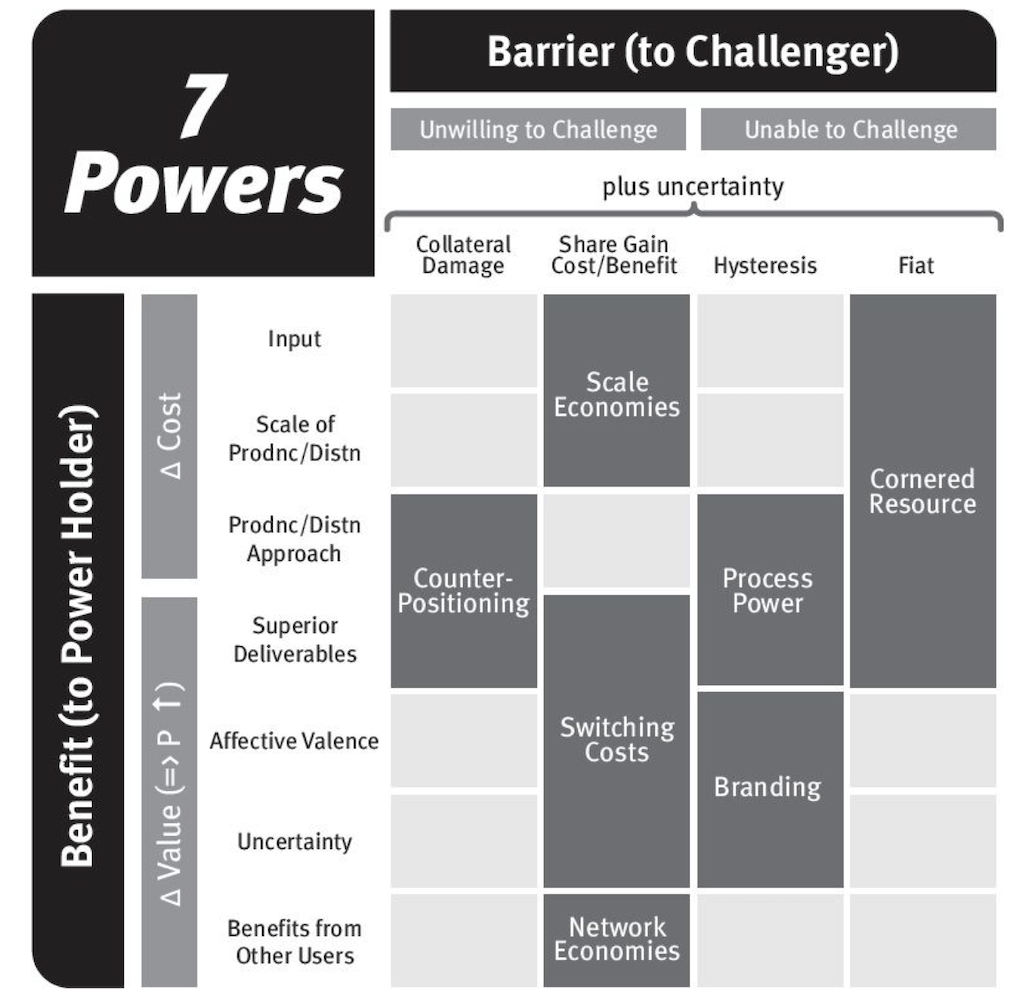
The full list of Power Intensity Determinants
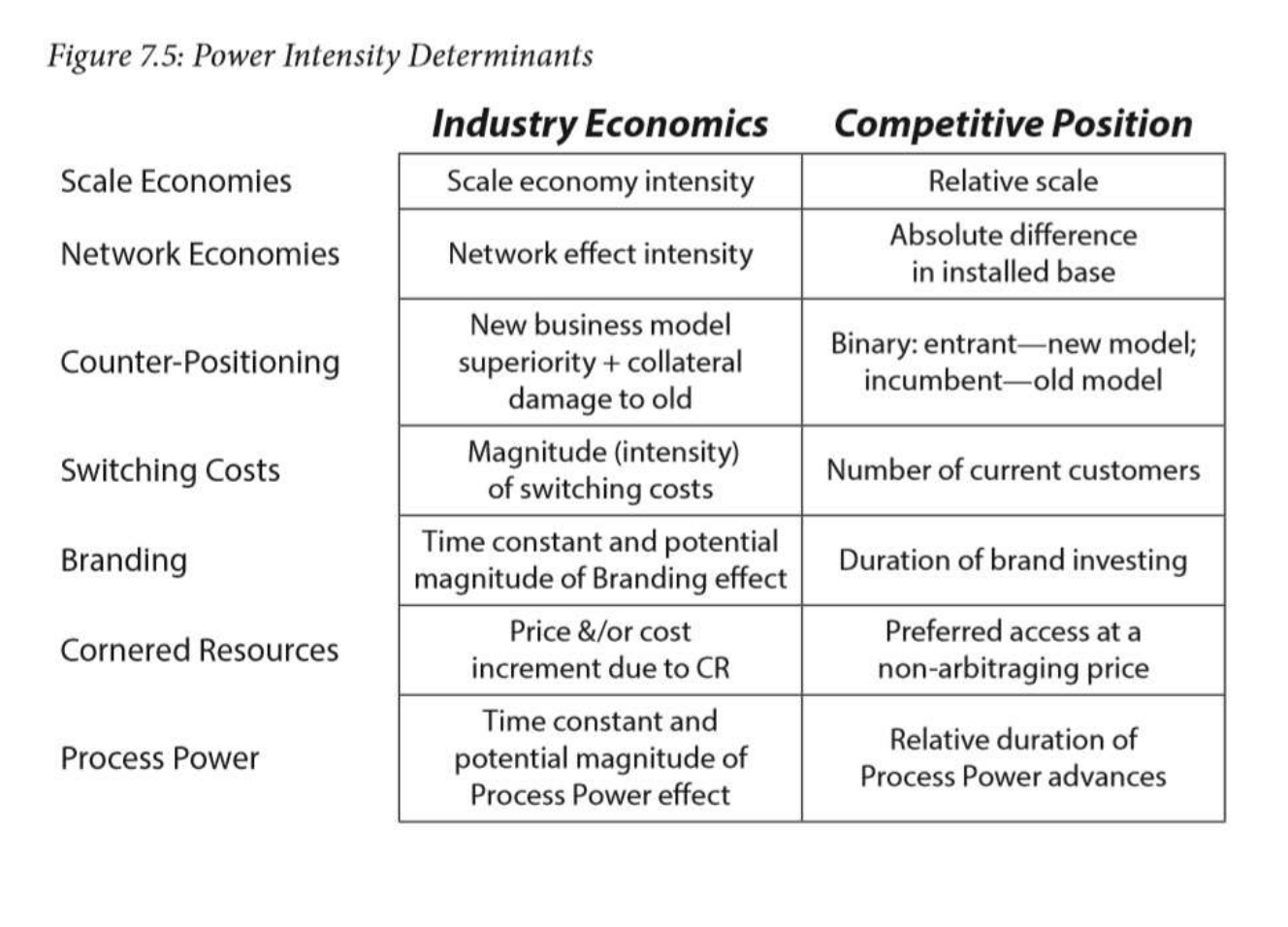
How To Use This?
7 Powers is one of the most theoretical books I’ve summarised on Commonplace. The paradox of the book, however, is that it was written for the practitioner.
The foreword to 7 Powers was written by Netflix CEO Reed Hastings. And for good reason. In 2004, Helmer bought a position in Netflix through his hedge fund Strategy Capital, and scheduled a meeting with Hastings and his team. Instead of doing the usual investor digging-for-scuttlebutt-dance, however, Helmer gave him a succinct presentation of the Power Dynamics framework, which made an impact on Hastings. Five years later, he reached out to Helmer to develop a training program for Netflix’s key people. I’ll quote from Hastings directly:
As I had learned over my years as a business person, strategy is an unusual beast. Most of my time and that of everyone else at Netflix must be spent achieving superb execution. Fail at this, and you will surely stumble. Sadly, though, such execution alone will not ensure success. If you don’t get your strategy right, you are at risk. (…) 7 Powers tightly integrates the numerous insights (Helmer) has developed in his several decades of consulting, active equity investing and teaching. It is a uniquely clear and comprehensive distillation of strategy. It will change how you think about business and pull into focus your critical strategy challenges, not to mention their solutions. It may not be the lightest of beach reads; you probably won’t tear through it in a night, but I am confident that your attention will be rewarded many times over.
When the best contemporary practitioner of business strategy says that 7 Powers is the pre-eminent book about business strategy; you learn to pay attention.
Earlier in this piece I quoted Helmer in saying that 7 Powers ‘turns strategy into a multiple choice question, not an essay question’. If you are an operator, this remains the primary contribution of the book. Helmer argues that the job of a business operator is to keep the subset of Powers that are possible for their business at the back of their heads, and then to look for creative opportunities to build those Powers.
He tells the story of Netflix as an generalisable example. When Netflix pivoted to streaming, it had created many short-term advantages for itself within its first years online (a fantastic UI, a world-leading recommendation engine, and industry-leading cloud-based infrastructure) but no long-term advantages. And they knew it. Reed Hastings had Helmer’s framework in mind when Ted Sarandos, Netflix’s content head, signed the first exclusive agreement with Epix in 2010. From there, it was a short conceptual leap to the idea of ‘Netflix Originals’ — thus turning Netflix’s content costs from a variable cost to a fixed cost. Originals gave them the ability to turn their scale into an advantage. By 2015 it was clear that they had their Power figured out: in a New York Times interview, for instance, Hastings said “If the television networks stop selling shows … the company has a game plan. We just do more Originals.”
The point that Helmer makes is that you have to take action to generate the information necessary to find the route to Power. The reason for this is because it is ‘flux’ in external conditions that creates new threats and new opportunities, and thus new routes to Power. The flux obscures these routes — which is good; if a route to Power is identifiable through analysis, it would likely be taken (or obstructed) by competitors. Helmer writes:
This is where the 7 Powers figures in. In the midst of invention, you need to be ever watchful for Power openings. The 7 Powers framework focuses your attention on the critical issues and increases the odds of a favourable outcome. This is the most Strategy can accomplish. It’s not everything, certainly, but it’s a lot.
There is one other major idea in 7 Powers, and it is the idea of a ‘Power Progression’. You can sort of squint and see the kernel of ‘Power Progression’ within the following two sentences:
- “The one sentence story of Intel is a single design win, then a decade and a half of very high Switching Costs, then Scale Economies.”
- To which I would add: the one sentence story of Netflix is Counter-Positioning against Blockbuster, modest spatial-distribution Scale Economies against other DVD-by-mail wannabes; a switch to streaming; then Counter-Positioning against the cable companies, then Scale Economies.
It turns out that each of the seven Powers tend to emerge at a particular stage in a business’s life.
- In the origination phase, the company is searching for product-market fit, and has yet to scale. There are two Powers that apply here: Cornered Resource and Counter-Positioning.
- In the takeoff phase, the company is scaling rapidly. There are three Powers available here: Scale Economies, Network Economies, and Switching Costs.
- In the stability phase, the company begins to slow down (Helmer says the end of the takeoff phase is when growth slows to 30-40% per-year unit growth). There are two Powers available here: Branding and Process Power.
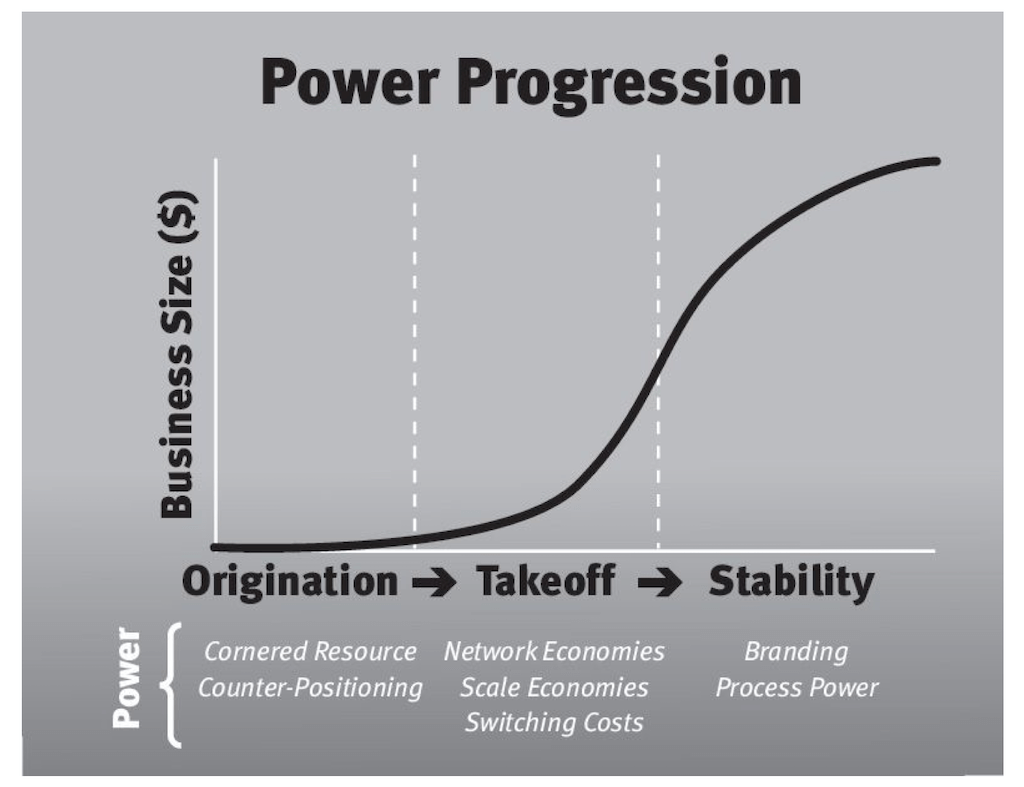
Power Progression
Helmer argues this ‘Power Progression’ using both anecdotal evidence, but then backs it up with statistical analysis from his time teaching business strategy at Stanford. There are exceptions (for instance, the Disney theme park business had Branding during origination), but by and large, the broad majority of businesses followed the Power Progression laid out above.
The irony is that while the end goal of every business is Power — that is, sustainable competitive advantage; the path itself consists of short-term tactical advantages. In other words, the way to achieve long-term differential margins are through a million small operational tweaks; the road to sustainable advantage is with unsustainable advantage — or at least, unsustainable advantage and invention. At least with 7 Powers you know that there are only seven forms that advantage can take, and each of them emerge at a particular point in the business’s life. As Helmer puts it: it’s not everything, certainly, but it’s a lot.